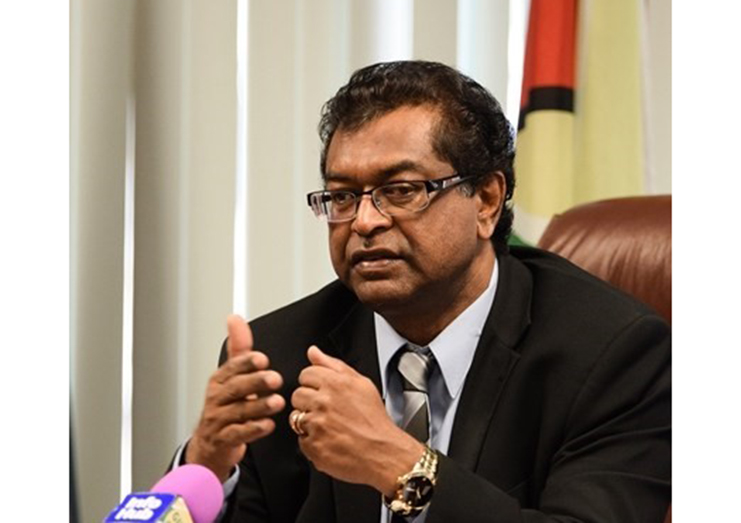
Former minister and Alliance For Change (AFC) Executive member Khemraj Ramjattan is dismissing President Irfaan Ali’s promise of a “massive diversification plan” for the Guyana Sugar Corporation (GuySuCo) as nothing more than political theatre aimed at misleading sugar workers and securing votes ahead of elections.
Last week, President Ali pledged sweeping reforms for GuySuCo under a second term of the People’s Progressive Party/Civic (PPP/C), touting a vision of a revitalised, modernised sugar industry capable of contributing meaningfully to national development.
President Irfaan Ali had announced a major diversification plan for GuySuCo, aiming to transform the struggling sugar industry into a modern agro-industrial hub. The plan includes expanding into crops like rice and cassava, livestock rearing, and agro-processing, along with increased mechanization and infrastructure upgrades. Sugar workers would be given a stake in operations through co-ownership models, according to the president. He also pledged support for replanting and private cane farming, with over $13 billion allocated to boost cultivation. But Ramjattan is not buying it.
Calling the announcement a “gimmick,” Ramjattan warned sugar belt residents — many of whom are traditional PPP/C supporters — not to fall for the “propaganda.” He argued that the plan is an unsustainable electoral ploy aimed at pouring more public funds into a historically failing sector.
“It seems that the PPP wants to spend a massive set of money, and probably for electoral purposes too, on a sector that has gone down the drain in the worst of its history,” Ramjattan said. “They’re willing to drag the country down with it, just to keep GuySuCo alive.”
From 2020 to present, the PPP/C government has committed at least G$ 20–28 billion, including a standalone G$6 billion in 2022, in sustained financial support to keep GuySuCo operational.
In defending the decision by the former A Partnership for National Unity + Alliance For Change (APNU+AFC) administration to close several estates between 2016 and 2017 — including Wales, Skeldon, Rose Hall, and East Demerara — Ramjattan said the move was based on expert recommendations and financial realities.
He blamed the PPP/C for mismanaging the industry during its 23 years in government prior to 2015. “The PPP brought the industry down to the ground,” Ramjattan stated. “They misused more than US$100 million from the European Union that was meant for factory upgrades and critical infrastructure like drainage and irrigation.”
Ramjattan said that when the APNU+AFC government assumed office in 2015, the sugar industry was already in freefall. He noted that “right-sizing” the sector — a strategy backed by industry experts like Errol Hanoman — was the only viable path forward. This included estate mergers and phased closures of non-performing factories.
Between 2015 and 2020, the coalition government pumped approximately $42 billion into GuySuCo. In 2018, the APNU+AFC government arranged a G$30 billion syndicated bond for GuySuCo. But despite the injection, Ramjattan believes there is no long-term future in sugar, particularly as younger generations turn away from “back-breaking” field work.
He also raised doubts about GuySuCo’s often-touted goal of “mechanisation,” arguing that terrain and soil types in the sugar estates are largely unsuitable. Moreover, the level of capital investment required to modernise aging infrastructure, he said, would be “tremendous” — and ultimately unjustifiable in the face of low global sugar prices.
“Even if we solve the capital investment challenge, our cost of production will still be higher than the world market price,” Ramjattan explained. “There’s no viable future in sugar unless we accept these hard truths.”
He concluded by stressing that changing CEOs won’t fix structural problems. Instead, he reiterated his call for rational downsizing and warned PPP/C supporters not to be misled by promises that, in his view, have no economic foundation.