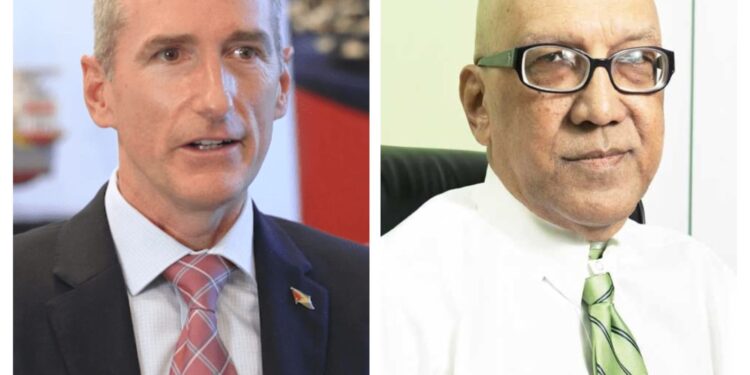
“The math scores are too consistently bad for a nation that claims educational advancement. The sudden improvements in 2023–2024 do not align with known policy shifts, investments, or professional development efforts. At best, the numbers are selectively presented. At worst, they’re politically manipulated. I’d be happy to review the raw data to gain a better understanding” – UNC Professor
Minister of Education Priya Manickchand stood before the cameras this week to declare that the 2025 National Grade Six Assessment (NGSA) results mark “Guyana’s best performance yet.” According to the Ministry, the national pass rate has jumped from 49% in 2024 to 63% in 2025. And going back to 2020, the increase is even more striking, a 14-point rise over five years.
But if this sounds too good to be true, that’s because it likely is.
From 2020 to 2025, Guyana’s children endured the most disruptive education crisis in living memory. Two years of COVID-related school closures, inconsistent online access, and lingering learning loss have taken a toll across the country, especially in hinterland and underserved communities.
Yet the Ministry now claims that not only have we recovered, but that we’ve catapulted forward, making the most rapid academic gains in the country’s NGSA history. English, Social Studies, and Science are all posting comfortable pass rates above 63%. Mathematics, which hovered below 40% for years, has reportedly surged to 55.5%.
As one professor / researcher from University of North Carolina said, “The math scores are too consistently bad for a nation that claims educational advancement. The sudden improvements in 2023–2024 do not align with known policy shifts, investments, or professional development efforts. At best, the numbers are selectively presented. At worst, they’re politically manipulated.”
If this were true, it would be the result of a transformative, system-wide intervention, dramatic new teacher recruitment, curriculum reforms, nationwide tutoring, and technology infrastructure. But no such revolution occurred.
Instead, the Ministry vaguely credits school feeding programs, quizzes, textbook distribution, and monitoring, programs that have been in place for over a decade. Nothing introduced in the past five years justifies a 14-point surge in performance, especially not in a system still reeling from pandemic-era disruptions.
Let’s be clear, this is not the first time the Ministry of Education has presented a selective, triumphalist narrative to the public. Raw NGSA data is rarely released. We do not get region-by-region breakdowns. We don’t see performance by gender, income level, or school type. We don’t get third-party evaluations of scoring practices.
We get headlines. We get talking points. We get choreographed press conferences designed to sell a story of success, while masking the uncomfortable truth: Guyana’s education system is still broken in many places, and deeply unequal.
Ask any high school teacher across the country what kind of learners are arriving in Form One, and the response is consistent, reading and math deficiencies, low critical thinking skills, and severe gaps in content mastery. That’s not a reflection of lazy students or bad teachers. It’s the result of a weak foundation, and a system that inflates pass rates while failing to build real competence.
Worse, this year’s celebration distracts from the long-standing structural neglect of rural schools, overburdened teachers, and underfunded learning centers. If these gains were real, the evidence would show up across the board, in national literacy rates, secondary school readiness, and eventual CSEC performance. But the disconnect persists.
Instead of praising the 2025 NGSA results as a turning point, we should be asking hard questions:
- Why are we seeing sudden, unexplained spikes in pass rates across all core subjects?
- Where is the disaggregated data to allow for independent verification?
- Why is the Ministry celebrating when so many of our students still cannot perform at grade level?
Guyanese families deserve more than a political photo op. They deserve an honest accounting of the challenges, and a real strategy to fix them, beyond meals and mantras.
If we want to build a 21st-century education system, we must start by grounding our reforms in reality, not rhetoric. Otherwise, we’re not raising achievement, we’re raising illusions.