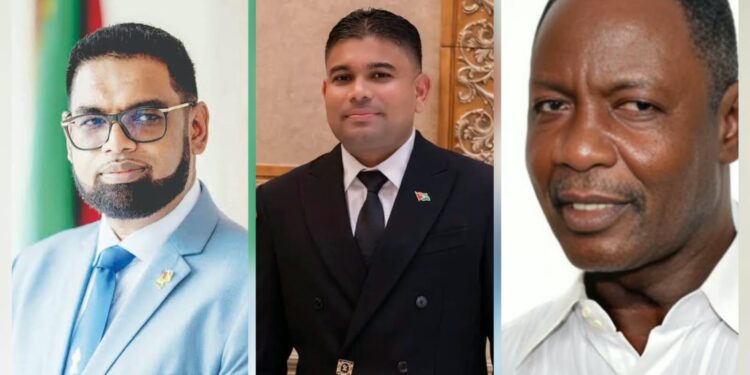
Political analyst and former People’s Progressive Party (PPP) government minister Dr. Henry Jeffrey has issued a strong indictment of Guyana’s political culture, warning of deep moral decay at the highest levels of power. In his today’s article titled “Ali v Mohammed: Moral & Political Decline“, Dr. Jeffrey condemned both the ruling elite and aspiring political figures, pointing to a climate of impunity and a drift toward autocracy.
At the center of his critique is embattled businessman Azruddin Mohammed’s public admission that he sought the help of President Irfaan Ali to bypass the authority of the Guyana Revenue Authority (GRA) over the controversial importation of a Lamborghini. “Mr. Mohammed has recently admitted that he sought the president’s help in undermining the authority of the GRA, and now he wants us to give him the president’s job!” Jeffrey remarked.
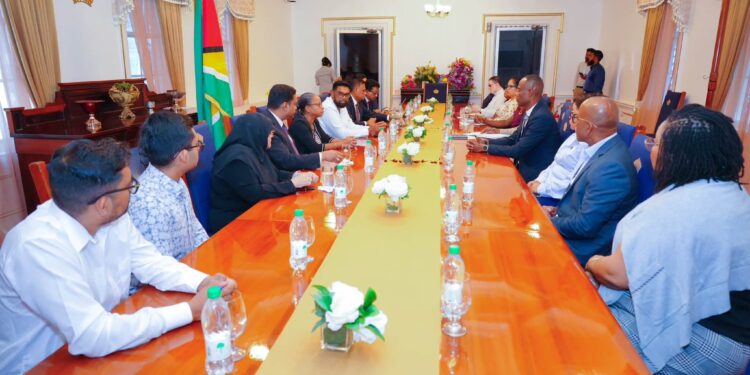
The president and Mohamed—once an ally and major financial backer of the PPP—are now locked in open conflict. Mohamed alleged that the tax assessed on his imported Lamborghini was influenced by the involvement of PPP General Secretary and Vice President Bharrat Jagdeo, as well as President Irfaan Ali. Both officials denied the claim, but Mohamed responded by publishing WhatsApp messages purportedly showing discussions with the president on the matter. Ali has since claimed he has no recollection of those conversations. Meanwhile, the Guyana Revenue Authority has taken Mohamed to court over allegations of tax evasion.
Moral Collapse and Political Cynicism
Jeffrey warned that the broader implications of this episode signal a near-total breakdown of political ethics in Guyana. Drawing from Aristotle’s Politics, he stressed that the goal of political leadership should be the cultivation of moral virtue. But instead, he said, the current reality more closely reflects Machiavelli’s amoral realpolitik, where power is pursued at any cost. “Criminal behaviour, conflicts of interest, [and] highly questionable undemocratic meanderings” are now brushed aside as parties and individuals jostle for control, he lamented.
He noted the silence of institutions and the public as troubling signs of a system where political accountability is almost nonexistent.
The op-ed highlighted a joint call by Transparency International Guyana Inc. (TIGI) and commentator Christopher Ram for President Ali and Vice President Bharrat Jagdeo to answer allegations that they were personally approached by Mohammed in the GRA matter. “Such a remarkable tolerance for impropriety is inconsistent with the rule of law,” Ram stated. Dr. Jeffrey added that Mohammed’s own potential legal liability has been conspicuously overlooked—despite his presidential aspirations. “Where are the law enforcement authorities in Guyana?” he asked.
A Warning to the International Community
Jeffrey proposed turning to liberal democratic ideals as outlined by philosopher John Rawls, whose theory of “justice as fairness” emphasized equal rights, impartiality, and equitable opportunity. These, Jeffrey argued, are entirely absent from the Guyanese political system, which remains mired in ethnic division and governed by an oligarchic structure.
He echoed the Carter Center’s call for constitutional reform and the dismantling of Guyana’s winner-takes-all electoral system, saying GECOM’s partisan structure perpetuates political exclusion and weakens democratic accountability.
With elections looming, Jeffrey warned of a worsening democratic deficit. He cited Ram’s stark conclusion: “President Ali’s corruption tolerance spans governments, marshalling dark money and state resources to maintain power.” Ram added that the absence of campaign finance laws and weakened oversight bodies has made the PP party “one of the country’s most lawless organisations.”
Jeffrey closed with a call to CARICOM and international stakeholders not to abandon their 2020 commitment to democratic principles. “I hope… [they] have not now abdicated their position as we proceed to elections without serious reforms, thus making an autocratic outcome inevitable!”