The Women’s Chamber of Commerce and Industry Guyana (WCCIG) has joined the growing movement to repeal outdated laws that criminalise same-sex intimacy, partnering with the Guyana Together campaign to amplify the message. This call was made during a special session at their Women and Girls’ Summit at the Arthur Chung Convention Centre, held last Thursday to mark International Women’s Day and Women’s History Month.
A National Conversation for Equality
During her opening remarks, WCCIG President Josephine Tapp called for a “national conversation” on the need to treat all Guyanese with dignity and respect. “I’m proud that the Women’s Chamber is part of this conversation,” Tapp said, “especially around International Women’s Day and Women’s History Month – a time when we are celebrating progress towards gender equality and reaffirming our commitment to gender justice.”
Tapp, who praised the Guyana Together campaign’s work, emphasised the importance of tangible change. “The Women’s Chamber stands with Guyana Together in calling for the immediate repeal of discriminatory laws that criminalise same-sex intimacy. These colonial-era laws are outdated and no longer represent the values of a progressive, 21st-century Guyana,” she stated.
The Call for Decriminalisation
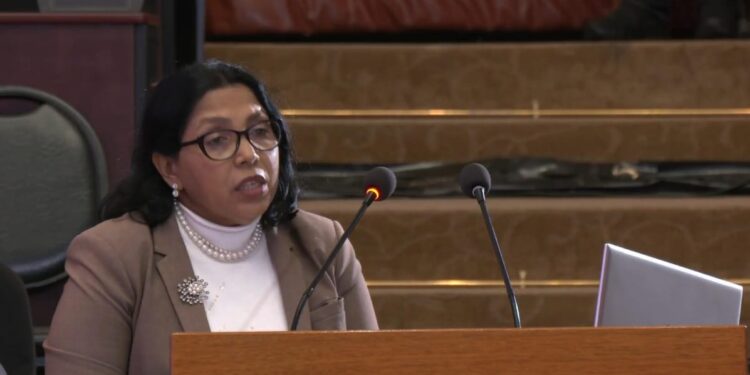
Attorney-at-Law Chandrawattie Persaud, guest speaker at the event, underscored that Guyana is the only South American country with laws that criminalise same-sex intimacy. “These laws, imposed in 1893 by the British Empire, no longer reflect the values of today’s Guyanese society,” Persaud told the audience.
She pointed out that most CARICOM countries have already removed these discriminatory laws. As more nations, especially in the Caribbean, overturn anti-gay laws, Guyana must act now to be on the right side of history, Persaud said. A 2022 poll indicated that 54% of Guyanese support the repeal of this law, with even higher support among younger generations.
Persaud, who has a background in public health and workers’ advocacy, also highlighted the health implications of criminalisation. “Criminalisation, along with pervasive discrimination, obstructs LGBTQ+ people from accessing health services, including testing and treatment for HIV and other life-saving medical care” she explained. Several international bodies have linked decriminalisation to better health outcomes, equality, and dignity for everyone.
Linking Gender Empowerment and LGBTQ+ Rights
Persaud stressed the connection between women’s empowerment and protections for LGBTQ+ individuals. Empowering women goes hand-in-hand with protecting lesbian, gay, bisexual, and transgender people, she said. Women understand that challenging societal norms and identities is never easy,” she advised.
Persaud lamented that women in Guyana still face discrimination, often judged by different standards and denied opportunities based on gender stereotypes.
She drew attention to ongoing issues such as sexual harassment and domestic violence, which continue to affect women in the country. Similarly, she noted that LGBTQ+ individuals also experience high levels of exclusion, harassment, and violence. “Laws that stigmatise them lead to further discrimination in education, employment, healthcare, and social services,” she added.
A Call for Respect and Unity
Persaud concluded her address by appealing for respect and equality for all individuals, regardless of their sexual orientation or gender identity. “Discrimination in any form is wrong,” she said, recalling the values instilled in her growing up on the Essequibo Coast. “I was taught the Golden Rule – do unto others as you would have them do unto you. It applies to every aspect of life, including how we treat our gay, lesbian, bisexual, and transgender neighbours.”
Her message echoed the universal truth that respect for others is a fundamental part of building a just and inclusive society for all.