


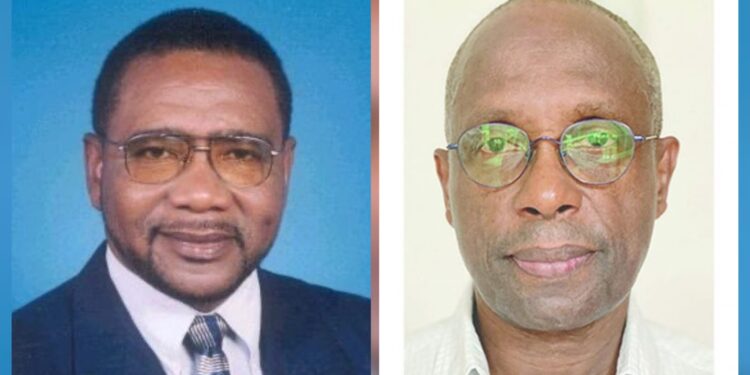
Responding to calls for renegotiation of the 2016 Production Sharing Agreement (PSA) with ExxonMobil, Prof. Stanley A. V. Paul stated that consideration of such matters ‘demand a measured and deeply introspective response, one rooted in historical awareness, legal pragmatism, and economic foresight’ (‘Guyana should focus on extracting maximum value from the existing PSA rather than pursue a path that could imperil its economic stability’ SN 07/01/2025). These are indeed important elements that should be accounted for in this kind of consideration, but just as important is an adequate explicit political contextualisation of the issue, and this is so if only because of assertions such as those of economist Papa Demba Thiam that are prevalent in Guyana.
Speaking of the situation in Senegal, he claimed that ‘most of the mining and oil contracts around the world are renegotiated: 40 to 92% of contracts being re-negotiated within 1 to 8 years in Latin America and the Caribbean. The fear of risks is often used as a political and moral threat on underdeveloped countries, when the Constitution states that natural resources belong to the people’ (https://senemgroup.com/the-delicate-equation-of-renegotiating-oil-contracts/).
Demba identifies possibly the most common reason given by those who seek to prevent renegotiation, but there are other legitimate political reasons to be considered. For example, in a competitive electoral setting such as exists in Guyana, where because of the ethnic configuration the autocratic regime is largely unaccountable, is renegotiation with a powerful and historically quite hard-nosed entity that is willing to use its power to facilitate the sides that will not undermine the status quo not unrealistic?
Particularly in the context of Guyana, does a focus on renegotiation not detract from one’s dealing with the major obstacles the prevent such renegotiation, namely national political participation, accountability, equitability, which, particularly in a small country, can provide a united national front that can lead to victory in these kinds of uneven contestations?
I am not saying that renegotiation is not justifiable or that it should not be immediately pursued. But in the present political context, where should one’s focus be? As it is, is it not putting the proverbial cart before the horse: should the focus not be on eliminating the real obstructions to progressive national development and renegotiation? Thus, for me, while the approach of Prof. Paul is obstructive that of much of Guyana’s renegotiation lobby is utopian and this accounts for the frustrations they face when neither government nor opposition is willing to take on Exxon. Someone once said that only utopia can save us: I hope whoever it was is right!
Apart from this general consideration, Prof. Paul has made a few extremely questionable specific assertions that could affect the environment and have a bearing on what I have to say next week. He said that, ‘the suggested course of aggressive renegotiation is a high-stakes gamble that could imperil Guyana’s economic stability, investor confidence, and long-term growth trajectory. … To suggest renegotiation without ExxonMobil’s willingness reduces the process to an exercise in coercion rather than dialogue.’
I am not certain what is meant by ‘aggression’, but all negotiations require a level of belligerence. Rarely are those with the advantage voluntarily prepared to negotiate a change in the status quo. How can one unilaterally negotiate and who has been suggesting ‘cohesion’ unless by this Prof. Paul meant the adequately mobilising of all one’s assets to bring the other side to the table? But this is the normal, legitimate and only sensible way of getting a reluctant partner, particularly one who has the upper hand, to the negotiating table.
The good professor cannot be saying that ‘History is unkind to nations that have chosen this path’ of legitimately forcing renegotiations, for as indicated above, many such contracts have been renegotiated without the dire consequences he portends. Further, he chose to give examples of only those that have resulted in what he considers ‘disasters’, but even so, as in the case of Guyana, he fails, among other things, to deal with the national and global environment factors that may have contributed significantly to such consequences.
‘Advocates of renegotiation often frame their arguments through the lens of fairness…. While it is indisputable that the PSA appears disproportionately favourable to ExxonMobil, the world is not governed by abstract notions of moral equity but by pragmatism and power dynamics.’ This is quite alarming! Generally, human society hankers after fairness: freedom, justice, equitability, etc. It is indeed the power dynamics that make abstract aspirations real and this is why one needs to mobilise all the necessary resources to confront the other side.
‘The question we must ask ourselves’, he posits, ‘are we willing to risk economic disruption, legal arbitration, and investor flight in pursuit of an ideal that may ultimately cost us more than it yields?’ All one can say here is that it will be extremely foolhardy to go into a negotiation without making a thorough assessment of the possible cost and benefits. But in life it is deadening to make an inordinate fear of defeat prevent the struggle for justice.
‘The prudent path,’ Prof. Paul advises, ‘does not lie in attempting to strong-arm ExxonMobil into renegotiation but in optimizing the opportunities already available within the existing framework.’ Firstly, the use of the phrase ‘strong-arm’ is another effort to bias the discourse in favour of the status quo when the request for renegotiation is due to the popular belief that Guyanese have already been ‘strong-armed’.
Secondly, optimising the opportunities of the existing contract need not prevent one from immediately or in the future seeking justice. Thirdly, like the question of ‘negotiating a better contract’, ‘optimising the opportunities’ begs the question for whom? The level of political domination and inequity in Guyana is palpable and thus returns us to the priority question of good governance!
We are told that ‘President, Dr. Irfaan Ali and Vice President, Dr. Bharrat Jagdeo are faced with an unenviable but crucial responsibility to secure the nation’s long-term future while navigating the treacherous waters of resource governance.’ Is this not a prostration to autocracy? The Constitution of Guyana intended that the elected representatives of all the people should be adequately facilitated in the decision-making process about the future.
Unfortunately, it also gives the executive to the PPP in a fashion that allows the latter, as the late President Jimmy Carter noted, to take ‘full advantage of its winner takes all’ political system and exclude the peoples’ representatives from decision-making at all levels with the facile claim that they are going directly to the people. Thus, the PPP’s autocratic approach has significantly enhanced the ‘treacherous waters of resource governance!’
Prof. Paul has opined that ‘The ExxonMobil agreement represents not just a contract, but a foundation’. This is not a sensible prioritisation: the agreement is firstly and foremost a contact and only becomes a foundation if it is psychologically and materially liberating. However, the existing contract, the responses to criticisms and the distribution of its outcomes have already been psychologically debilitating to many and at the rate the current regime, fixated on staying is power, is proceeding, promises neither the present nor future generations prosperous human existence even close to optimality.
It is true that ‘Guyana stands at a pivotal moment in its history [and that] [t]he choices we make today will determine whether we seize this opportunity for transformation or squander it through misguided adventurism.’ It is already being squandered by reckless adventurist governance.




![Black students graduate at rates higher than or comparable to peers from other racial groups at many ... [+]BOSTON GLOBE VIA GETTY IMAGES](https://villagevoicenews.com/wp-content/uploads/2023/07/image-2023-07-10T084217.331-120x86.png)

