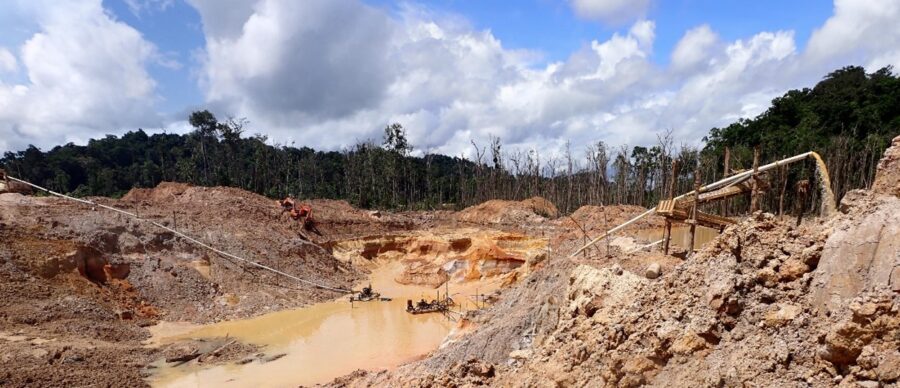
The Guyana Human Rights Commission (GHRA) has expressed concern about the pollution of the rivers by gold mining which now pose health and safety hazards. In a statement the body warned that the river banks and river course are being affected by illegal hydraulic mining. The environmental problem is compounded by the failure of the Guyana Geology and Mines Commission (GGMC) to enforce Codes of Practice, GHRA said.
There is concern no effort has been made to apply penalties for the transgressions despite the fact that the River Navigation Act (cap. 50:01, 1998) and the State Lands Act 1903/1972 (Section 22) state ‘Everyone who willfully causes any impediment to the free use or navigation of any river or navigable creek, shall be liable to a fine of ninety-seven thousand five hundred dollars, unless he has previously obtained permission under this Act or the Forests Act to cause the impediment.”
Mining disrupts riverine ecosystems, leading to habitat destruction, reduced water quality, and the loss of bio-diversity. It is imperative that the EIA process be consistently, rigorously and transparently applied. To halt the problems the GHRA is calling for regular and thorough inspections, coupled with stringent penalties for non-compliance which the body said is currently ignored due to understaffing at GGMC. It is reported that a handful of field Mines Officers and Wardens are expected to monitor an industry which has issued thousands of mining claims.
Attention is drawn that environmental neglect and human suffering, together with bio-diversity and wildlife loss, are not even considered a cost by the gold industry or Government. To change behaviors the human rights body said costs should be added to legal and illegal export of profits from gold mining. “In these circumstances the rationale for Government subsidies to this industry requires urgent explanation. Moreover, they represent a stark contradiction to the Low Carbon Development Strategy 2030 (LCDS 2030) which figures prominently in government speeches at overseas events].”
GHRA said the existing penalties for breaches of the various rules and regulations do not disincentivize breaches and has called for prioritizing the restoration of mining sites and enforcement of environmental regulations.
Guyana is signatory to the 2016 United Nations Paris Agreement on Climate Change. The World Bank outlines that under this agreement countries should pursue smart mining which ensures sustainable extraction and processing of metals concomitantly with minimizing social, economic and climate degradation.
The GHRA’s full statement follows:
Press Release
Massive Incentives Unwarranted by Widespread Illegality In the Gold Industry
Recently, on July 31 2024, a long statement from the Ministry of Natural Resources (MNR) catalogued the extensive perks, concessions and privileges extended to the gold-mining sector. It contains not a single word on the huge environmental and human cost perpetrated by this industry. The statement concludes with a reminder that this unwavering support by the Ministry is ‘in keeping with the ruling party Manifesto prior to the last elections’.
Tax reductions, duty-free concessions, simplified licensing arrangements, expansion of available mining properties in conflicted areas such as Marudi Mountains and removal of protective regulations are exhaustively listed. Road-building in interior regions has become mining-driven rather than influenced by community or environmental considerations.
Because all mining has a significant effect on the environment, the Environmental Protection Act 1996, (Section 11) and Schedule 4, (item 9) mandates that Environmental Impact Assessments (EIA) and Environmental Permits (EP) are to be undertaken for each and every mining operation. However, the Guyana Geology & Mines Commission (GGMC) has not enforced such requirements for many years for the thousands of small-scale mining claims or medium-scale mining permits covering millions of hectares (see the annual reports of the Guyana Extractive Industries Transparency Initiative (GY-EITI).
Most of Guyana’s prized large rivers have been reduced to health and safety hazards by gold mining. River banks and the actual course of rivers have been altered by illegal hydraulic mining and by failures to apply the several GGMC Codes of Practice to the waste in mine tailings now spilling polluted sediment into the creeks and rivers. No effort has been made to apply penalties for these transgressions despite the fact that River Navigation Act (cap. 50:01, 1998) and the State Lands Act 1903/1972 (Section 22) states ‘Everyone who willfully causes any impediment to the free use or navigation of any river or navigable creek, shall be liable to a fine of ninety-seven thousand five hundred dollars, unless he has previously obtained permission under this Act or the Forests Act to cause the impediment.’
Mining disrupts riverine ecosystems, leading to habitat destruction, reduced water quality, and the loss of bio-diversity. It is imperative that the EIA process be consistently, rigorously and transparently applied. Regular and thorough inspections, coupled with stringent penalties for non-compliance are required but are currently ignored given the understaffing of the Guyana Geology and Mines Commission (GGMC).
A handful of field Mines Officers and Wardens are expected to monitor an industry which has issued thousands of mining claims. Penalties for breaches of the various rules and regulations do not disincentivize breaches. There is a need for penalties to be much more severe. Prioritizing the restoration of mining sites and enforcing robust environmental regulations, can mitigate long-term environmental damage, protect our vital water resources, and promote sustainable development.
A sense of the financial cost of mine-site restoration on a national scale can be assessed from an experiment undertaken by GGMC some years ago. The cost of a small-scale restoration by a contracted company was estimated to be in the region of G$6mn. Moreover, the derisory token sum of G$100,000 for restoration (the obligatory environmental bond) is treated by the majority of miners as payment to the GGMC to get the job done.
Long-standing claims by indigenous communities are aggravated by land ownership policies, progressively dominated since colonial times by the mineral potential of lands rather than ownership claims. The most severe consequences of the free-for-all in the mining sector are felt by Amerindian communities who have seen their land rights progressively eroded despite the catalogue of Statutes and Regulations that provide a legal defense. Amerindian rights to ‘quiet enjoyment of their land and surroundings’ have trumped any mining claims in a series of laws. The Mining Regulation of 1905 stated ‘All land occupied or used by the Aboriginal Indians, and all land necessary for the quiet enjoyment by the Aboriginal Indians of any Indian settlement, shall be deemed to be lawfully occupied by them’(Section 199). Virtually the same language is reproduced in the Mining Act 1989 (Section 111) and similarly reproduced in the Water and Sewerage Act Cap. 30-01 2002 (Section 94).
This ‘quiet enjoyment’ clause ought to constitute a deterrent to GGMC issuing small-scale mining claims or medium-scale mining permits before a due diligence check is completed in each requested area in or including a titled Amerindian Village (required in section 53 of the Amerindian Act 2006). In practice, as shown in the High Court cases in 2009 (Arau Village) and 2012-3 (Isseneru Village), such checks appear not to have been made and mining concessions have been issued by the GGMC over titled and untitled Amerindian lands without the knowledge of the Amerindian communities
Use of mercury, for recovery of gold fragments in the ‘wash-down’ process, adds to the heavy metal pollution of aquatic life, increases mortality, reproductive failures and disrupts food chains. Reducing the incidence and scale of mercury methylation into the environment and food chain does not attract the concern and urgent remedial action it merits. A random sample of mercury use by both terrestrial and river based hydraulic dredges was undertaken in 2008. A total figure of mercury used annually was estimated to be 11.37. tonnes. Official imports peaked in 2011 at 5.4 times the national requirement and grew to an estimated 35.82 tonnes in 2013. Over this period total imports were 504 tonnes with an excess of approximately 355 tonnes, (10 years’ worth of demand at 2013 levels). It is alleged that much of this mercury is smuggled into Suriname where importation of mercury has been prohibited.
Environmental neglect and human suffering, together with bio-diversity and wildlife loss, is not even considered a cost by the gold industry or Government. These costs should be added to legal and illegal export of profits from gold mining, at no benefit whatever to their sovereign owners – the citizens of Guyana. In these circumstances the rationale for Government subsidies to this industry requires urgent explanation. Moreover, they represent a stark contradiction to the Low Carbon Development Strategy 2030 (LCDS 2030) which figures prominently in government speeches at overseas events].
Executive Committee
Guyana Human Rights Association
August 3 2024