By Francois Cleophas, Stellenbosch University- Who were the first Africans to compete in the modern Olympic Games? The answer to that question reveals the surprising story of a 1904 marathon – and exposes the history of racism and white supremacy that characterised the Olympics in its early days.
The first modern Olympic Games was held in 1896 in Greece. This was at the height of European colonialism and there is no record of Africans participating. It was only after the second world war, in the late 1940s, that African countries began to join the Olympic movement in significant numbers, as African independence took hold.
There exists, however, a little-known story of two black South African runners who competed in the first US-hosted Olympics, in St Louis in 1904. They were Jan Mashiani and Len Taunyane (Tau), who appeared along with a white South African runner – B.W. Harris – on the Olympic marathon programme. (A Boer tug-of-war team from South Africa also took part in the Olympics that year.)
1904 Olympic marathon participants Len Tau (left) and Jan Mashiani of South Africa. Missouri History MuseumA photo of Mashiani and Tau is housed at the museum of the Missouri Historical Society, which switched their names around in the caption, resulting in the two men being given the wrong identities for decades.
Mashiani and Tau did not officially represent South Africa at the games. That’s because, in 1904, South Africa was not South Africa at all, it was a colony governed by Great Britain. This was two years after the South African War between Great Britain and two independent Boer (Dutch Afrikaner) republics.
Both sides used black South Africans in various roles, including running with messages. Which is how Mashiani and Tau enter the picture – along with their appearance at a world’s fair in St Louis that was tied to the Olympics. The fair presented “savages” competing in physical displays as part of its international exhibition of science and culture.
The story of Mashiani and Tau was documented by the South African sport historian Floris van der Merwe. It is from this research that a reconstruction can be drawn about them.
For me as a sport historian who teaches this history, this reconstruction matters. Colonialism wiped out records of African sporting history and achievements. And African Olympic history has not been researched as extensively as US and European Olympic histories.
So, documenting African sport histories like this one is an important act of reclaiming black life – while discussing the ugly prejudices it has had to endure and rise above.
Back in 1904
The 1904 Olympic Games was a far cry from what we will see in Paris in 2024. For one thing, events looked pretty different. One researcher writes:
The early games was a fascinating jumble of bizarre tournaments … that included swimming obstacle races, tug of war, hot air balloon contests, polo cycling and American croquet.
The 1904 games was also steeped in racism and reflected the eugenics culture of the day. The St Louis Olympics accommodated the St Louis World’s Fair, which held various competitions for the indigenous people of different continents, under the title Anthropology Days.
Van der Merwe writes that while the Olympic marathon was scheduled for 30 August, “athletic events for savages” were planned for 11 and 12 August:
The unique spectacle of men deliberately throwing stones at one another was to be one of the features at the athletic meet … in which all of the ‘savage tribes’ at the World’s Fair will compete.
Before competing in the Olympic marathon, Jan Mashiani (referred to as “Yamasani” by officials who could not pronounce his name) and Len Tau (referred to as “Lentauw”) participated in this “athletic event for savages”. Besides the stone-throwing battle, there was javelin throwing for accuracy, tree climbing, throwing the baseball, and various track and field sports including a one-mile (1.6km) race, which they ran in.
They did so as part of the South African War Show at the fair. Both had most likely been messengers for the Boers during the war. Van der Merwe cites an account of the one-mile event:
From the start Lentauw set a killing pace for the first lap, running like an old-time professional followed by his countryman. Despite his lead of 20 yards, he kept looking back and lost valuable ground in the process. In the stretch he was finally passed by a Syrian and an Indian.
Mashiani and Tau
Mashiani and Tau were most likely from South Africa’s Tswana ethnic group. But the country’s Zulu people were better known internationally. By 14 August it was reported, according to Van der Merwe, that entries for the Olympic marathon had been received from, among others, Zululand.
Van der Merwe believes that they had been used by the Boers under General Piet Cronje during the war in South Africa to carry messages – which is why they could move at a fast pace for long periods. He contests newspaper reports from the St Louis Post-Dispatch that “Leetouw” and “Yamasani” had been runners for the English army.
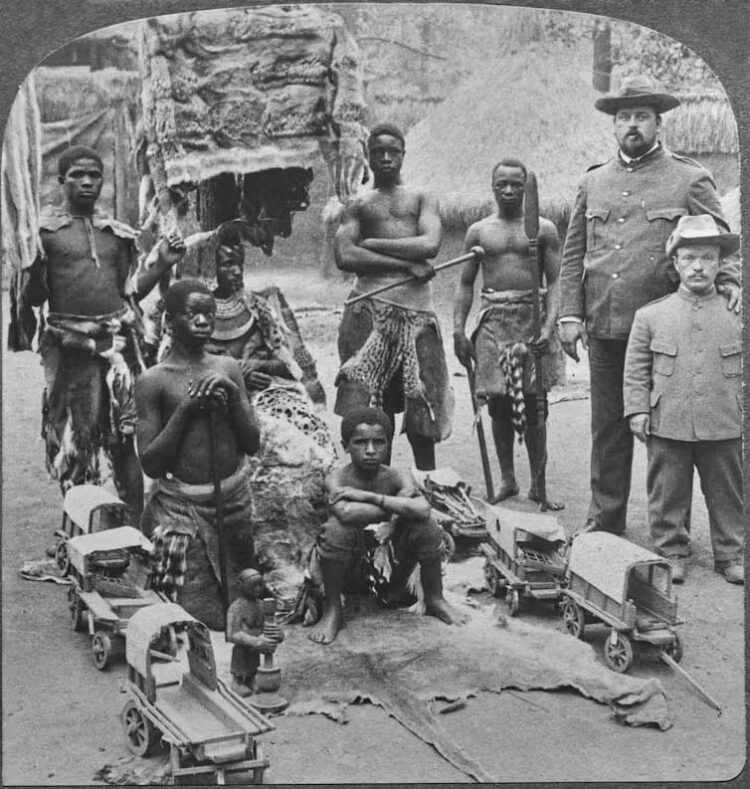
A delegation of Sotho men with Boers at the world’s fair display. Underwood & Underwood/Graphic House/Archive Photos/Getty ImagesToday in South Africa, using the racial slur “kaffir” to describe black people is punishable by law. In 1904, the official Olympic programme notes “B.W. Harris; Lentauw, k… mail carrier; and Yamasani, k… mail carrier” on the marathon line-up. The white South African runner Harris had entered about a week earlier than Mashiani and Tau, so it’s possible that he persuaded them to take part.
The 1904 Olympic marathon was a gruelling race run over 40km in very hot (32°C) conditions – made worse by the dust generated by automobiles using the same road. The runners started in two rows, Harris in the front row and Mashiani and Tau in the back row. Harris dropped out, while Tau finished 9th and Mashiani 12th. One of them, it was reported, could have done better had he not been chased off course by a dog while running along a deserted road that formed part of the course.
Mashiani and Tau were the first two indigenous Africans to compete in the Olympic Games. (The third from South Africa would be Ron Eland, who qualified for the British weightlifting team in 1948 before emigrating to the US and later to Canada.)
In 1948 the South African government introduced apartheid – a system of separate development imposed by a white minority government. Because of apartheid, black South Africans were not able to represent their country at the Olympics. And because of apartheid, the country was banned from competing in the games from 1964 until 1992.
Francois Cleophas, Associate professor, Stellenbosch University
This article is republished from The Conversation under a Creative Commons license. Read the original article.