By Nicole Winfield (AP) — The Vatican has been trying for years to debunk the idea that its vaunted secret archives are all that secret: It has opened up the files of controversial World War II-era Pope Pius XII to scholars and changed the official name to remove the word “Secret” from its title.
But a certain aura of myth and mystery has persisted — until now.
The longtime prefect of what is now named the Vatican Apostolic Archive, Archbishop Sergio Pagano, is spilling the beans for the first time, revealing some of the secrets he has uncovered in the 45 years he has worked in one of the world’s most important, and unusual, repositories of documents.
In a new book-length interview titled “Secretum” to be published Tuesday, Pagano divulges some of the unknown, lesser-known and behind-the-scenes details of well-known sagas of the Holy See and its relations with the outside world over the past 12 centuries.
In conversations over the course of a year with Italian journalist Massimo Franco, Pagano delves into everything from Napoleon’s sacking of the archive in 1810 to the Galileo affair and the peculiar conclave — the assembly of cardinals to elect a pope — of 1922 that was financed by last-minute donations from U.S. Catholics.
“It’s the first time and it will also be the last because I’m about to leave,” Pagano, 75, said in an interview with The Associated Press in his archive office, ahead of his expected retirement later this year.
Pope Leo XIII first opened the archive to scholars in 1881, after it had been used exclusively to serve the pope and preserve documentation of the papacies, ecumenical councils and Vatican offices dating from the 8th century.
With 85 kilometers (53 miles) of shelving, much of it underground in a two-story, fireproof, reinforced concrete bunker, the archive also houses documentation from Vatican embassies around the globe as well as specific collections from aristocratic families and religious orders.
While often the source of Dan Brown -esque conspiracies, it functions much as any national or private archive: Researchers request permission to visit and then request specific documents to review in dedicated reading rooms.
Pagano keeps a close eye on them from a giant television screen perched to the side of his desk, which provides a live, closed-circuit feed to the reading rooms downstairs.
Most recently, scholars have been flocking to the archive to read through the documents of the pontificate of Pope Pius XII, the wartime pope who has been criticized for not having spoken out enough about the Holocaust.
Pope Francis ordered the documents of his pontificate opened ahead of schedule, in 2020, so scholars could finally have the full picture of the papacy.
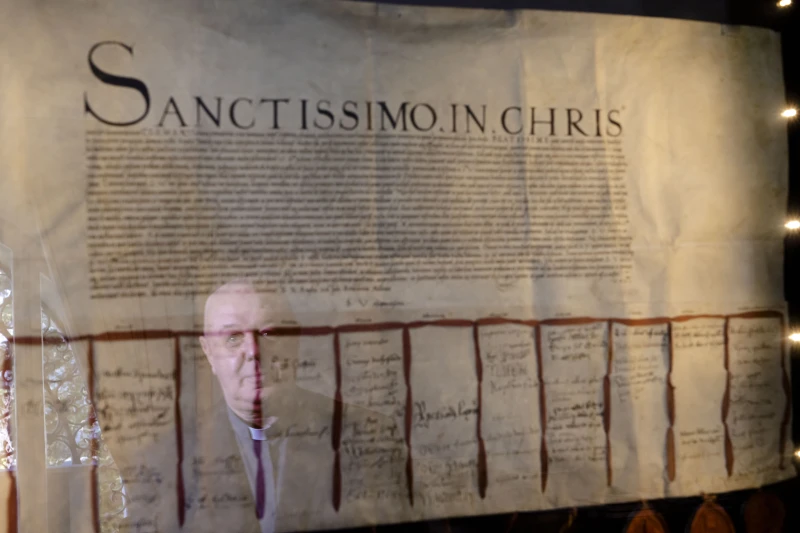
Prefect of the Archivio Apostolico Vaticano, Bishop Sergio Pagano reflects on the glass protection of the original 1530 letter kept in his office at The Vatican, Wednesday, Feb. 14, 2024, and signed and sealed by the overwhelming majority of the House of Lords that attempted to pressure Pope Clement VII into granting the divorce to King Henry VIII of England from his wife Catherine of Aragon that was famously denied. (AP Photo/Domenico Stinellis)
The Vatican has long defended Pius, saying he used quiet diplomacy to save lives and didn’t speak out publicly about Nazi crimes because he feared retaliation, including against the Vatican itself.
Pagano is no apologist for Pius and stands out among Vatican hierarchs for his willingness to call out Pius’ silence. Specifically, Pagano says he cannot square Pius’ continued reluctance to publicly condemn Nazi atrocities even after the war ended.
“During the war we know that the pope made a choice: He could not and would not speak. He was convinced that an even worse massacre would have happened,” Pagano said. “After the war, I would have expected a word more, for all these people who went to the gas chambers.”
Pagano attributes Pius’ continued, post-war silence to his concerns about the creation of a Jewish state. The Vatican had a long tradition of supporting the Palestinian people and was concerned about the fate of Christian religious sites in the Holy Land if the territories were turned over to the newly created state of Israel.
Any word from Pius about the Holocaust even after the war “could have been read in political terms as a support for the foundation of a new state,” Pagano said.
In the book, Pagano doesn’t hold back about his disdain for the incomplete research behind Pius’ sainthood cause, which is now apparently on hold as scholars dissect the newly available documentation.
The two Jesuit researchers who compiled Pius’ sainthood dossier, the late Revs. Peter Gumpel and Paolo Molinari, relied only on the partial, 11-volume compilation of the papacy’s documents that was published in 1965, Pagano revealed.
“Neither Father Gumpel nor Father Molinari ever set foot in the Apostolic Archive,” he says in the book. He said he believed Pius’ sainthood cause should have waited until the full archive of the pontificate was catalogued and available, and scholars had time to draw conclusions.
“Written documents must weigh heavily on the life of a servant of God, you can’t ignore the archives,” Pagano told Franco, the journalist. “But the postulation by the Jesuits wanted to bypass it.”
Aside from the well-known stories of Vatican intrigue, the book also reveals some novelties, including the origins of the important financial relationship between the U.S. church and the Vatican that continues today and dates back to the 1922 conclave.
Pagano said that after Pope Benedict XV died, the camerlengo — the cardinal in charge of the papal treasury and accounts — went to his safe and discovered it was “literally empty. There wasn’t a paper, bank note or coin.” It turns out Benedict wasn’t terribly responsible fiscally, and left the Holy See somewhat in the red when he died on Jan. 22 of that year.
Papal coffers were always used to fund the conclave to elect a new pope, meaning the Holy See was in a cash crunch at a time when Europe was still reeling financially from World War I.
The book, for the first time, reproduces the encrypted telegrams in which the Vatican secretary of state asked his ambassador in Washington to urgently wire “what you have in the safe” so that the vote could take place.
According to the telegrams, the Vatican embassy sent what U.S. churches had collected from the American faithful, down to the cents: $210,400.09, allowing the vote that eventually elected Pope Pius XI.
Pagano suggests that Francis’ 2019 decision to remove the word “Secret” from the archive’s name and rename it the “Vatican Apostolic Archive” was perhaps another financial nod to the wealthy U.S. church — a rebranding to remove any negative connotations and thus encourage potential donations, primarily via “Treasures of History,” a new U.S.-based foundation that supports the archive.
At the end of the interview, Pagano proudly showed visitors one of the archive’s prized possessions, which he keeps in an otherwise nondescript wooden armoire near the entrance of his office. There, behind plate glass and illuminated with special lights, is the original 1530 letter from British nobles urging Pope Clement VII to grant King Henry VIII an annulment so he could marry Anne Boleyn.
As is well known, the pope refused and the king went ahead and got married, breaking with Rome.
“You can say that here we are at the birth of the Anglican Church,” Pagano says as he holds up a light-tipped pointer to show off the red wax seals of some of the signatories.
Pagano delights in revealing how the document survived: When Napoleon Bonaparte famously seized the Vatican archives in 1810 and carted them off to Paris, Pagano’s predecessor as chief archivist rolled up the 1530 letter and hid it inside a secret drawer in a chair in the archive antechamber.
“The French never found it,” Pagano says proudly, keenly aware that an archivist’s main job is to preserve the archive.