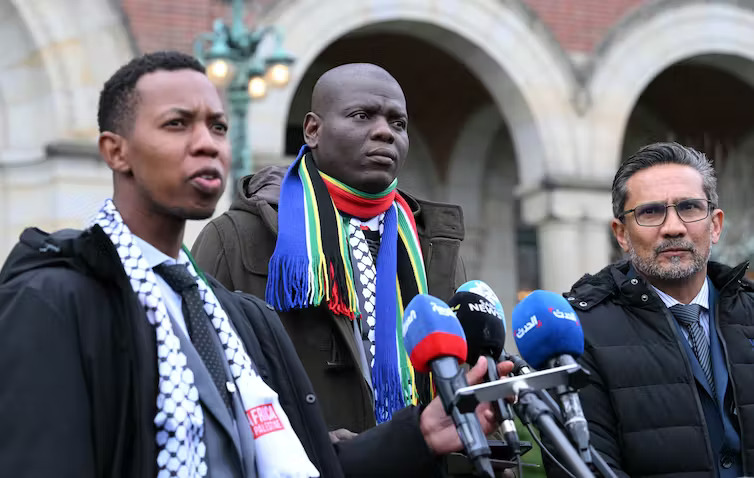
South Africa says that Israel is committing genocide against Palestinians in Gaza and has asked the International Court of Justice to intervene and stop Israeli military action in Gaza.
Israel issued its initial defense to South Africa’s charges on Jan. 12, 2024, at the International Court of Justice – the United Nations’ highest human rights court – based in The Hague, Netherlands. Israel argues that its military is trying to minimize civilian harm and that South Africa is trying to both weaponize the term genocide and interfere with Israel’s right of self-defense against Hamas.
But can the International Court of Justice enforce any decision it makes in the case? “The question of the International Court of Justice’s actual powers of enforcement is a key issue on many people’s minds,” said Victor Peskin, a scholar of international relations and human rights.
We spoke with Peskin to better understand the potential impacts of South Africa’s genocide complaint against Israel and the scope of the court’s power.
What is the significance of South Africa bringing these charges?
South Africa is a former apartheid state that underwent a largely peaceful transition to democracy in the mid-1990s. Symbolically, the fact that South Africa is bringing the case may have particular resonance.
However, South Africa has itself been accused of thwarting the 1948 U.N. Genocide Convention. This happened after it hosted and failed to arrest Sudan’s then-President Omar al-Bashir in 2015. Al-Bashir was charged by the International Criminal Court with committing war crimes and genocide in the Darfur region of western Sudan in the 2000s.
South Africa’s case against Israel is the fourth genocide-related case at the International Court of Justice. The others pertained to the conflicts in Bosnia, Myanmar and Ukraine.
What precedent did the Gambia-Myanmar case set for the court?
There is some precedence for countries to bring a case regarding a conflict it is not directly involved in to the International Court of Justice. In 2019, Gambia filed a complaint at the court against Myanmar, regarding its alleged genocide of the Rohingya people, an ethnic minority living in Myanmar.
The Genocide Convention obligates all ratifying states to comply with the treaty. So, countries without a direct connection to an alleged case of genocide can legally bring a genocide complaint forward.
What are provisional measures and why are they important?
The International Court of Justice judges are still reviewing and adjudicating the merits of Gambia’s genocide complaint. There isn’t a final decision on that yet. The court did, within a relatively short period of time after it held a hearing in the case, issue written orders called provisional measures, directing Myanmar to prevent genocide and to preserve evidence related to the case.
If the judges were convinced that the Israeli military’s attacks on Gaza were excessive, they could quickly call for a halt in Israel’s attacks and a cessation of hostilities.
In theory, this could put public pressure on Israel to curtail or halt its military campaign. But even if the International Court of Justice calls for this, it would not necessarily indicate that the court will eventually rule that genocide has occurred.
The International Court of Justice lacks enforcement power. So, is this case more than political theater?
The International Court of Justice does not prosecute individuals, but rather focuses on resolving legal disputes between countries. The Hague-based International Criminal Court, which has the legal authority to investigate and prosecute individuals for war crimes, crimes against humanity and genocide, has opened up a separate investigation into Israeli forces’ and Hamas militants’ alleged violations of international humanitarian law.
It’s always an open question – will an International Court of Justice ruling even be enforced and have any tangible effect?
While the International Court of Justice moved at a glacial pace in reaching a final decision in the Bosnia-Serbia case, it has shown that it can move more quickly when addressing mass violence. The judges did issue provisional measures calling for the prevention of violence in the Myanmar and Russia cases.
However, there is little indication that the International Court of Justice’s provisional measures eased Myanmar’s crackdown on the Rohingya. Similarly, the ICJ’s provisional measures calling on Russia to halt its invasion of Ukraine has had no apparent effect.
This International Court of Justice could call for the Israeli military to end or curtail its conduct in Gaza, or to ease the flow of much-needed humanitarian aid for Palestinians, for example. This could put considerable international pressure on Israel. It could also push Israel’s strongest allies, such as the United States and the United Kingdom, to put more pressure on Israel.
What does the ICJ’s track record on genocide tell us about this current case?
In the first case of this kind, in 1993, Bosnia instituted proceedings against Serbia, which was then part of the former republic of Yugoslavia, for alleged genocide.
The International Court of Justice’s eventual ruling in 2007 in the Serbia case was controversial. The court ruled that genocide was committed in the Bosnian war but that the government of Serbia was not directly responsible for it. Instead, the court ruled that the Serbian government failed to prevent genocide in Srebrenica.
Srebenica was the eastern, Muslim enclave in Bosnia that Bosnian-Serb military forces overran in 1995, murdering around 8,000 Muslim boys and men.
The court also found the Serbian government violated the Genocide Convention by failing to arrest former Bosnian Serb Gen. Ratko Mladic, then wanted for genocide by the U.N. International Criminal Tribunal in the former Yugoslavia.
That judgment by the International Court of Justice was a big blow and disappointment to many Bosnian Muslims and global human rights activists.
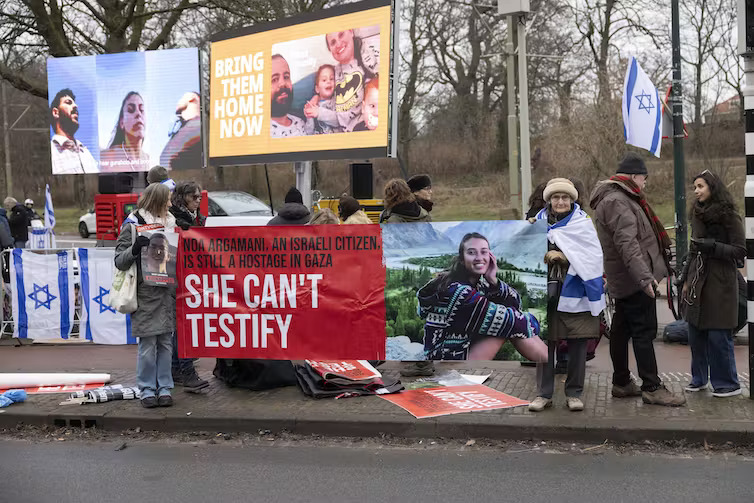
How long could it take the ICJ to determine whether Israel committed genocide?
It could take a number of years. The Bosnia-Serbia case took 14 years. It is unclear if the South Africa-Israel case would have to wait for a final judgment to first be rendered in the Gambia-Myanmar and Ukraine-Russia cases, which have not concluded.
Victor Peskin, Associate professor of politics and global studies, Arizona State University
This article is republished from The Conversation under a Creative Commons license. Read the original article.
(WiredJA)