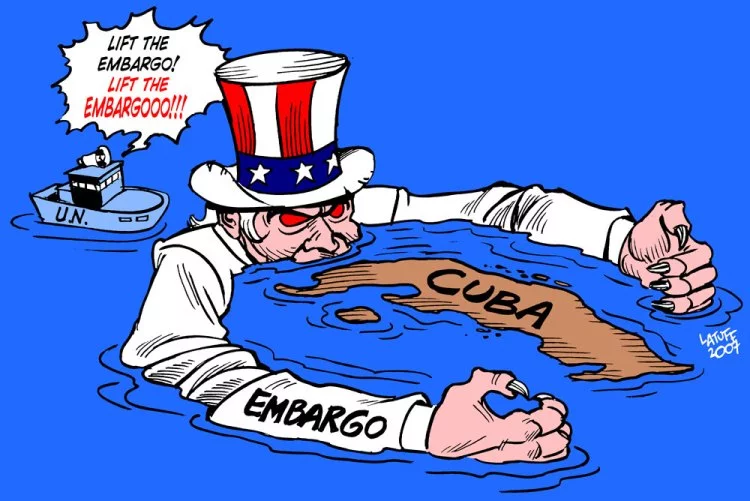
Havana, Cuba – For six decades, the United States has waged an unyielding economic war against the Republic of Cuba, a campaign rooted in a political grudge.This grudge is the result of the aftermath of Cuba’s revolutionary overthrow of U.S.-backed dictator Fulgencio Batista.
The phrase “hell hath no fury like a woman scorned” could be reinterpreted to describe how the U.S. has behaved akin to a spurned partner, embarking on a tireless campaign to impose economic sanctions on Cuba. This is largely in response to a political fallout, with the intensity of the U.S.’s actions following the Cuban revolution and the subsequent severance of their tight bond with Cuba demonstrating a remarkably harsh reaction, characterized by extended economic restrictions.
This economic onslaught, designed to punish the Cuban people for their audacity to claim independence and establish a government under Fidel Castro’s leadership, manifests as a comprehensive blockade, imposing unilateral sanctions that have bled the island nation of more than $130 billion.
The U.S. sanctions, colloquially termed the ‘blockade,’ intricately weave through the fabric of Cuban life, significantly hampering access to essential goods and services, including medicine, food, and materials crucial for vaccine development, notably during the Covid-19 pandemic.
Beyond the direct impacts, the sanctions aim to suffocate Cuba’s economy, restricting travel and barring international businesses from engaging with Cuba if they wish to maintain trade relations with the United States.
The rationale behind such draconian measures traces back to a stark admission by the U.S. State Department in the wake of the Cuban Revolution: to dislodge the widespread support for Castro and his government, the U.S. resolved to incite internal dissent by imposing economic hardships on the Cuban populace.
An internal memo from 1960 by Lester D. Mallory, Deputy Assistant Secretary of State for Inter-American Affairs, starkly outlines this strategy: “The majority of Cubans support Castro… The only foreseeable means of alienating internal support is through disenchantment and disaffection based on economic dissatisfaction and hardship… every possible means should be undertaken promptly to weaken the economic life of Cuba… to decrease monetary and real wages, to bring about hunger, desperation and overthrow of government.”
This candid acknowledgment reveals a deliberate intent to destabilize Cuba through economic deprivation.
Despite international condemnation, the United States, with Israel as its solitary ally, continues to enforce this blockade.
On the 4th of November 2023, the UN General Assembly, by an overwhelming majority of 287 votes to 2 with 1 abstention, called on states for the 31st time “to refrain from promulgating and applying laws and measures of the kind referred to in the preamble to the present resolution (Helms-Burton Act)”.
The resolution is based on the clear decision that unilateral sanctions are illegal if their effects exceed a certain level of severity. Although this threshold is not defined, the duration, scope and objective of the sanctions leave no doubt as to their illegality. The USA cannot invoke justification grounds either.
Amidst this historical backdrop of economic antagonism, recent leaks suggest the U.S. intelligence community is now advancing a nuanced strategy aimed at further distorting Cuban finances.
This strategy, a contemporary extension of the longstanding economic warfare against Cuba, seeks to undermine the nation’s financial stability and exacerbate the already dire economic conditions imposed by the blockade. The following sections will explore the specifics of this strategy, its implications for the Cuban people, and the international response to ongoing U.S. policies in the Caribbean.
In the heart of this renewed strategy, the U.S. intelligence community is reported to have orchestrated a multi-phase operation designed to further cripple Cuba’s already besieged economy.
The operation unfolds in four distinct stages: inducing shortages, stimulating inflation, boycotting supplies, and enforcing a financial blockade, each meticulously crafted to compound the hardships faced by the Cuban populace and destabilize the nation’s economic foundations.
The first phase targets the lifelines of Cuba’s economy, deliberately constraining the inflow of foreign currency, especially U.S. dollars, into the country.
This move not only exacerbates the existing scarcity of basic necessities such as food and medicine but also strategically undermines sectors vital to Cuba’s economic resilience, namely tourism and healthcare services.
By restricting access to these essential resources, the operation aims to erode public confidence in the government’s ability to provide for its people, thereby sowing seeds of discontent and disaffection within the Cuban society.
As the strategy progresses to its second phase, the focus shifts to inflationary pressures. Utilizing digital platforms purportedly financed by the U.S. government, anonymous actors engage in manipulating currency values and inflating prices within the Cuban market.
This digital front of economic warfare employs social media networks like Facebook, WhatsApp, and Telegram as conduits for spreading disinformation and artificially driving up the cost of living, further straining the economic endurance of the Cuban people.
The echoes of similar tactics deployed in other nations underscore the broader implications of such maneuvers, suggesting a pattern of economic subversion employed by the U.S. across different geopolitical landscapes.
The operation’s subsequent stages, supply boycott and financial blockade, aim to sever Cuba’s commercial ties and access to international markets. These measures intensify the economic siege by targeting entities willing to engage with Cuba, through tactics ranging from license denials to direct blackmail, thereby throttling the island’s supply chains and exacerbating the scarcity of goods. This comprehensive encirclement serves not only to isolate Cuba economically but also to project a cautionary tale to potential allies, highlighting the far-reaching arm of U.S. sanctions and the peril of non-compliance.
In the face of such relentless economic aggression, the Cuban government and its people have mounted a resistance that is as multifaceted as the strategies deployed against them. Despite the tightening noose of economic sanctions and the complex challenges posed by digital warfare, Cuba’s resolve to safeguard its sovereignty and uphold the principles of the revolution remains undiminished.
The nation’s response, characterized by a combination of diplomatic outreach, economic adaptation, and a call for international solidarity, underscores a profound commitment to resilience and self-determination.
The international response to the U.S. blockade against Cuba, particularly in the context of the U.N. General Assembly, reveals a stark disapproval of American sanctions. Year after year, the global community has voiced its opposition through overwhelming votes in favor of lifting the embargo.
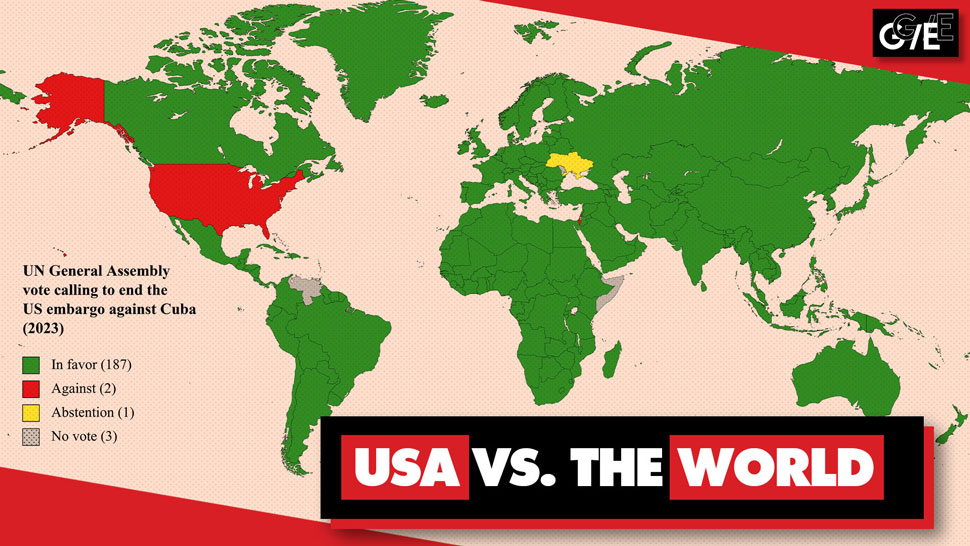
In 2023, this sentiment was manifest when 287 U.N. member states voted with 2 against and 1 abstention, against the blockade, highlighting the isolation of the U.S. and its staunch ally, Israel, on this issue. This near-unanimous condemnation serves as a poignant reminder of the blockade’s perceived injustice and its discord with international norms and human rights standards.
The legal and ethical questions surrounding the U.S. economic sanctions on Cuba are profound. Critics argue that the blockade constitutes a form of collective punishment, penalizing the entire Cuban population for their government’s policies.
Such measures are seen as contraventions of international law, including principles enshrined in the United Nations Charter and international humanitarian law, which prohibit actions that harm civilian populations.
Furthermore, the sanctions’ impact on healthcare, especially during the Covid-19 pandemic, has raised serious humanitarian concerns, spotlighting the blockade’s role in exacerbating public health crises by restricting access to vital medicines and medical supplies.
Amidst these challenges, Cuba has not remained passive. The Cuban government has actively sought international solidarity and legal redress, leveraging diplomatic channels to highlight the blockade’s adverse effects on its population and economy.
Cuba’s resilience is also evident in its efforts to circumvent the sanctions through innovation and self-reliance, notably in the development of its own Covid-19 vaccines despite significant resource limitations.
The path forward for Cuba in the face of ongoing economic warfare from the United States is fraught with challenges but also possibilities. International advocacy and diplomatic engagement remain crucial in seeking an end to the sanctions.
At the same time, Cuba’s continued pursuit of economic diversification and its efforts to strengthen ties with allies resistant to U.S. pressure are vital strategies for mitigating the blockade’s impact.
The global community’s growing recognition of the need for a reevaluation of sanctions as a tool of foreign policy may eventually contribute to a more favorable environment for dialogue and, potentially, a resolution to the decades-long standoff between Cuba and the United States.
In conclusion, the economic war waged by the United States against Cuba, epitomized by the longstanding blockade, raises critical questions about the ethics of international relations, the legality of unilateral sanctions, and the principles of sovereignty and human rights. As the world grapples with these issues, the resilience of the Cuban people and their government in the face of adversity underscores the complex interplay between geopolitical strategies and the universal quest for dignity, independence, and development.
The ongoing saga between Cuba and the United States remains a testament to the enduring spirit of a nation that refuses to be defined by external pressures, and a reminder of the international community’s responsibility to uphold justice and peace in the global order. (WiredJA)
![People gather on the street during an electricity blackout in Havana, Cuba [AFP]](https://villagevoicenews.com/wp-content/uploads/2026/03/cubans-on-the-street-1200_large-750x375.jpg)