Source: Oceanic Preservation Society
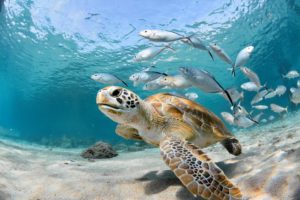 Industrialized fishing practices are a primary threat to marine life worldwide. Global fish stocks are being overharvested at ecologically and economically indefensible levels. Destructive large-scale fisheries undermine sensitive ocean ecosystems, threaten climate stability, jeopardize global food security, and imperil marine wildlife.
Over 90% of the world’s marine stocks are fully exploited, overexploited, or depleted. Hundreds of thousands of tons of plastic waste and other marine debris from discarded and lost fishing gear enter the oceans each year. As much as 40% of the world’s catch is bycatch of unwanted non-target species. An estimated 650,000 whales, dolphins, and seals are killed annually in fishing nets—not including the numerous sea turtles, birds, sharks, and other marine life also killed by unselective fishing practices. Destructive fishing methods, such as bottom trawling and drift net fisheries, also indiscriminately destroy delicate marine habitats, including coral reef, seagrass, and seabed communities.
Global fisheries and aquaculture contribute nutrition and livelihoods for hundreds of millions of people around the world—but at a high cost to the future of marine ecosystems. Fish is one of the most-traded food commodities worldwide. Commercial fisheries are highly subsidized by global governments, contributing to months-long, distant-water fishing expeditions seeking to harvest more fish from declining stocks with even bigger boats and contributing to human rights abuses. Large-scale commercial fisheries are the floating factory farms of the sea.
Illegal, unreported, or unregulated fishing accounts for more than 15 percent of the world’s total annual fisheries output. Some estimates indicate that at least 42 percent more fish are caught by countries than is reported. This means that fisheries’ management decisions are being made with incorrect or limited data. Global certification schemes for ‘responsible’ or ‘sustainable’ fisheries are reliant upon observers to verify catch methods, but fisheries observers are rarely (or under) deployed, and their safety may be threatened during operations.
OPS believes that the use of the term ‘sustainable’ is a misleading anthropocentric term that fails to consider the individuality and sentience of marine life that is captured, discarded, or consumed annually from global fisheries. Referring to fish as a ‘resource’ also diminishes the value of every living creature in the complex marine ecosystem in which it functions. Local and artisanal operations may leave more fish in the ocean, but even small-scale fisheries do not prioritize the welfare of marine life that is captured, hooked, or netted. Even mathematically approved sustainable harvest levels often allow for acceptable limits of mortality for important marine species, including marine mammals.
Ocean-based industrial aquaculture is often offered as a possible solution to alleviate fishing pressures on the world’s oceans; however, finfish and other aquaculture carry risks to coastal ecosystems and utilize wild-captured fish to feed farm-grown seafood. This does not alleviate the problem of overfishing or eliminate the issues of entanglement of marine life. In addition, it introduces nutrient and chemical pollution into marine ecosystems and risks to biodiversity from escaped non-native fish species.
OPS’ goal is to reduce humankind’s collective fisheries footprint, one person at a time. The environmental, societal, and animal welfare impacts of seafood consumption have been eclipsed by the focus on the impacts of industrial (terrestrial) animal agriculture. Consumers often turn to seafood as an alternative to ‘meat’ when seeking to reduce their consumption of animal products for health, environmental, or ethical reasons, but the detrimental impacts of fisheries are a global issue.
We do not expect the millions of people who rely on seafood as a primary source of protein to stop eating fish and other seafood. Instead, we are focused on those who are in the privileged position to make consumer choices that include a transition to a more just, environmentally-friendly, healthier, and humane plant-rich diet.
A reduction in consumer demand can ultimately help to reform global fisheries subsidies that promote overfishing and human rights abuses, thereby protecting our incredible oceans and marine life. The surest way to reduce our impact on the oceans is to reduce or eliminate our consumption of seafood.
This position is reflected in OPS’ broad policy and impact campaigns. These include, but are not limited to, our work to address harmful fishing subsidies; challenge the Marine Stewardship Council’s shark finning and other certification policies; eliminate driftnets and reform other destructive fisheries to minimize bycatch; curtail the proliferation of industrial finfish aquaculture; challenge the global aquarium fish trade; transition to a plant-based diet through plant-based seafood alternatives; ban the shark fin trade and use of shark squalene in cosmetics; confront the use of dolphin meat in shark fisheries; and end whale and dolphin hunting globally.