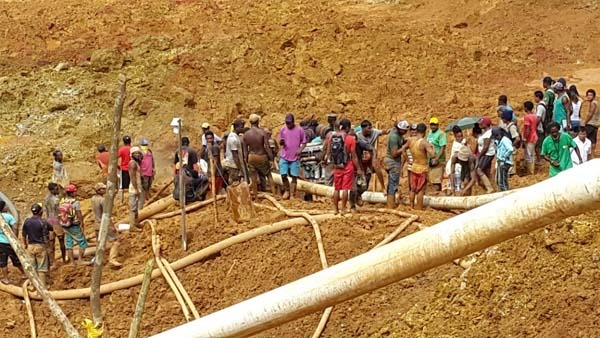
With pressure mounting for the closure of mining operations here until this country gets control of the COVID-19 pandemic, the Guyana Gold and Diamond Miners Association (GGDMA) on Friday said it is alarmed by the recent upsurge in the number of cases of the disease in certain mining areas.
The association said it has recognised that most of the cases can be traced and are connected to illegal cross border activity at mining landings and areas where miners dwell. “These cases have been linked and traced to itinerant workers who are not directly involved or associated with mining or specific operations. It appears that the COVID-19 is being spread at our borders which remain porous because of lax enforcement of crossings and other border control measures, this must be addressed immediately by the authorities,” the GGDMA said in a statement.
According to the body at mining landings, registered shops need to follow the COVID-19 guidelines and the curfew which is in place. “The association calls on all miners to have a strict adherence of the measures in place to prevent the spread of the virus and to avoid congregating unnecessarily at public spaces. Specifically, shops are reminded that no social gatherings or the consumption of food and drinks are to be allowed on premises, customers must purchase and leave. The GGDMA is against illegal shops which encourage mining workers to flaunt the COVID-19 guidelines and breaches the curfew. These illegal shops must be removed. We call on the relevant authorities to assist in this regard,” the statement read.
The GGDAM said activities, at landings and camps, that promote the spread of the disease and contribute to the disobedience of the curfew and COVID-19 guidelines must stop. “Camp Managers must follow the guidelines and enforce the rules established by the MOH, PAHO and WHO to ensure the safety of mining camps. There can be no compromise to ensure the safety of all workers on the mining camp. The GGDMA recognises the increasing spread of the virus and would like to be engaged by the COVID-19 Steering Committee on whatever decisions are being made for the gold and diamond mining industry of Guyana to help alleviate this disease. In the meantime, the Association continues to work with PAHO to develop a guideline for mining, this is expected to be completed by next week.”
Health authorities here have time and again warned “mining regions” to be extra cautious because of the “heavy traffic” in and out of communities within those regions. The traffic in those communities remain high because the gold and diamond mining sector remains “essential” and is fully operational.
The state-owned Guyana Chronicle had reported that Indigenous villages are highly vulnerable to the COVID-19 pandemic, and this vulnerability could be exacerbated if persons, particularly miners and residents of neighbouring Brazil, who test positive for the disease, knowingly enter those villages.
The Guyana Human Rights Association (GHRA) had suggested that legal charges be instituted against miners and persons, who test positive for the disease in Brazil, and purposely visit Indigenous villages in Guyana. “The controversial issue of mining being declared an ‘essential service’ is also at the centre of this problem. Many ordinary Guyanese are struggling to provide for their families while abiding by the lockdown, while miners are driving 500 miles through Amerindian communities, putting many people at serious risk en route, is considered an essential activity,” said the GHRA.
BEEF UP CONTROL AT BORDERS
In a report last week the Director of the Pan American Health Organisation, Dr. Carissa F. Etienne, called countries to “work together to strengthen the health response within their territories and across frontiers,” in order to contain the spread of COVID-19 cases among migrant and vulnerable populations in border areas. “Most border towns lack robust health infrastructure and service quality, and access are often low. Due to limited hospital facilities, they often rely on labs of limited capacity and small clinics that serve communities in vast catchment areas,” PAHO’s Director said. The increases of COVID-19 transmission in these areas “is cause for serious concern and immediate action.”
In the Americas, “We are fast approaching four million cases and the epidemic is still accelerating in the region,” she said, with almost 203,600 deaths reported from COVID-19. Currently, the United States accounts for 54 per cent of all cases in the Americas and Brazil has 23 per cent of all cases. “And we are not seeing transmission slowing down. That is the case in almost all countries in Latin America and a few in the Caribbean.” “While the majority of infections in the region are reported in big cities, where economic inequality and population density fuel transmission, our data show a concerning trend towards high transmission in border areas.” Etienne said in a media briefing today.
As an example, PAHO remains concerned about Haiti and the Dominican Republic, that share an active border and continue to report a rise in new cases. The PAHO Director referred to a spike in transmission in the north of Costa Rica, around the border with Nicaragua, as well as in French Guiana which borders Brazil, and an increase of cases in neighboring countries such as Suriname. In addition, there is ongoing transmission in the northern states of Brazil that border Guyana and Suriname; the Amazonian region where Venezuela, Brazil and Colombia intersect; and the borders between Peru, Brazil and Colombia.
Dr. Etienne said PAHO is supporting countries “to address the spread of COVID-19 in border areas, either by establishing a local presence, or by boosting the capacity of local health authorities.” She cited examples where PAHO enhanced local capacities in border areas with field offices in the Amazon, supported migrants on the Venezuela-Colombia border, and worked with UN partners in a triage centre on the Haiti-Dominican Republic border. Strengthening primary care services in border areas and sharing information across borders are important steps countries can take to improve the response to COVID-19, Etienne said. “Emergency facilities and surge personnel will be needed to back up local capacity during the pandemic” in border communities and among transient populations, and information on prevention must be shared in languages and formats that various cultures can understand, she added.
The PAHO Director called for partnership and cooperation to address the issue in the Region of the Americas and highlighted the need for “solidarity towards the communities most affected by the virus”.
“These are day laborers, migrants, and people who rely on the informal economy each and every day to survive. They are among the most vulnerable to COVID-19, and the least likely to receive care. We have a responsibility not to leave them behind,” she said. Stigma and discrimination toward migrants or day laborers most vulnerable to COVID-19 “have no place in our region. Not now, not ever, and especially not amid a pandemic. I count on all Member States to uphold these values, so together, we can beat our common enemy,” COVID-19 the PAHO director said.

Owen Arthur passes away
Former Barbados Prime Minister, Owen Arthur died, officials in Barbados confirmed. He was said to be critical Sunday night as...
Read moreDetails