COP 31 KEY TAKEAWAYS & EARLY OUTCOMES.
COP 31 FULL SUMMIT from November 9 to November 20, 2026, though the opening Leaders’ Summit segment.
Hosted in Antalya, Türkiye, with Australia serving as President of Negotiations, the early days of the conference and the HIGH-LEVEL Leaders’ Summit have centered on several major themes and developments.
TAKEAWAYS & EARLY OUTCOMES.
Acknowledging the 1.5°C Overshoot: Leaders and UN officials openly framed COP31 as the FIRST climate summit where GLOBAL WARMING is clearly on track TO EXCEED the Paris Agreement’s 1.5°C limit. UN Secretary-General António Guterres WARNED that “the climate crisis is outrunning us,” urging countries to FIGHT HARDER to minimize the DURATION and SEVERITY of the overshoot.
New Methane & Super-Pollutant PLEDGES: At the Leaders-Level Non-CO₂ Greenhouse Gases Summit on November 12, China, the UK, Brazil, and philanthropic partners announced over $480 million in new philanthropic funding plus $25 million for the Climate and Clean Air Coalition to rapidly cut methane and other super-pollutants.
Push for Electrification: COP31 Negotiations President Chris Bowen emphasized shifting from broad pledges to practical execution, framing the global transition around “the age of electricity” to insulate economies from volatile fossil fuel.
Climate FINANCE & Adaptation DEADLOCKS: Developing nations are demanding delivery on the $300 BILLION annual finance goal agreed upon at COP29 in Baku, alongside urgent increases in adaptation funding. Analysts note that disputes over grants versus loans and unresolved funding roadmaps remain major hurdles for the remainder of the summit.
CRITICISMS & CONTRADICTIONS.
Mixed MESSAGING on Fossil Fuels: Host nation Türkiye drew sharp criticism from health and climate advocates after celebrating the DISCOVERY of TWO NEW domestic OILFIELDS on the EVE of the SUMMIT.
PRIVATE JET Scrutiny: Oxfam and media outlets highlighted that at least 93 PRIVATE JETS landed in Antalya during the OPENING DAYS of the conference, drawing renewed criticism over the SUMMIT’S OWN CARBON FOOTPRINT.
FINAL negotiated AGREEMENTS and Official Cover DECISIONS will not be finalized until the conference closes on November 20, 2026.
RAPID Timeline.
Guyana produced its very FIRST COMMERCIAL BARREL of oil in December 2019. Reaching 1 MILLION bpd in just SEVEN years makes it ONE of the FASTEST offshore oil ramp-ups IN HISTORY, propelling the nation to become South America’s third-largest oil producer.
Global Supply & Climate Context
Global Market Impact. While 1 MILLION bpd represents roughly 1% of TOTAL GLOBAL OIL SUPPLY, Guyana is one of the world’s largest sources of new non-OPEC+ supply growth. Its exports increasingly supply refineries in Europe, the United States, and Asia, helping offset geopolitical supply disruptions elsewhere.
https://www.cfr.org/articles/how-guyanas-oil-boom-will-reshape-energy-security
Guyana is crossing the 1 MILLION BARRELS b per day (bpd) milestone right now.
After PRODUCING roughly 900,000 to 920,000 bpd through the first three quarters of 2026, the startup of its fifth offshore production vessel is lifting national output past 1 million bpd by the end of the year. Because Guyana consumes extraordinarily little oil domestically, nearly all of this production goes directly to global export markets.
CURRENT Output (Late 2026). Guyana averaged 902,000 bpd in the first half of 2026 across four offshore Floating Production, Storage, and Offloading (FPSO) vessels—Liza Destiny, Liza Unity, Prosperity, and One Guyana.
CROSSING 1 Million bpd. The arrival and startup of the fifth FPSO, Errea Wittu (at the Uaru project), adds 250,000 bpd of capacity. This pushes total production past 1 million bpd (and potentially up to 1.2 million bpd) in late 2026, with preliminary export schedules for December 2026 already reaching 1.06 million bpd.
Rapid TIMELINE. Guyana produced its very FIRST COMMERCIAL BARREL OF OIL in December 2019. Reaching 1 Million bpd in just SEVEN years makes it ONE of the FASTEST offshore oil ramp-ups IN HISTORY, propelling the nation to become South America’s THIRD-LARGEST oil producer.
FUTURE Capacity (2027–2030). An ExxonMobil-led consortium (alongside Chevron and CNOOC) has discovered roughly 11 billion oil-equivalent barrels in the offshore Stabroek Block. With upcoming projects like Whiptail, Hammerhead, and Longtail, production capacity is projected to reach 1.3 million bpd in 2027 and 1.7 million bpd (or over 2 million barrels of oil equivalent per day including natural gas) by 2030.
Per-Capita Leader & COP31 Tension. With a POPULATION of roughly 800,000 people, Guyana is the World’s LARGEST oil producer PER CAPITA. At climate summits like COP31, Guyana highlights a CENTRAL TENSION in the energy transition: developing nations argue they have a RIGHT to MONETIZE newly discovered fossil FUEL reserves to FUND economic development, while maintaining that Guyana’s vast rainforests still make the country a NET CARBON SINK.
The GEOPOLITICAL DISPUTE over the ESSEQUIBO region (known in Venezuela as Guayana Esequiba) is a century-old TERRITORIAL CONFLICT between Guyana and Venezuela that has ESCALATED sharply since massive offshore oil reserves were DISCOVERED in 2015.
At stake is 159,500 square kilometers (61,600 square miles) of RESOURCE-RICH JUNGLE west of the Essequibo River. The area makes up ROUGHLY two-thirds of Guyana’s TOTAL LAND MASS and directly BORDERS the offshore Stabroek Block, where Guyana’s BOOMING OIL production takes place.
Historical & LEGAL Roots
The 1899 Paris Arbitral Award. Guyana’s claim rests on an 1899 ruling by an International Tribunal (composed of arbitrators from Britain, Russia, and the United States) that drew the modern border largely in favor of then-British Guiana. Both countries initially accepted the ruling, and a joint commission demarcated the boundary in 1905.
Venezuela’s REJECTION & The 1966 Geneva Agreement. In 1962, Venezuela declared the 1899 award NULL and VOID, arguing that European powers and the U.S. conspired to CHEAT IT out of LAND held since the Spanish colonial era. Just before Guyana gained independence in 1966, Britain, Guyana, and Venezuela signed the Geneva Agreement, establishing a framework to seek a Peaceful, NEGOTIATED settlement.
The International Court of Justice (ICJ) Case. After decades of stalled UN-mediated talks, Guyana asked the International Court of Justice in 2018 to affirm the 1899 border as legally valid. The ICJ ruled in 2020 that it has jurisdiction over the case.
RECENT Escalations & Current Status
Annexation Push and Referendum. Following Guyana’s RAPID oil boom, Venezuela intensified its claim. In December 2023, Caracas held a domestic referendum backing the creation of a Venezuelan state in Essequibo, followed in 2024 by a DOMESTIC LAW formally designation.
Guyana’s offshore OIL BOOM has transformed it into the World’s fastest-growing economy, generating roughly US$6.5 BILLION in projected Government Petroleum Revenues for 2026. With an average output of 902,000 barrels per day in the first half of 2026 across its four active FPSOs—and global crude prices boosted by Middle East supply disruptions—Guyana exported over US$15 BILLION worth of oil in the first six months of the year alone.
To manage this MASSIVE INFLUX of capital without destabilizing its domestic economy, Guyana routes its OIL royalties and profit-sharing proceeds through a dedicated sovereign wealth fund.
Economic Growth & Per-Capita Transformation
World-Leading GDP Expansion. According to Guyana’s 2026 Mid-Year Report and the International Monetary Fund (IMF), real GDP is projected to expand by 20.8% in 2026, following 19.3% growth in 2025 and an average of nearly 40% during 2023–2024.
Surging Per-Capita Income. Once one of the poorest nations in South America, Guyana’s GDP per capita has quadrupled since 2019 to roughly US$32,000, placing it among the highest-income nations per capita in the Americas.
Non-Oil Spillover. Beyond petroleum, the non-oil economy is projected to grow by 10.2% in 2026, driven by a massive construction boom, agriculture, mining, and expanded financial services.
The Natural Resource Fund (NRF)
Growing Sovereign Wealth Balance. All Government OIL royalties and profit-oil revenues are deposited directly into the Natural Resource Fund (NRF), held at the Federal Reserve Bank of New York. By the end of September 2026, the fund’s balance reached approximately US$5.5 Billion.
Statutory Withdrawal Rules. To prevent unchecked spending, withdrawals require National Assembly approval and follow a tiered legal formula based on the prior year’s deposits. The Government can withdraw 100% of the First US$1 billion deposited, scaling down progressively to just 10% on annual inflows above US$5 billion.
Funding the National Budget. For 2026, Guyana approved US$2.37 Billion in NRF transfers, financing roughly 32% of the US$7.47 Billion National Budget. Because oil revenues are arriving FASTER than the statutory WITHDRAWAL ceiling permits spending, the fund’s net savings CONTINUE TO CLIMB RAPIDLY.
Where the MONEY GOES & Key Economic RISKS
Mega-Infrastructure & Public Services. The Government is channeling OIL WITHDRAWALS into LARGE-SCALE CAPITAL PROJECTS—including Highways, NEW Hospitals, Healthcare Modernization, Schools, Demerara Harbour Bridge, Housing Development, and a Gas-to-Energy Project aimed at CUTTING domestic electricity COSTS in HALF. It has also EXPANDED direct CASH GRANTS, pensions, and FREE UNIVERSITY tuition.
Inflation & Cost-of-Living Pressures. Rapid government spending and LABOR SHORTAGES have PUSHED UP Housing, FOOD, and Wage costs, raising concerns among economists about “DUTCH DISEASE”—where an extractive BOOM inflates LOCAL PRICES and makes TRADITIONAL SECTORS like Agriculture and Manufacturing LESS competitive.
UNEVEN Wealth Distribution. Despite soaring National Wealth, watchdog groups and institutions like the Inter-American Development Bank note that extreme POVERTY RATES and infrastructure gaps PERSIST in rural and indigenous communities, fueling ongoing POLITICAL DEBATE over TRANSPARENCY, ANTI-CORRUPTION oversight, and the PACE OF CASH TRANSFERS.
Guyana’s CORE climate argument is that developing nations have a sovereign right to monetize newly discovered oil reserves to lift their citizens out of poverty, provided they invest those revenues into low-carbon development while keeping their vast tropical forests intact. At COP31 in Antalya this week, Guyanese leaders have framed this model as a practical middle ground between economic survival and global climate goals.
CORE Pillars of Guyana’s Position
Maintaining Net-Zero Status via Rainforests. Tropical forests cover roughly 85% of Guyana’s landmass (about 18 million hectares), storing nearly 20 billion tons of carbon and sequestering roughly 154 million tons of CO2 annually. With a deforestation rate of just 0.04%—one of the lowest in the world—Guyana maintains that its forests absorb far more carbon than its domestic economy emits, keeping the nation a net carbon sink even as oil production passes 1 million barrels per day.
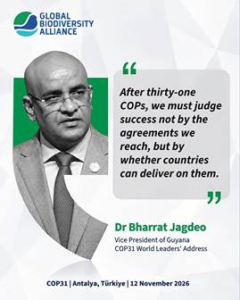
Climate Justice and Historic Responsibility. Guyanese officials, including President Dr. Irfaan Ali and Vice President Dr. (hc) Bharrat Jagdeo, argue that Wealthy nations industrialized using CHEAP fossil fuels and cleared their OWN FORESTS to build modern ECONOMIES. They contend that asking poor nations to leave newly discovered oil in the ground without offering comparable financial compensation UNFAIRLY PENALIZES the Developing World.
FUNDING Transition and Adaptation with Oil Revenues. Under its Low Carbon Development Strategy (LCDS 2030), Guyana channels oil proceeds from its Natural Resource Fund into solar power, hydropower, and coastal flood defenses—critical investments for a country where 90% of the population lives on a low-lying coastal plain vulnerable to rising seas.
MONETIZING Standing Forests. Guyana argues that the world must pay countries to keep forests standing rather than waiting until they are threatened. In 2022, Guyana became the first nation issued jurisdictional forest carbon credits under the ART-TREES standard, securing a minimum US$750 million 10-year purchase deal with Hess (now owned by Chevron) and selling credits to over 30 airlines under the UN’s CORSIA aviation offsetting scheme. At the COP31 Leaders’ Summit on Forests on November 11, 2026, Vice President Dr. (hc) Jagdeo urged wealthy nations—particularly in Europe—to stop delaying compliance rules and scale up forest finance.
A SWOT analysis of Guyana’s climate-and-development strategy highlights a high-stakes BALANCING ACT between record offshore oil wealth and world-leading rainforest conservation. While Guyana commands extraordinary FINANCIAL momentum and vast natural carbon sinks, it faces ACUTE climate-vulnerability RISKS, Geopolitical THREATS, and growing International SCRUTINY over exported emissions.
STRENGTHS (Internal Advantages) IN GUYANA.
Vast Intact Rainforest Carbon Sink. Tropical forests cover roughly 85% of Guyana’s landmass, storing nearly 20 BILLION tons of carbon and maintaining a DEFORESTATION rate of just 0.04%. This allows Guyana to claim DOMESTIC net-zero status while monetizing jurisdictional forest carbon credits under the ART-TREES standard.
Massive OIL-DRIVEN FISCAL Capacity. With production crossing 1.1 MILLION BARRELS per day BY 2027 and the Natural Resource Fund holding over US$5.5 BILLION, Guyana can SELF-FINANCE Renewable Energy, Coastal Defenses, and Public Infrastructure WITHOUT RELYING on HIGH-INTEREST FOREIGN DEBT.
Structured Policy Framework. Guyana operates under a clear Low Carbon Development Strategy (LCDS 2030) paired with statutory sovereign wealth withdrawal caps, channeling dedicated shares of carbon revenue directly to Indigenous communities and national adaptation projects.
WEAKNESSES (Internal Vulnerabilities) IN GUYANA.
SEVERE Coastal Climate Exposure. Roughly 90% of Guyana’s population and most of its agricultural land sit on a narrow coastal plain below high-tide sea level, making the country highly vulnerable to sea-level rise and EXTREME flooding.
Low-lying coast: About 5% of the total land area—specifically the narrow coastal strip where the capital city of Georgetown and most major settlements are located—sits roughly 1 to 3 meters (about 6 feet) BELOW MEAN SEA LEVEL.
Flood DEFENCES: Because the ATLANTIC OCEAN and LOCAL RIVERS sit higher than the streets at HIGH TIDE, the CAPITAL, GEORGETOWN, and COAST rely on an AGING, complex network of Dutch-built SEAWALLS, DIKES, and DRAINAGE CANALS.
Population concentration: Roughly 90% of Guyana’s population LIVES in this VULNERABLE, low-lying coastal zone.
Economic Over-Reliance on Petroleum. OIL NOW DOMINATES GDP growth and exports, creating risks of DUTCH DISEASE, local INFLATION, labour SHORTAGES, and vulnerability to long-term GLOBAL OIL PRICE SWINGS.
Institutional & GOVERNANCE Strain. Rapidly SCALING public SPENDING evaluates the administrative CAPACITY of a small nation of roughly 800,000 people, drawing ongoing SCRUTINY over infrastructure BOTTLENECKS, uneven rural development, and anti-CORRUPTION oversight.
Ongoing inequality: Even with massive inflows of wealth, POVERTY remains a real CHALLENGE, particularly in RURAL and interior INDIGENOUS communities where infrastructure and public services LAG BEHIND the coast.
OPPORTUNITIES (External Tailwinds) IN GUYANA.
Global LEADERSHIP in FOREST Finance. At forums like COP31, Guyana is positioned to lead developing forest nations in shaping international carbon market rules (such as Article 6 and CORSIA) and attracting Compliance-grade Corporate and Sovereign Buyers.
Domestic Clean Energy Leapfrog. Oil and carbon REVENUES ENABLE Guyana to bypass LEGACY fossil-fuel grids and build out utility-scale solar, hydropower, and lower-emission gas-to-energy infrastructure to slash domestic electricity costs.
Regional Supply & Strategic Partnerships. Rising GLOBAL DEMAND for secure non-OPEC+ crude gives Guyana strong DIPLOMATIC and TRADE LEVERAGE with partners in the United States, Europe, and Asia.
THREATS (External Risks) IN GUYANA.
Geopolitical CONFLICT with VENEZUELA. Venezuela’s Territorial CLAIM over the Essequibo region and adjacent offshore waters creates ongoing security, diplomatic, and investor uncertainty ahead of the International Court of Justice’s FINAL ruling BY DECEMBER 2026 OR January 2027, BEFORE the NEW FIVE Judges are SWORN IN on February 6, 2027.
ICJ 15-JUDGE BENCH
President IWASAWA Yuji, JAPAN; Vice-President Julia SEBUTINDE, UGANDA; Judge Peter TOMKA, SLOVAKIA; Judge Ronny ABRAHAM, FRANCE; Judge XUE Hanqin, CHINA; Judge Dalveer BHANDARI, INDIA; Judge Georg NOLTE, GERMANY; Judge Hilary CHARLESWORTH, AUSTRALIA; Judge Leonardo Nemer Caldeira BRANT, BRAZIL; Judge Juan Manuel GÓMEZ ROBLEDO, MEXICO; Judge Sarah H. CLEVELAND, United States of America; Judge Bogdan-Lucian AURESCU, ROMANIA; Judge Dire TLADI, SOUTH AFRICA; Judge Mahmoud Daifallah HMOUD, JORDAN; and Judge Phoebe N. OKOWA, KENYA.
FIVE NEW JUDGES
Five were ELECTED on November 3, 2026, by the UN General Assembly and Security Council to serve NINE-YEAR TERMS on the International Court of Justice (ICJ) BEGINNING on February 6, 2027.
Newly Elected ICJ Judges (Term: 2027–2036)
- Judge Dapo Akande, United Kingdom
- Judge François Alabrune – France
- Judge Mahmoud Daifallah Hmoud – Jordan (re-elected)
- Judge Rena Lee – Singapore
- Judge Phoebe Okowa – Kenya (re-elected)
Context: The ICJ election filled FIVE SEATS as part of the STANDARD ROTATION where ONE-THIRD of the 15-JUDGE BENCH is renewed every THREE Years.
https://www.icj-cij.org/current-members
BACK CHANNEL — US Favoring BILATERAL Under US Auspices
THIS is a 180-degree SHIFT and extremely DANGEROUS for Guyana. IF MATERIALIZES.
US State Dept under His Excellency Secretary Rubio negotiating Status of Forces Agreement (SOFA) for Long-Term US military presence in Venezuela — OIL deal + Treasury RECOVERY talk.
IF, US pushes “BILATERAL Negotiations under USA AUSPICES.”
US would be ENDORSING Venezuela’s Historic Position — that Geneva Agreement 1966 Requires Negotiation, NOT ICJ Adjudication.
Would undermine PENDING ICJ ruling — gives Venezuela EXIT ramp: “US supports TALKS, we do not need to accept ICJ RULING.”
Linked to US-Venezuela OIL + MILITARY deal — US needs STABILITY with Her Excellency Rodriguez Interim Government, SO MAY TRADE, Guyana’s LEGAL position for OIL/MILITARY access to Venezuela.
Guyana RISK — SHOW TELL KNOW:
Guyana wants “NEW ERA” after ICJ ruling — BOTH sides ABIDE.
BILATERAL under US auspices = NO Binding Enforcement — Venezuela can DRAG FOREVER, like 1966-2018.
President Dr. Irfaan Ali at UN:
“We urge Venezuela to ABIDE by forthcoming RULING as Guyana WILL DO” — US BILATERAL IDEA contradicts that.
The phrase is a cornerstone concept of realpolitik (pragmatic, power-based statecraft) frequently associated with U.S. DIPLOMAT, His Excellency Dr. Henry Kissinger.
American Foundations
Long BEFORE Kissinger, early U.S. leaders warned AGAINST permanent Emotional or Political Entanglements.
George Washington’s 1796 Farewell Address warned AGAINST Permanent Alliances, and Thomas Jefferson’s 1801 Inaugural address Championed “Peace, Commerce, and Honest Friendship with ALL Nations, Entangling Alliances with NONE”—a concept known as the Washington Doctrine of Unstable Alliances.
National Interest FIRST
Modern U.S. Administrations—spanning BOTH REPUBLICANS and DEMOCRATS Political Parties—Frequently LEAN BACK TOWARD an “INTERESTS-FIRST” or “AMERICA FIRST” Framework, Prioritizing DOMESTIC ECONOMIC SECURITY, Energy Independence, and STRATEGIC DOMINANCE over traditional GLOBAL ORDER Assumptions.
THREATS: CARBON Accounting & GREENWASHING Backlash.
SCIENTISTS and climate ADVOCATES increasingly CHALLENGE Guyana’s net-zero NARRATIVE by COUNTING Scope 3 (downstream) EMISSIONS from its EXPORTED OIL, which could ERODE buyer confidence in its FOREST CARBON CREDITS.
THREATS: Long-Term Stranded Asset RISK.
As Global clean-technology adoption accelerates—backed by initiatives like COP31’s electrification push—long-term GLOBAL OIL DEMAND could PEAK and DECLINE FASTER than projected, reducing FUTURE RETURNS on late-stage OFFSHORE projects.
COP32 will be hosted by ETHIOPIA in ADDIS ABABA from November 8–19, 2027, making imagery of Addis Ababa, the UN’s Africa Hall, and Ethiopia’s Green LEGACY REFORESTATION campaign the primary VISUAL representations of the summit.