
Twenty-three years after regional leaders promised at Rose Hall to give the Community an income of its own, the Barbados Prime Minister says the integration movement still survives on small cheques that arrive late — and she has put a price on the fix.
MONTEGO BAY, Jamaica, November 20, 2026 (Calvin G. Brown, Regional) — It was here, at Rose Hall in July 2003, that Caribbean heads of government adopted the principle that their Community should be financed by automatic transfers of resources rather than by the goodwill of finance ministers.
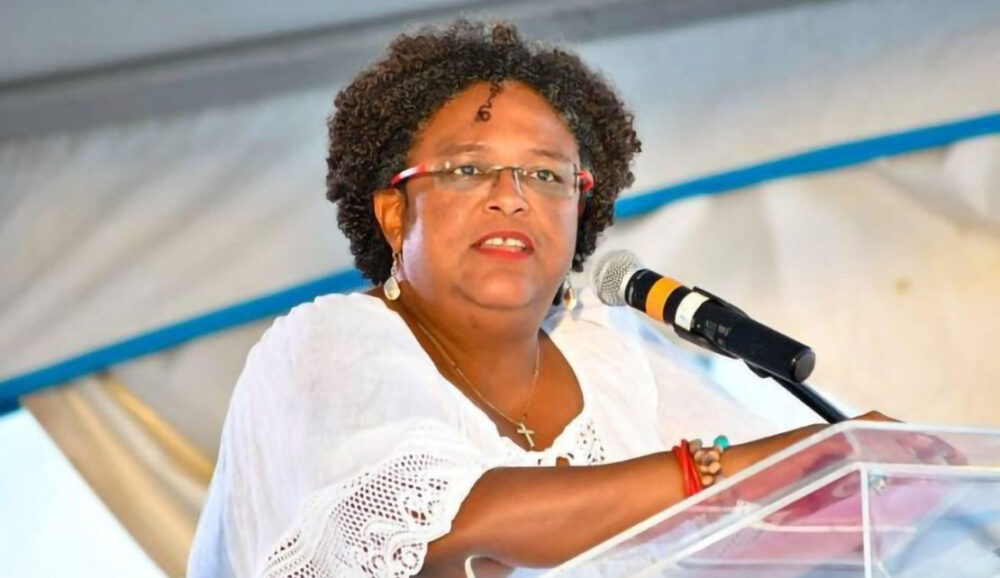
Last Sunday in Kingston, Barbados Prime Minister Mia Amor Mottley looked across a room at the man who chaired that meeting, former Prime Minister P.J. Patterson, and delivered the audit: the promise remains unkept.
“At Rose Hall you agreed in 2003 for automatic resource transfers,” Mottley said. “But 23 years later, we have not had the political will to execute it as a core action for our regional community.”
She was speaking at the University of the West Indies, Mona, at the launch of Caribbean Integration: The Patterson Doctrine, the 386-page study by Professor Sir Kenneth Hall and Myrtle Chuck-A-Sang. Former Prime Minister Bruce Golding was also in the audience. Book launches are usually polite affairs. Mottley used this one to read the region its own unpaid bill.
A Community on an allowance
Her description of how the Caribbean Community pays its way was brief and brutal. “CARICOM runs on an annual assessed contribution from member governments set by a formula and it is voted through national budgets,” she said. “The amounts are small. They’re often paid late, and every payment, regrettably, is a fresh political decision. You cannot run an organisation on that basis.”
Strip away the diplomacy and the charge is this: the Community that leaders praise at every summit is kept on an allowance, and the allowance depends on the mood of each treasury in the membership. Every budget cycle, in every capital, the region must compete all over again with roads, hospital beds and debt payments. An institution financed that way cannot plan. It can only hope.
Mottley put the point to the room as a matter of common sense. “Which one of us in this room can live without independent financing being assured, whether through salary or contractual arrangements? None of us!” Why, then, she asked, should the Community “be at the mercy of others in order to continue the excellent work which it is doing?”
The conviction is not new to her. She credited the late Barbadian Prime Minister Sir Harold Bernard St. John with impressing on her, when she entered public life, that unless the region financed its existence through an automatic mechanism, “we will never make the progress.”
“These agencies are not decorative”
Mottley tied the money directly to survival. The region, she said, faces three existential threats: the weakening of the international rules-based order on which small states depend for their sovereignty; climate change and the loss of biodiversity; and the rise of artificial intelligence. None can be met by “singular national action.” All demand coordinated policy.
“Funding CARICOM cannot be an afterthought because it is the very same CARICOM that will help us get to safety.”
MIA AMOR MOTTLEY, PRIME MINISTER OF BARBADOS
Her evidence was the region’s own recent memory. When COVID-19 struck, she said, the Caribbean Public Health Agency “made the defining difference” in saving lives and livelihoods. When Hurricane Melissa hit Jamaica, the Caribbean Disaster Emergency Management Agency was among the first on the ground, as it had been in Grenada and St Vincent after Beryl.
“These agencies are not decorative,” she said. They deliver where individual member states lack the capacity. For Jamaicans still rebuilding after Melissa, the argument lands close to home: the responders who came are financed by the same small, late cheques.
Three dollars on a thousand
Mottley did not stop at complaint. She tabled what she called “a very modest treaty-based levy”: 0.3 per cent on imports from outside the region, “paid automatically from customs into a community account.” It would be supplemented by a small travel levy of no more than US$1 for each cruise ship passenger and US$2 for each long-stay visitor.
She was careful to say this was not “the way or the only way,” but an attempt to restart a debate that “must now once again engage the heads” of the Community.
The arithmetic is the most arresting part of the case. Regional institutions, she said, need US$80 million to US$90 million a year. The import levy would raise between US$60 million and US$86 million, depending on national exclusions. The travel levy could bring in as much as another US$30 million. On her figures, the two together would cover the bill.
To the obvious objection, the cost of living, she had an answer ready. “Three dollars on a thousand dollars of goods” cannot fairly be used to justify a price increase on anything, she argued, “not if people are being faithful.” She added a contribution of her own: Barbados has committed 25 megawatts of renewable energy licences that regional institutions, the UWI among them, could monetise as an independent revenue stream.
The mechanism, not the money
“The problem, my friends, is not the amount, it is the mechanism. It is the governance,” Mottley said. Pointing to the experience of ECOWAS and the African Union, she warned that such levies fail “when national treasuries keep the money, when each act becomes a new political decision.”
Her remedy is a protocol to the Revised Treaty of Chaguaramas that would make the levy Community revenue in law, with automatic remittance through central banks, a collection fee to give customs departments a reason to pay it over, independent audits, and sanctions for members that do not comply.
The hard questions
None of this is CARICOM policy. It is one head of government’s opening bid, and it faces real hurdles. Mottley herself conceded that any change to cruise passenger charges means negotiating with the cruise lines over a long lead time.
Other questions were left hanging. The Caribbean imports most of what it eats, wears and drives, and nobody can guarantee that importers will absorb even a small charge rather than pass it on. Every parliament would have to surrender control of a revenue stream, the very sovereignty reflex that has kept the Rose Hall principle on the shelf since 2003. And sanctions against a defaulting member remain an untested idea in a Community built on consensus.
There is also the matter of trust. In an editorial on November 18, The Gleaner judged Mottley’s ideas feasible, but insisted that any new financing mechanism be matched by greater transparency in the Secretariat’s financial reporting. It is a fair condition. A body seeking automatic access to the public’s money owes the public automatic accountability.
Mottley’s parallel call for a political head for the Community is a debate for another day. On the money, her verdict fitted in a single Bajan image: without a political head and an independent source of financing, “we are spinning top in mud.”
The promise made in this city is now 23 years old, old enough to have finished university. The question for the heads of government when they next meet is whether it will finally be put to work.
WiredJA