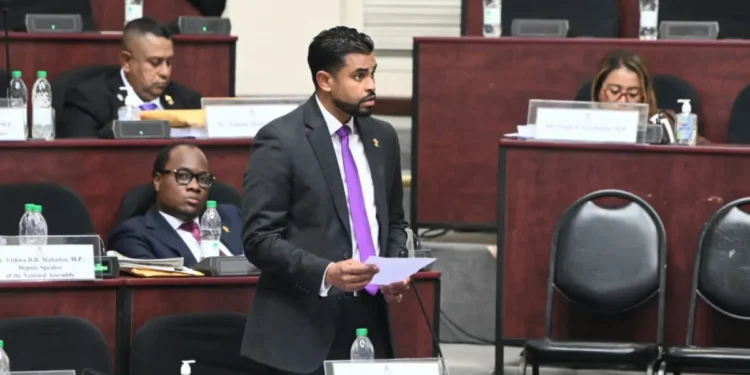
Today, I submitted a motion to amend the Standing Orders of the National Assembly to require regular sittings of Parliament and to protect opportunities for Private Members’ Business. The motion is seconded by the Opposition Chief Whip, the Hon. Tabitha Sarabo-Halley, MP.
The message is simple. Parliament belongs to the people of Guyana. It does not belong to the PPP. It does not exist at the convenience of the Government. It is not an institution to be summoned when the Government needs approval for expenditure and then left silent when the people’s representatives have questions to ask.
The proposed amendments require Parliament to meet at least once every fourteen days while it is in session, subject to the Constitution and the recess provisions. They also require Parliament to meet within fourteen days after the annual recess ends.
The motion preserves the existing entitlement to precedence for Private Members’ Business at every fourth sitting and provides for at least one such sitting in each qualifying calendar month. This is essential if Members who are not part of the Government are to have regular opportunities to bring the concerns of the people before the Assembly.
The need for this motion should embarrass any Government that claims to respect democratic accountability.
There have been periods when the National Assembly has not met for more than one hundred days. That is unacceptable in any country that claims to be a democracy.
It is an embarrassment that, in Guyana, we have had to write to international bodies and bring the matter to the attention of the diplomatic community before the Government appeared to give serious consideration to the voices of Guyanese citizens and their elected representatives.
The people of Guyana should not have to seek international attention to secure the functioning of their own Parliament. The Government’s duty to account is owed to the people, and their voices and those of their representatives must be heard and respected.
The absence of regular sittings delays scrutiny of Government decisions, public expenditure and the urgent matters affecting our communities. It leaves questions
unanswered and weakens the ability of elected representatives to act on behalf of the people who sent them to Parliament.
This is not a new concern. In his 2005 Needs Assessment of the Guyana National Assembly, Commonwealth parliamentary adviser Sir Michael Davies observed that the Assembly had met only nineteen times in 2004. He described that record as “hardly an endorsement of its status” and made clear that the timing of sittings should not be left to the whim of the Government.
More than twenty years later, Guyana is a major petroleum producer, with public revenues and expenditure on a scale previously unimaginable. The responsibilities of oversight have grown. The need for the National Assembly to function consistently and effectively has grown with them.
Yet the PPP Government continues to treat parliamentary accountability as though it were optional. The National Assembly cannot be reduced to an afterthought, or treated simply as a place to obtain approval to withdraw and spend money from the Consolidated Fund.
Article 9 of our Constitution declares that sovereignty belongs to the people. Those words must mean something in the way our institutions operate. The Government must understand that it is accountable to the people, and we, the people, must insist that the institutions established to secure that accountability are allowed to function.
I urge Members of the National Assembly to support these amendments. Regular sittings and meaningful opportunities for Private Members’ Business are necessary to protect the authority of Parliament and the right of the people to be represented.