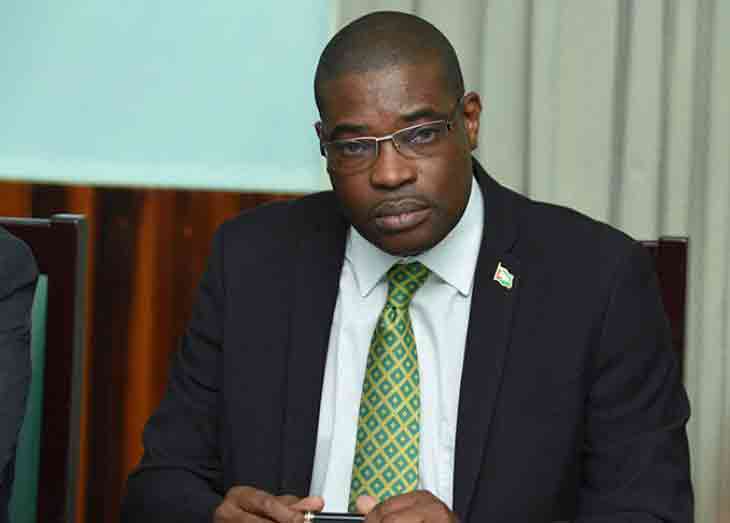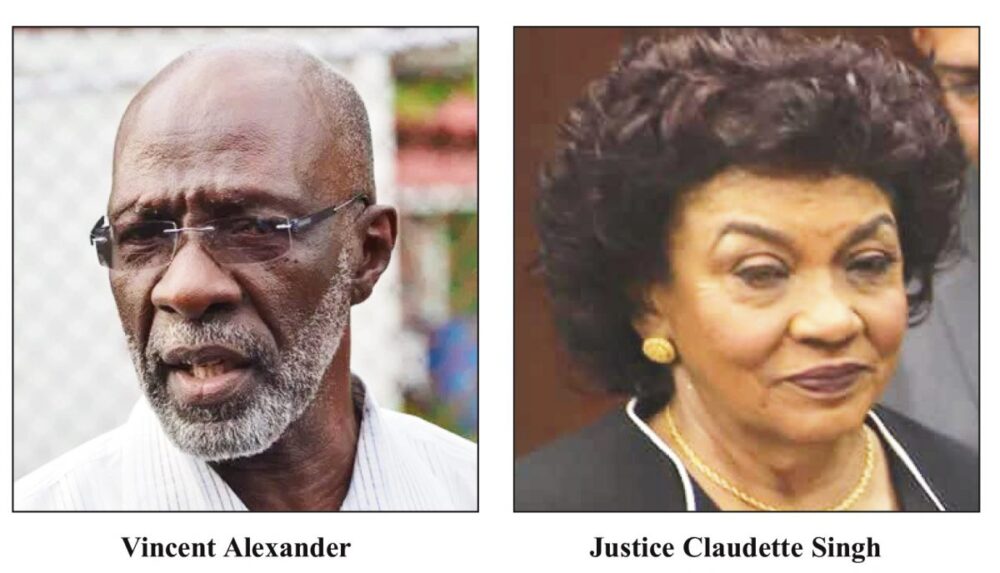
The Guyana Elections Commission (GECOM) is facing renewed scrutiny after opposition-nominated Commissioner Vincent Alexander challenged the authority of Chairperson, retired Justice Claudette Singh, to engage five Western diplomats on electoral matters while the Commission itself remains effectively paralysed by an unresolved dispute over its composition.
In a letter to the editor published by Village Voice News on Monday, Alexander questioned the legitimacy and purpose of the November 5 meeting between Singh, Chief Election Officer Vishnu Persaud and representatives of the United States, United Kingdom, Canada, France and the European Union.
His central concern is that the Chairperson was discussing matters falling within the responsibility of the Commission without first convening the commissioners to deliberate and establish a collective position.
“This meeting places a comatose GECOM in the spotlight,” Alexander wrote.
He questioned the authority under which the meeting was held, its purpose and what action was required to restore the Commission to operation.
“What authority does she have to hold discussions with the Diplomatic Corps on behalf of a commission which has been decommissioned?” Alexander asked.
He argued that Singh could not legitimately speak on behalf of a Commission that had not met for more than a year, contending that the discussions represented the views of the Chairperson and Secretariat rather than decisions reached collectively by the six-member constitutional body.
The criticism strikes at the heart of an institutional crisis that has left one of Guyana’s most important constitutional bodies unable to conduct its normal business, despite the passage of more than a year since the September 2025 General and Regional Elections.
A Commission unable to function
GECOM has not held a meeting as a Commission since September 7, 2025, when it declared the results of the general elections, according to reporting by WiredJA. The continuing impasse centres on the three opposition-nominated seats, which remain occupied by Vincent Alexander, Charles Corbin and Desmond Trotman, originally appointed on the advice of the former APNU-led opposition.
Following the 2025 elections, the We Invest in Nationhood (WIN) party emerged as the principal opposition force in the National Assembly, with Azruddin Mohamed subsequently becoming Leader of the Opposition.
Mohamed has argued that the composition of GECOM should reflect the changed parliamentary and political landscape. On June 30, 2026, he formally submitted the names of Senior Counsel Roysdale Forde, Siand Dhurjon and Damien Da Silva to President Irfaan Ali for appointment as opposition-nominated commissioners. A further letter was sent on August 7, but the Opposition Leader has said he has received no substantive response.
The three sitting commissioners have resisted calls to vacate their positions, maintaining that their tenure cannot simply be terminated through a political request. The dispute has consequently developed into a constitutional and political stalemate, with no agreed mechanism yet implemented to resolve it.
Singh has previously maintained that GECOM cannot proceed with its work until the Commission is properly constituted in keeping with the current political dispensation. The impasse, however, has persisted without a resolution from the President or Parliament.
Local elections and electoral reforms caught in the deadlock
The consequences extend well beyond the disagreement over who occupies the opposition seats.
Local Government Elections, which were expected to be held before the end of 2026, remain in serious doubt. GECOM has acknowledged that its completed work plan for the elections cannot be activated without the necessary decisions of the Commission.
The Carter Center, which observed Guyana’s September 2025 elections, warned in August that the impasse over GECOM’s composition threatens the Commission’s ability to organise Local Government Elections within the statutory timeframe and implement reforms before the next General and Regional Elections.
The organisation called on Guyanese officials to resolve the deadlock, warning that a Commission unable to function effectively cannot adequately discharge its electoral responsibilities.
The paralysis also raises questions about the implementation of recommendations made by international observer missions following the 2025 elections, including measures intended to strengthen transparency, public confidence and the integrity of the electoral process.
Among the contentious issues is biometric voter verification. The use of fingerprint identification at polling stations was not implemented for the 2025 elections, despite demands from sections of the opposition and civil society. The issue has resurfaced following the recent diplomatic engagement, which reportedly included discussions about recommendations arising from the last elections.
Diplomats meet Chair and CEO, not the Commission
The November 5 delegation comprised United States Ambassador Nicole Theriot, British High Commissioner Joe Fisher, Canadian High Commissioner Deborah Gomes-Schultz, European Union Ambassador Luca Pierantoni and French Ambassador Olivier Plançon.
According to a statement issued by the diplomatic missions, the meeting was an:
“informative and constructive discussion”
The discussions covered Guyana’s electoral process, GECOM’s consideration of recommendations from observer missions following the September 2025 elections, and priorities for strengthening electoral institutions ahead of the next Local Government Elections.
The statement did not publicly explain whether the diplomats raised the unresolved dispute over the Commission’s composition or the fact that GECOM has not met as a body for more than a year.
Alexander’s objection is not simply that the Chairperson met foreign representatives. Rather, he questions whether a Chairperson can engage diplomats on behalf of the Commission when the commissioners have not convened to deliberate on the matters discussed.
He also questioned the judgment of the diplomatic representatives in proceeding with a meeting under those circumstances, arguing that the engagement risked giving the impression that the Commission was functioning normally.
A question of accountability
The controversy places renewed pressure on the President, the Opposition Leader, the existing commissioners and the Chairperson to address a stalemate that is increasingly affecting the country’s electoral preparations.
GECOM is constitutionally entrusted with the conduct of elections and the protection of the electoral process. Its inability to meet and make collective decisions raises fundamental questions about institutional accountability, electoral readiness and public confidence.
The President has yet to provide a substantive response to Mohamed’s proposed nominees, while the sitting opposition-nominated commissioners have not agreed to relinquish their positions. Meanwhile, the Chairperson’s position that the Commission cannot proceed until its composition is resolved has left the institution in prolonged suspension.
Alexander’s letter also uses the term “treasonable” in describing the conduct he is criticising. That is his characterisation and not an established legal finding.
Ultimately, the diplomatic meeting has exposed a troubling contradiction: GECOM’s leadership is discussing electoral reform and preparations for future elections with international representatives, while the Commission itself remains unable to meet and collectively address the very issues that threaten its effectiveness.
The question now is whether Guyana’s political and constitutional authorities will resolve the impasse—or allow the paralysis of the Elections Commission to continue at the expense of local democracy and confidence in the country’s electoral institutions.