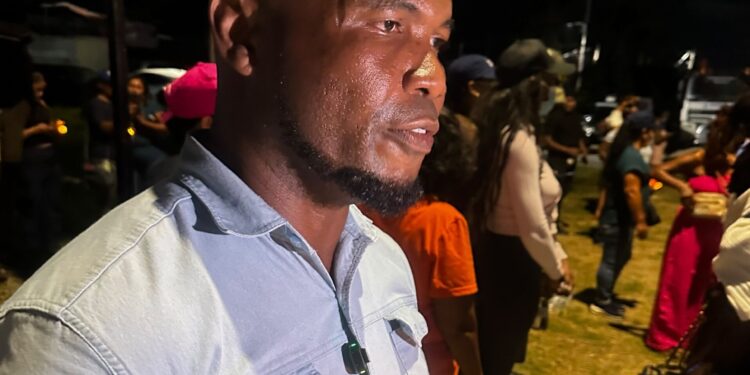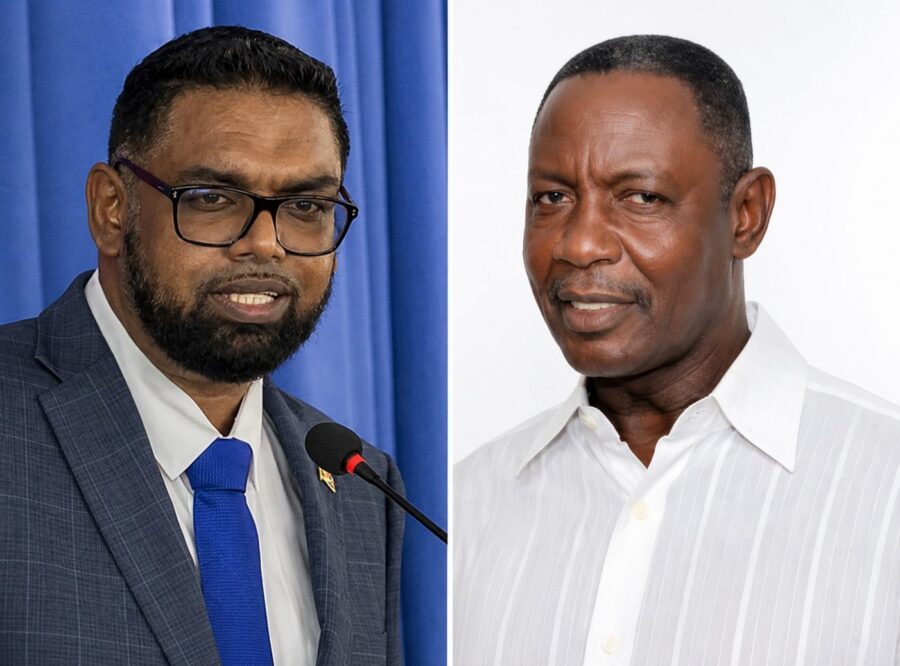
Guyana Trades Union Congress (GTUC) General Secretary Lincoln Lewis has described the remand of Opposition Leader Azruddin Mohamed and Police Constable Ryan Greene on charges under the Cybercrime Act as a potentially sinister political manoeuvre, alleging that the government may be seeking to secure a conviction to remove Mohamed from the National Assembly and diminish his political influence.
In an interview with Village Voice News, Lewis argued that the criminal charges against Mohamed should be viewed within the context of his political activism, public criticism of the government and persistent efforts to expose alleged corruption.
Lewis said Mohamed had become a significant political threat because of his willingness to challenge the Irfaan Ali administration and expose alleged wrongdoing, including matters that he believes have not received adequate scrutiny from sections of the local media.
He questioned the government’s approach to the case, arguing that its actions could undermine freedoms and have a chilling effect on political opponents, whistleblowers and citizens who seek to investigate and expose alleged corruption.
Lewis pointed to Article 155(1)(c) of Guyana’s Constitution, which provides for the disqualification of a person from election to the National Assembly if that person is under a sentence of death or is serving a sentence of imprisonment exceeding six months, including a suspended sentence of such duration.
He also referenced Article 156(2), which addresses the position of a sitting Member of Parliament who becomes subject to a disqualification decision but has a right of appeal. Under that provision, the member must cease performing parliamentary functions while the appeal is pending, although the seat is not immediately vacated. The Constitution provides a 30-day period, with possible extensions, to allow the appeal process to be pursued.
Lewis argued that these constitutional provisions make the criminal proceedings against Mohamed particularly consequential. He alleged that, following what he described as unsuccessful attempts to remove Mohamed from the political arena, the government could be seeking to fast-track a conviction that would undermine his political activism and the influence of the We Invest in Nationhood (WIN) movement.
Although Mohamed has the right to pursue legal challenges and appeals through the judicial system, including the Caribbean Court of Justice (CCJ), Lewis expressed concern that the process could be compromised by what he characterised as an increasingly close and unhealthy relationship between the Executive and the Judiciary.
He also raised broader concerns about the protection of political opposition, judicial independence and the preservation of constitutional safeguards, alleging that these principles face erosion under the Ali-Jagdeo administration.
Lewis further warned that he believes the government could resort to increasingly aggressive tactics against its political opponents, including the possibility of violence. He linked that concern to what he described as the People’s Progressive Party’s (PPP) history and its current political vulnerability in the face of Mohamed and WIN’s growing influence.
Describing the Cybercrime Act proceedings as a form of censorship and legal retaliation, Lewis argued that the case was not genuinely about accountability or improving Guyana, but about using the justice system to weaken the opposition.
When asked why he repeatedly referred to the administration as the “Ali-Jagdeo regime,” Lewis said he believed the two leaders should be viewed as one political force.
“ It should be the Jagdeo-Ali regime,” Lewis said, describing Vice-President Bharrat Jagdeo as the chief architect and President Irfaan Ali as the administration’s public face. He characterised Jagdeo as the “puppeteer.”