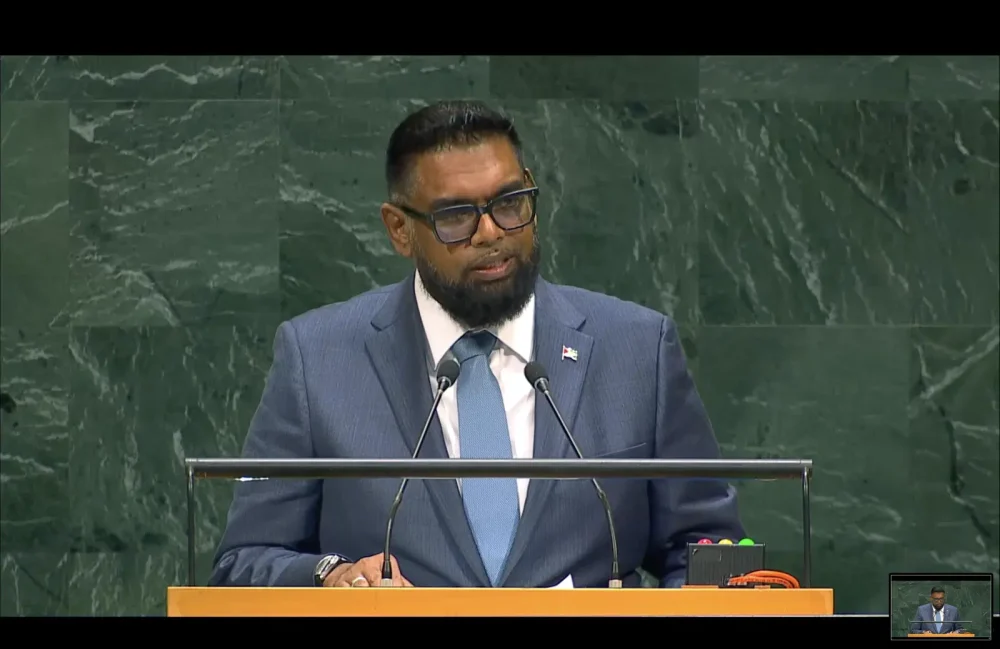
Guyana, under the Irfaan Ali administration, has abstained from a United Nations (UN) General Assembly resolution calling for an end to the United States’ decades-old economic embargo against Cuba, breaking with its longstanding position and raising questions about Washington’s growing influence over Georgetown’s foreign policy.
The resolution, considered on Thursday, October 29, secured 130 votes in favour, 17 against and 25 abstentions, reflecting a significant decline in international support compared with previous years. Guyana joined Jamaica and Haiti among the Caribbean countries abstaining, while Trinidad and Tobago voted against the resolution alongside the United States.
The vote comes amid heightened US pressure on Cuba and countries maintaining cooperation with Havana, including its overseas medical programmes. For Guyana, the decision is particularly striking given the decades of assistance Cuba has provided in healthcare, education and professional training.
A relationship built on healthcare and education
Guyana and Cuba established diplomatic relations in 1972, developing a partnership that has benefited Guyanese through medical assistance, scholarships, technical cooperation and cultural exchanges.
Cuban medical personnel have served in Guyana for decades, helping to provide healthcare services, including in communities where access to doctors and specialists has been challenging. Cuba has also trained Guyanese medical professionals and provided scholarships in medicine, engineering, agriculture and other disciplines.
Programmes such as Operation Milagro have helped Guyanese patients obtain specialised eye treatment. These initiatives have been particularly valuable to a developing country seeking to expand healthcare access while strengthening its own professional workforce.
Guyana previously supported the annual UN resolution calling for the embargo’s removal. In its statements to the General Assembly, Georgetown had described the restrictions as unjust and called for their termination, while also urging Washington to remove Cuba from its list of state sponsors of terrorism.
Against that history, Guyana’s abstention represents a notable diplomatic shift. The government must now explain why it withheld support from a resolution consistent with the position it had defended for years.
Cuban medical programme ends amid US pressure
The vote also follows the termination of Guyana’s longstanding medical cooperation arrangement with Cuba in 2026.
The Cuban medical brigade, which had supplied doctors and other healthcare personnel to Guyana for decades, began withdrawing after the government-to-government arrangement ended. The development came amid the Trump administration’s campaign against Cuban overseas medical missions, which Washington characterises as exploitative labour arrangements.
The United States has threatened visa restrictions against individuals involved in facilitating Cuba’s medical programmes, placing pressure on countries that rely on Cuban medical personnel.
Guyana’s Health Minister, Dr Frank Anthony, said the government remained willing to employ qualified Cuban professionals directly under individual contracts.
Georgetown has maintained that Cuba chose to withdraw its brigade, and it has not publicly established that Washington directly ordered the termination of the agreement. Nevertheless, the timing has intensified scrutiny of the relationship between US pressure and Guyana’s changing approach to Havana.
The withdrawal raises practical concerns about the availability of doctors and specialists, particularly in underserved communities. Replacing the services previously provided by Cuban personnel could present additional challenges for the healthcare system.
The broader question is whether Guyana’s expanding relationship with Washington is coming at the expense of a partnership that has delivered tangible benefits to the country.
Former Caribbean leaders defend Cuba
Guyana’s abstention also contrasts with an appeal by 11 former Caribbean heads of government urging countries to support lifting the embargo.
Among the signatories was former Guyanese President Donald Ramotar, alongside former Jamaican prime ministers P.J. Patterson and Bruce Golding, former Trinidad and Tobago prime minister Keith Rowley, and former St Vincent and the Grenadines prime minister Ralph Gonsalves.
The former leaders called on governments to resist external pressure and support an end to restrictions they argue have undermined Cuba’s economic development and harmed ordinary citizens.
Their intervention stressed the importance of sovereignty, international law and the Caribbean’s ability to determine its own foreign policy without intimidation.
The split among Guyana, Jamaica, Haiti and Trinidad and Tobago illustrates the competing pressures facing Caribbean governments, which depend heavily on the United States for trade, investment and security cooperation while maintaining longstanding ties with Cuba.
The question of foreign policy independence
The United States defends its embargo as a means of pressuring Cuba’s government over its political system and human rights record. Cuba and its supporters argue that the restrictions impose severe economic hardship on the population.
Although the General Assembly resolution is non-binding, the annual vote carries considerable diplomatic significance. It provides an international measure of opposition to Washington’s policy, even though the United States retains the power to determine its own sanctions regime.
Guyana’s abstention does not amount to an outright endorsement of the embargo. However, it marks a departure from its established position and raises questions about the considerations behind the change.
As Guyana deepens its strategic and economic relationship with the United States, the Ali administration faces a difficult balancing act: protecting national interests while preserving regional solidarity and longstanding partnerships.
If Guyana has consistently regarded the embargo as unjust, what has changed to justify withholding its support for lifting it?
For a country that has benefited from Cuban medical assistance and educational cooperation for more than five decades, the government owes the public a clear explanation. The vote has placed the consistency of Guyana’s foreign policy under scrutiny at a time when the consequences of US pressure on Cuba are being felt across the Caribbean.