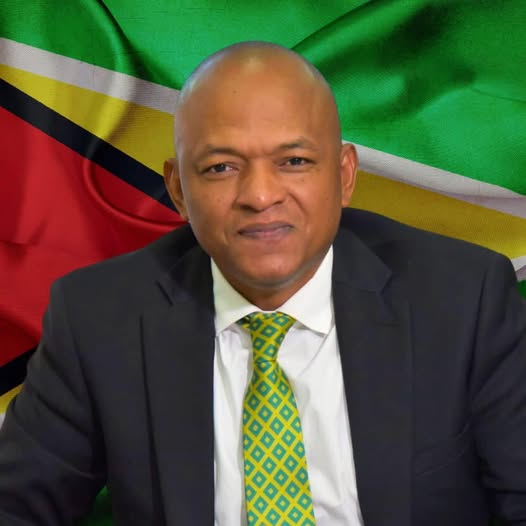
A Partnership for National Unity (APNU) Member of Parliament Sherod Duncan is pressing the government to account for police disciplinary safeguards, unanswered calls to police stations, public surveillance systems and the performance of essential services, using parliamentary questions to demand specific information on how public institutions exercise their authority and deliver services.
Duncan said he has submitted 13 questions on notice to the National Assembly across four batches, seeking answers on issues ranging from investigations involving senior police officers to housing allocation, water quality, electricity infrastructure and emergency response.
Among the most sensitive is an oral question submitted on October 16 to the Minister of Home Affairs, seeking clarification on the legal authority for placing a Deputy Commissioner of Police on administrative leave or restricting the officer’s operational duties.
Duncan is also asking whether disciplinary powers have been formally delegated in writing, whether investigators can access relevant records and personnel, and what safeguards protect complainants and witnesses during investigations.
The questions are framed around the procedures and safeguards governing investigations, rather than the merits of any criminal allegation.
“It expressly avoids asking the Minister to comment on the merits of any criminal allegation,” Duncan said of the oral question.
A separate written question seeks the implementation status of a proposed system for tracking unanswered calls to police stations and whether performance indicators will be made public.
The question seeks to establish whether police response to calls for assistance is being monitored and whether the proposed tracking system has been implemented. Duncan’s statement does not specify how many calls go unanswered or confirm whether the system is operational.
Parliamentary review forces changes to police question
Duncan’s original oral question underwent procedural changes after the Clerk’s office, on October 20, requested the removal of two sections before forwarding it to the Speaker.
According to Duncan, the office ruled that one section—asking how the absence of a constituted Police Service Commission affected the exercise of authority—sought the minister’s opinion, contrary to Standing Order 20(1)(j).
A second section, which asked about progress in reconstituting the commission, was deemed to concern a matter on the agenda of the Parliamentary Standing Committee on Appointments, which is responsible for nomination mechanisms.
Duncan agreed on October 21 to delete both sections and renumber the remaining questions. He said the revisions retained the substantive requests for information on the exercise of police authority, access to investigative material and protections for those involved in investigations.
Wider scrutiny of government performance
The police questions form part of a broader parliamentary effort by Duncan to obtain details on government policies, public spending and service delivery.
A September 29 submission covered admissions and immigration status under the Guyana–United States Migration Cooperation Framework, Guyana Power and Light’s generation capacity and infrastructure, the new Amerindian Hostel, and housing delivery in Region Ten.
Three questions submitted on October 7 focused on public-security cameras, including the number of cameras by region, contract details, data storage and retention, authorised access and oversight. They also sought information on the deployment and results of the Safe Country initiative.
On October 21, Duncan submitted three further written questions concerning the Central Housing and Planning Authority’s procedures for identifying housing lots, confirming boundaries and reviewing enforcement action; Guyana Water Incorporated’s water access, treatment, reliability and quality; and the Guyana Fire Service’s hydrant readiness, fire prevention and emergency-response performance.
Together, the submissions seek information on systems that affect residents’ safety, property rights, access to utilities and the use of public resources.
Duncan said the purpose was to obtain clear answers through Parliament and determine whether the systems intended to protect and serve residents were producing measurable results.
“My purpose is to obtain clear answers through the parliamentary process on public safety, public expenditure and essential services.”
The questions now place several government ministries and public agencies under parliamentary scrutiny, with answers expected to clarify the safeguards, procedures and performance standards governing their operations. Whether those responses provide specific, measurable information on accountability and service delivery remains to be seen.