OCTOBER is Breast Cancer Awareness Month, a global opportunity to raise awareness of breast cancer and call for action to improve access to timely diagnosis and quality care.
The THEME “Every Story is Unique, every Journey Matters” recognizes that every experience of breast cancer is different.
Behind every diagnosis is a person, a family, and a unique journey. People may face different challenges depending on their diagnosis, treatment, support networks, and access to care.
Every person affected by breast cancer deserves to be SUPPORTED and treated with DIGNITY. And everyone, wherever they live, should have access to the care they need.
BREAST CANCER is the MOST COMMON cancer among WOMEN IN 2024:
2.4 Million Women were diagnosed with breast cancer WORLDWIDE.
694 000 Women DIED from the disease.
8.2 Million Women were LIVING with breast cancer at the end of the year 2024.
Breast cancer occurs in EVERY COUNTRY and can affect women at any age after puberty, with incidence increasing later in life. Around 80% of breast cancers occur in women with no specific risk factors other than sex and age.
While breast cancer outcomes have improved in many countries, major inequalities remain. Access to early diagnosis and effective treatment can vary significantly, contributing to significant differences in survival between countries.
Breast cancer remains a MAJOR GLOBAL HEALTH Challenge. Breast cancer was the most common cancer in women in 164 of 186 COUNTRIES in 2024. It occurs in every country and can affect women at any age after puberty, with rates increasing later in life. We must act to detect breast cancer earlier, provide timely diagnosis and ensure access to quality treatment and care.
Know YOUR RISK. Certain factors increase the risk of breast cancer, including increasing age, obesity, alcohol use, family history of breast cancer, history of radiation exposure, reproductive history, and tobacco use. However, approximately 80% of breast cancers develop in women who have no modifiable breast cancer risk factor other than being female and increasing age. Most women diagnosed with breast cancer do not have a known family history of the disease. Knowing your risk can help you make informed choices and seek care when needed.
Know THE SIGNS. For women of all ages, it is important to be aware of changes in the breasts and to seek medical advice if something seems unusual. Signs can include a breast lump or thickening, changes in the size or shape of the breast, changes in the skin or nipple, or abnormal or bloody fluid from the nipple. For women in age groups where mammography screening is recommended, a mammogram may be recommended in health care settings with adequate screening services. Knowing the signs, being breast health aware and seeking care promptly can help support timely diagnosis and treatment.
We can SAVE LIVES. Countries MUST ACT. ALL countries should aim to reduce breast cancer mortality by 2.5% per year, putting the world on track to avert 2.5 million breast cancer deaths by 2040. This is feasible by providing breast cancer services as part of the essential benefit package for universal health coverage and making them available in public facilities. With the right policies, services and investment, countries can reduce breast cancer deaths and improve survival.
Where you LIVE SHOULD NOT determine whether you survive. Major inequalities in breast cancer survival persist around the world. 41% of women in low-income countries are expected to survive at least five years after a breast cancer diagnosis, compared with 87% in high-income countries. Around 70% of breast cancer deaths occur in low- and middle-income countries, where access to early detection, timely diagnosis and comprehensive treatment remain more limited. Everyone everywhere should have an equal chance to survive breast cancer.
Keep TALKING. Keep SUPPORTING. Keep ACTING. Advocate, contribute and act to empower and support people affected by breast cancer. Every story is unique. Every journey matters. No one should face breast cancer alone.
FEBRUARY
MARCH
APRIL
MAY
JUNE
JULY
AUGUST
SEPTEMBER
OCTOBER
NOVEMBER
CONTEXT: Breast cancer occurs in every country, affects women at any age after puberty, incidence increasing later in life. ∼80% occur in women with NO specific risk factors other than sex and age. Outcomes improved in many countries, but major inequalities remain. Access to early diagnosis & effective treatment varies, causing large survival differences.*
SWOT
W – WEAKNESSES (Internal Gaps)
O – OPPORTUNITIES (What we can do)
T – THREATS (External Risks)
MY RECOMMENDATION:
1. FINDING IT EARLIER – Before IT IS Deadly
2. UNDERSTANDING CANCER – The Blueprint
3. CREATING NEW DRUGS – FASTER CURE SEARCH
4. PERSONALIZED CURE – Not One-Size-Fits-All
5. CLINICAL TRIALS & EQUITY
LIMITATIONS – TRUTH:
MY VISION :
Bottom Line: AI/SI = Most powerful TOOL humanity ever had to END cancer’s inequalities and accelerate cures. It WILL NOT replace MEDICAL ONCOLOGISTS – IT supercharges them.
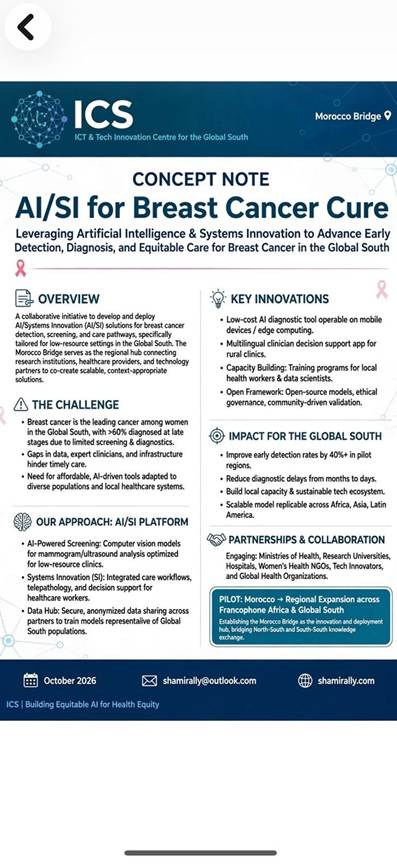
CONCEPT NOTE
1. VISION
2. RATIONALE
3. STRATEGIC OBJECTIVES
4. FOUR PILLARS
5. GOVERNANCE
6. FLAGSHIP PROGRAMMES (12-Month)
7. SUSTAINABLE FUNDING
8. EXPECTED IMPACT
Next Step: Stakeholder validation workshop in Rabat + Detailed business plan.
Contact: Dr. Shamir Andrew Ally, NEW YORK – ICS
The initiative aims to achieve three targets:
Achieving these targets requires action across the cancer care pathway – from health promotion and early detection to timely diagnosis, comprehensive treatment, and supportive care.
Listen and support : Recognize that every person’s experience of breast cancer is different and ensure that people affected by the disease are supported throughout their journey.
Improve access: Work to remove barriers to early diagnosis and quality treatment, particularly for people living in settings where access to care is limited.
Health PROFESSIONALS can support EARLY DETECTION, timely DIAGNOSIS, and high-quality CARE.