For Guyana’s Hinterland and Food Security Push
SWOT for Solar-Powered Cold Storage Units for Rural Farmers — Guyana Model
THE PROJECT
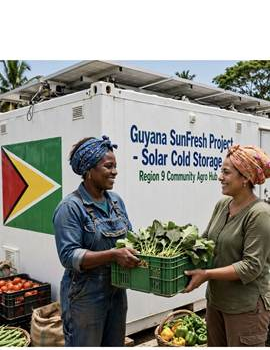
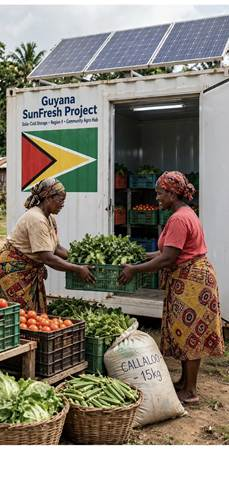
CONTAINERISED, OFF-GRID SOLAR COLD ROOMS (5–10 MT) placed in Regions 1, 2, 3, 8, 9 and 10 to store perishable vegetables, fruits, fish and cassava—reducing the estimated 40% post-harvest spoilage that never reaches Georgetown, Stabroek, Bourda, Lethem, Mon Repos, Plaisance, Buxton and Mahaica markets.
SWOT ANALYSIS
STRENGTHS
Solar Advantage: Guyana receives approximately 5.5–6 kWh/m²/day of solar radiation, making solar power suitable for off-grid applications.
Massive Need: An estimated 30–45% of some perishable produce, including tomatoes, leafy greens and mangoes, can spoil before reaching markets.
Low Operating Cost: No diesel is required, potentially reducing operating costs and supporting an estimated 18–24-month payback period.
Policy Alignment: Supports Guyana’s LCDS 2030 and CARICOM’s 25×25 Food Import Reduction initiative.
Empowers Women Farmers: Strengthens income opportunities for women who form a significant part of Guyana’s agricultural base.
WEAKNESSES
High Upfront CAPEX (Capital Expenditure): Approximately US$25,000 per unit.
Technical Maintenance in the Interior: Requires trained Toshaos, technicians and local maintenance capacity for batteries, inverters and refrigeration systems.
Roads and Logistics: Cold storage alone cannot resolve transportation challenges, particularly during the rainy season.
Limited Cold-Chain Culture: Many farmers remain accustomed to harvesting and selling produce on the same day.
OPPORTUNITIES
Oil and Gas Fund Linkage: Explore use of the Natural Resource Fund and Ministry of Agriculture resources to establish a 100-unit pilot programme, creating a visible food-security initiative.
IsDB, IDB and FAO Financing: The project could potentially fit climate-smart agriculture and food-security financing programmes.
Guyana/Kuwait Solar Technology Transfer: Explore technical cooperation with the Kuwait Institute for Scientific Research (KISR).
Cooperative Model: The Guyana Marketing Corporation and Regional Democratic Councils could manage the facilities, with farmers paying a modest fee per crate.
Export Potential: Improved storage could allow surplus produce to reach Trinidad and Tobago, Suriname, Barbados and other CARICOM markets.
THREATS
Competition for Funds: Oil and gas development could continue to dominate public investment priorities.
Battery Theft/Vandalism: Remote installations may require enhanced security measures.
Import Duties on Solar Components: Duties could increase project costs if concessions are not provided.
Political Five-Year Cycle: The programme requires institutional continuity beyond a single Government administration.
Proposal Title
Guyana SunFresh: 100 Solar Cold Hubs for Hinterland Farmers
PILOT — 10 UNITS
- Mabaruma: 2
- Bartica: 2
- Lethem: 2
- Mahdia: 1
- Parika: 2
- Linden: 1
STRUCTURE
The Government of Guyana/Ministry of Agriculture provides land and financing for the units.
University of Guyana and GTI engineering students participate in construction, technical training and maintenance.
The Guyana Marketing Corporation (GMC) manages the programme in partnership with Regional Democratic Councils and farmers’ cooperatives.
Proposed fee: GYD 500 per crate per day to support maintenance and operations.
Public Concept Note to the Government of Guyana / Ministry of Agriculture
Guyana SunFresh: 100 Solar-Powered Cold Storage Hubs for Hinterland Farmers
1. PROJECT
University of Guyana and GTI engineering students would participate in building off-grid solar cold-storage units for rural farmers, reducing the volume of harvested produce that spoils before reaching markets.
Guyana faces a significant post-harvest challenge. An estimated 30–45% of tomatoes, leafy greens, mangoes, fruits and fish can spoil before reaching Georgetown, Lethem or CARICOM markets because of inadequate cold-chain infrastructure and unreliable electricity in some locations.
The initiative aligns with Guyana’s Low Carbon Development Strategy (LCDS) 2030 and CARICOM’s 25×25 Food Import Reduction Target.
2. OBJECTIVE
Deploy 100 containerised, 5–10 metric-ton solar cold rooms in farming clusters to reduce post-harvest losses, increase farmer income and strengthen opportunities for women farmers.
The proposed target is to reduce post-harvest loss from approximately 40% to below 5% in participating clusters.
3. THE GUYANA MODEL
Unit: 20-foot insulated container + 6kW solar array + battery bank + 5–10 MT cold room operating between 0°C and 10°C.
Made in Guyana: University of Guyana and GTI engineering students participate in construction and maintenance, creating practical skills-transfer opportunities rather than relying entirely on imported technical expertise.
Ownership: Regional Democratic Councils, Guyana Marketing Corporation and farmers’ cooperatives.
Fee Model: GYD 500 per crate per day to support affordable access and maintenance.
Pilot Locations: Mabaruma (2), Bartica (2), Lethem (2), Mahdia (1), Parika (2) and Linden (1).
4. IMPLEMENTATION — 12 MONTHS
Phase 1 — Months 1–3: Feasibility assessment, financing arrangements and duty waiver for solar equipment.
Phase 2 — Months 4–8: Construction of 10 pilot units through UG/GTI workshops, with potential technical input from KISR.
Phase 3 — Months 9–12: Deployment, training of Toshaos and women farmer groups, and monitoring using IoT temperature sensors.
5. COST
Pilot — 10 units: Approximately US$250,000, or US$25,000 per unit.
Full 100-unit programme: Approximately US$2.2 million.
Projected payback: 18–24 months through user fees and reduced spoilage, subject to validation through a detailed feasibility study.
6. EXPECTED IMPACT
Food Security: Reduce post-harvest losses and improve the availability of locally produced food.
Farmer Income: Increase marketable production and reduce losses for participating farmers.
Women’s Economic Participation: Expand income opportunities for women farmers and producer groups.
Green Jobs: Create opportunities for young technicians in solar, refrigeration, electrical systems and cold-chain management.
Lower Emissions: Reduce dependence on diesel-powered refrigeration in off-grid communities.
Regional Trade: Improve Guyana’s ability to supply domestic and CARICOM markets with more consistent volumes of fresh produce.
Conscience Value: Food security as peacebuilding.
7. WHAT IS REQUESTED
a) Endorsement from the Ministry of Agriculture, GMC and farmers’ organisations for pilot sites.
b) Government financing or blended financing under climate-smart agriculture and food-security programmes.
c) Duty-free concessions for eligible solar and cold-chain equipment.
THREE KEY SILOS
1. Oil Fund Governance
Use Guyana’s new financial resources transparently to strengthen long-term food security.
2. Solar Cold-Chain Logistics
Build the infrastructure needed to reduce post-harvest losses and connect rural farmers to markets.
3. Tree Planting as Cooling Security
Expand tree planting and agroforestry as part of climate resilience and agricultural protection.
GLOBAL CLIMATE RESISTANCE PLATFORM
The proposed GCRP Corridor could connect agricultural communities from the Corentyne to the Rupununi, creating a stronger food-production and distribution corridor serving Guyana, Brazil, CARICOM and potentially wider international markets.
Motto: “Every Tree Planted Saves Heat.”
CONCLUSION
The Guyana SunFresh concept links renewable energy, agriculture, youth skills development, women’s economic participation and food security.
With conscience comes a peaceful world—and food security.