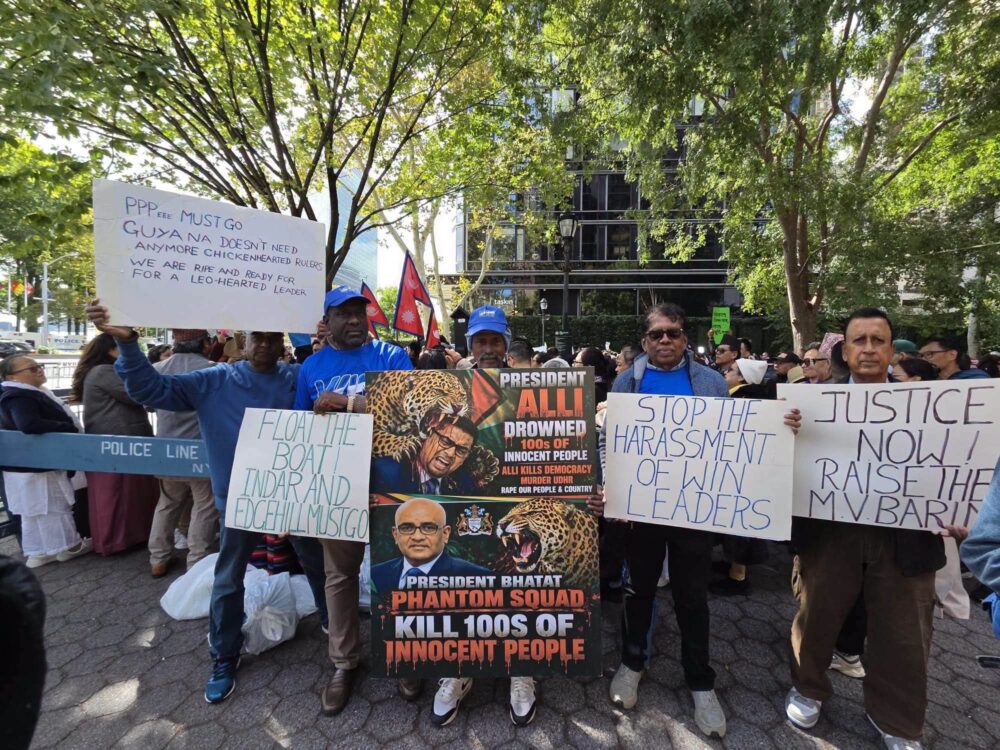
President Irfaan Ali’s call before the United Nations for a world where “law restrains power” and where prosperity does not deepen inequality was met with a pointed challenge from We Invest in Nationhood (WIN), whose New York chapter took its protest directly to the streets of Manhattan and Queens on Thursday.
WIN members and supporters protested outside the United Nations in Manhattan on September 24 as Ali attended the 81st UN General Assembly. Later that evening, protesters confronted the President again during his visit to Jericho Place Banquet Hall in Queens, turning his international message into a domestic accountability test.
The protests centred on a question running through WIN’s statement: do the principles Ali champions on the world stage apply equally to Guyanese at home?
Ali told the UN that “there can be no enduring prosperity where inequality deepens” and called for a world “where law restrains power.” He also declared:
“Development must not merely make our economies richer; it must make our societies better.”
WIN seized on those words, arguing that they should not stop at the doors of the United Nations.
“Those principles must apply in Guyana too.”
The party said its protests were intended to demand answers on what it identified as seven areas of concern: political persecution, poverty and the cost of living, democracy and human rights, judicial independence, political interference in policing, corruption and accountability, and the MV Barima tragedy.
Political rights and institutional independence
WIN accused the Government of escalating political persecution against Opposition Leader Azruddin Mohamed, Opposition MPs, staff, supporters and people associated with them.
“No Guyanese should lose a job, licence, livelihood or rights because of political association.”
The party also demanded protection of the rights to “speak, dissent, organise, associate and participate politically,” while insisting that judges and magistrates must be able to perform their duties without “threats, intimidation, retaliation or political pressure.”
It further called for the Guyana Police Force to perform its lawful duties “professionally and independently.”
The demands come amid continuing political tensions surrounding Mohamed and other Opposition figures, including the September 3 police interception of vehicles near President Ali’s private residence following reported concerns about unauthorised drone activity. Mohamed was detained and later released, while the police investigation continued.
Wealth versus lived reality
WIN also challenged the Government’s presentation of Guyana’s economic transformation, citing an Inter-American Development Bank figure that 58 per cent of Guyanese live in poverty, 32 percent in abject poverty. Local analysts believe the figures to be much higher given poor data gathering techniques and fear of political reprisal.
The party argued that extraordinary economic growth must translate into “better lives and greater economic security for ordinary Guyanese.”
That challenge came as Ali used his UN address to promote Guyana’s development record, including health care, education, housing, infrastructure and financing for small and medium-sized enterprises.
“RAISE THE BOAT!”
The most emotionally charged demand concerned the MV Barima, which capsized and sank on July 18 with a major loss of life.
WIN’s message was blunt:
“RAISE THE BOAT! Recover the vessel, establish the full truth, preserve the evidence, hold those responsible accountable and properly compensate affected families.”
The Government has established an independent Commission of Inquiry with a mandate to establish the facts and sequence of events, determine the causes of the disaster, identify failures and recommend accountability and reforms.
Three men have also been charged with murder in connection with the disaster, according to the Director of Public Prosecutions.
WIN nevertheless says the families and the wider public are entitled to full answers.
“We demand accountability, equal treatment, independent institutions, judicial independence, respect for human rights, an end to political victimisation, and justice for the families of the MV Barima.”
The significance of Thursday’s demonstrations extended beyond the physical protests. WIN deliberately placed Ali’s own words back before him, arguing that the standards he invoked before the international community should be measurable in Guyana itself.
The party’s closing message was direct:
“The principles proclaimed before the world must also be upheld at home.”