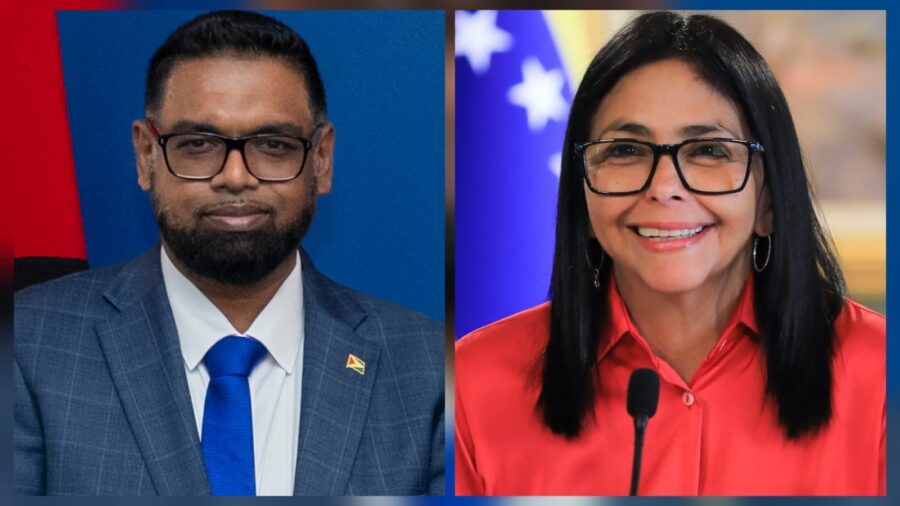
President Irfaan Ali and Venezuela’s acting President Delcy Rodríguez used the United Nations General Assembly this week to advance sharply different approaches to settling the Guyana-Venezuela border controversy, with Rodríguez calling for a return to bilateral negotiations and Ali insisting that the International Court of Justice (ICJ) process should be respected.
Rodríguez made Venezuela’s position first, addressing the 81st session of the UN General Assembly on Wednesday, September 23, 2026, in New York. She reaffirmed Caracas’ claim to the Essequibo region and appealed to Guyana to return to negotiations under the 1966 Geneva Agreement.
“Here, I appeal to the Cooperative Republic of Guyana to resolve the issue and to return to negotiations, as stipulated by the Geneva Agreement.”
Rodríguez argued that direct negotiations offered a more durable basis for settlement than decisions imposed by external institutions.
“Agreements which last the longest are those that emerge from bilateral negotiations. They last longer and function better than those imposed by external bodies.”
Her intervention came as the ICJ prepares to rule on Guyana’s case concerning the validity of the 1899 Arbitral Award, which Guyana maintains established the final international boundary between the two countries.
Less than 24 hours later, Ali addressed the General Assembly on Thursday, September 24, presenting Guyana’s position that the controversy has already entered the judicial phase after decades of efforts to resolve it through bilateral and United Nations-supported mechanisms.
Ali urged Venezuela to accept the forthcoming ICJ ruling, saying Guyana would do the same.
“Now that we have both participated in the hearings which were completed in May 2026, we urge Venezuela to abide by the forthcoming ruling in accordance with their obligation under the UN Charter, as Guyana will do.”
Ali stressed that Guyana’s resort to the World Court was not its first choice.
“Recourse to the ICJ came after decades of efforts to resolve the controversy bilaterally, including through a mixed commission and the Good Offices of the UN Secretary General.”
He also reiterated Guyana’s position that the 1899 Arbitral Award itself described the settlement of the land boundary as “full, perfect, and final.”
The contrasting presentations highlight the fundamental divide between Georgetown and Caracas.
Guyana’s position is that previous efforts to settle the controversy failed, the matter was referred to the ICJ under the framework of the Geneva Agreement, and both countries have participated in the court proceedings. The substantive hearings concluded in May 2026, leaving the parties awaiting the court’s judgment.
Venezuela’s position is that the Geneva Agreement remains the basis for a negotiated settlement and that the controversy should be resolved through direct talks rather than an external judicial determination.
The ICJ has already ruled that it has jurisdiction to hear Guyana’s case, which was filed after the UN Secretary-General referred the controversy to the court under the Geneva Agreement.
Ali nevertheless used his UN address to look beyond the legal proceedings, saying Guyana wants a new relationship with its neighbour once the controversy is settled.
“We look forward to a new era of neighbourly relations in the interest of our peoples, the development of our countries and the stability and prosperity of our region.”
The two UN addresses therefore underscored rather than narrowed the diplomatic divide: Rodríguez called Guyana back to the negotiating table on September 23, while Ali, speaking on September 24, called for Venezuela to respect the forthcoming judgment of the World Court.