By Mark DaCosta- In the wake of the March 2020 General and Regional Elections, Guyana plunged into a period of intense political and legal upheaval, with allegations of electoral fraud dominating the national landscape. The APNU/AFC coalition, led by then-President David Granger, challenged the election results and the subsequent recount process, asserting that the People’s Progressive Party/Civic (PPP/C) had orchestrated a scheme to secure its return to power.
The coalition’s claims eventually crystallised into two formal petitions filed with the High Court: Petition 99 of 2020, which focused on allegations of electoral fraud, and Petition 88 of 2020, which challenged the legality of GECOM’s national recount.
Petition 99: Allegations of Widespread Fraud
At the forefront of Petition 99 was the A Partnership for National Unity and Alliance for Change’s (APNU+AFC) contention that extensive irregularities had tainted the electoral process. The coalition described what it called a “sophisticated design of fraudulent activities” and sought judicial redress.
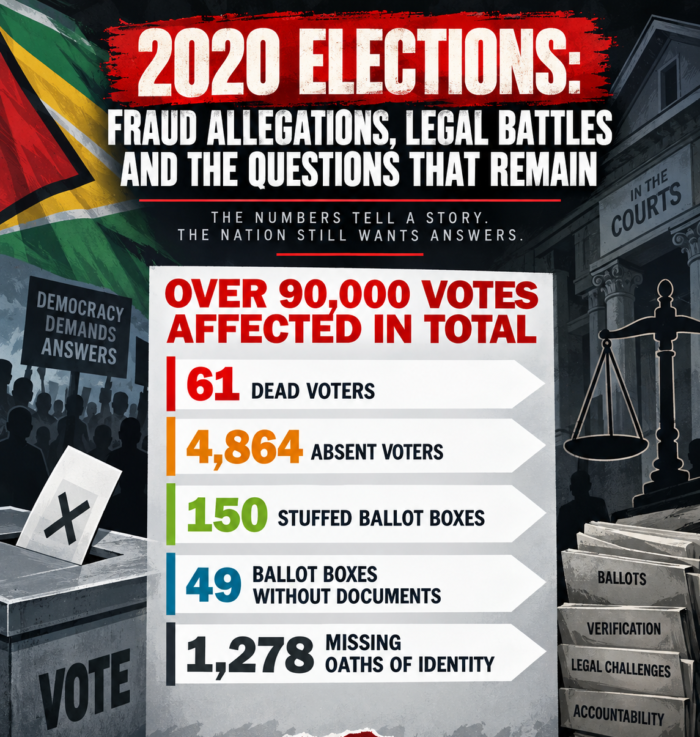
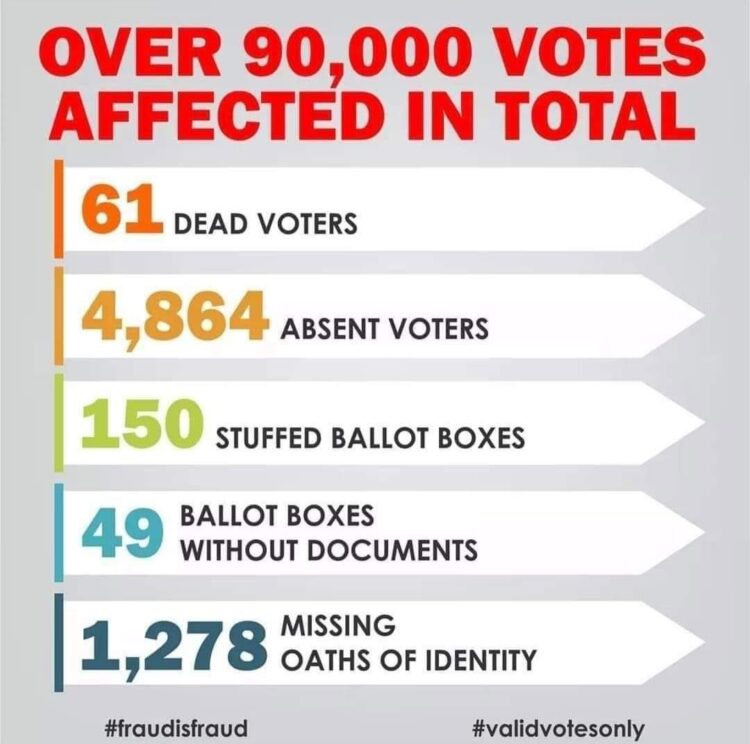
The petition, spearheaded by Monica Thomas and Brennan Nurse, alleged that the elections were unlawfully conducted because of widespread fraud. Among the claims was voter impersonation, including allegations that deceased persons had been recorded as voting. The petitioners cited 41 alleged “dead votes” in various electoral districts.
They also highlighted documentation discrepancies, claiming that hundreds of polling stations were without essential election documents, including official Poll Books used to record activities on polling day. They cited 617 instances in which Oaths of Identity were reportedly missing.
The coalition further alleged ballot tampering, including claims that ballots marked for APNU/AFC were found inside PPP/C envelopes. It also pointed to instances in which multiple ballots allegedly carried the same counterfoil security numbers, which the petitioners said breached GECOM’s security procedures.
Another allegation concerned what the coalition described as “cross-regional voting,” claiming that votes cast for APNU/AFC in one administrative region were found in ballot boxes from other regions.
These claims were allegations advanced by the petitioners and were not ultimately adjudicated on their merits in Petition 99.
Petition 99 Dismissed on Procedural Grounds
The legal challenge surrounding Petition 99 was halted by a procedural issue.
On January 18, 2021, Chief Justice Roxane George-Wiltshire dismissed the petition after determining that David Granger, a necessary respondent, had not been served within the required statutory period. The petition was filed on September 15, 2020, but Granger was not served until September 25, four days after the September 21 deadline. The Chief Justice consequently ruled the petition a nullity.
The coalition appealed, but the matter ultimately reached the Caribbean Court of Justice after the PPP/C challenged the Court of Appeal’s jurisdiction.
In October 2022, the CCJ ruled that the Guyana Court of Appeal lacked jurisdiction to hear the appeal from the dismissal of Petition 99. As a result, the substantive allegations of electoral fraud contained in the petition were never tested through a full trial.
Petition 88: The Battle Over the Recount
The APNU+AFC coalition then continued its challenge through Petition 88, filed by Claudette Thorne and Heston Bostwick.
Unlike Petition 99, which focused heavily on allegations of fraud, Petition 88 challenged the constitutional and legal basis of the national recount conducted after the March 2 elections.
The petitioners argued that GECOM’s Order No. 60 was unconstitutional and violated Section 22 of the Election Laws (Amendment) Act, as well as the principle of separation of powers. They maintained that GECOM had exceeded its lawful authority in initiating the recount and sought to have the recount results invalidated and the earlier declarations reinstated.
GECOM had issued Order No. 60 in May 2020 to facilitate a national recount of ballots from all 10 electoral districts. The order established procedures intended to make the process transparent, including observation and documentation of the recount.
During the recount, APNU/AFC representatives reported numerous alleged irregularities, including missing Oaths of Identity, missing Poll Books, unstamped ballots and ballots found in envelopes associated with another party.
On April 26, 2021, however, Chief Justice George-Wiltshire dismissed Petition 88. The court concluded that GECOM had acted within its constitutional authority and that there was no breach of the Constitution or electoral law that would invalidate the election or recount.
The Court of Appeal subsequently upheld the High Court’s decision.
A Dispute That Continues
Despite the legal setbacks, the APNU/AFC coalition has continued to maintain that the 2020 elections were fundamentally flawed and that electoral misconduct contributed to the PPP/C’s victory.
The distinction between the two petitions remains important. Petition 99 was dismissed on procedural grounds, meaning its substantive fraud allegations were never adjudicated. Petition 88, however, received a substantive judicial determination, with the courts upholding the legality of GECOM’s recount process.
The allegations nevertheless continue to feature in Guyana’s political debate. In statements made as recently as September 2026, General Secretary Sherwain Benjamin asserted that ongoing criminal proceedings involving former GECOM officials and APNU members were revealing irregularities connected to the 2020 elections. He called for accountability from the PPP/C and argued that persons allegedly involved in electoral misconduct should also face prosecution.
Village Voice News wishes to emphatically state that Mr. Benjamin’s remarks regarding a sub judice matter do not necessarily reflect the views of this publication.
The continuing dispute over the 2020 elections underscores the importance of transparent electoral procedures, effective oversight and public confidence in Guyana’s democratic institutions. Five years after the elections, the legal record contains both judicial findings on the recount and fraud allegations that were never examined on their merits.
The controversy surrounding the 2020 elections therefore remains an important part of Guyana’s political history, while the distinction between allegations, evidence considered by the courts, and matters never judicially determined remains essential to understanding what occurred.