by Randy Gopaul
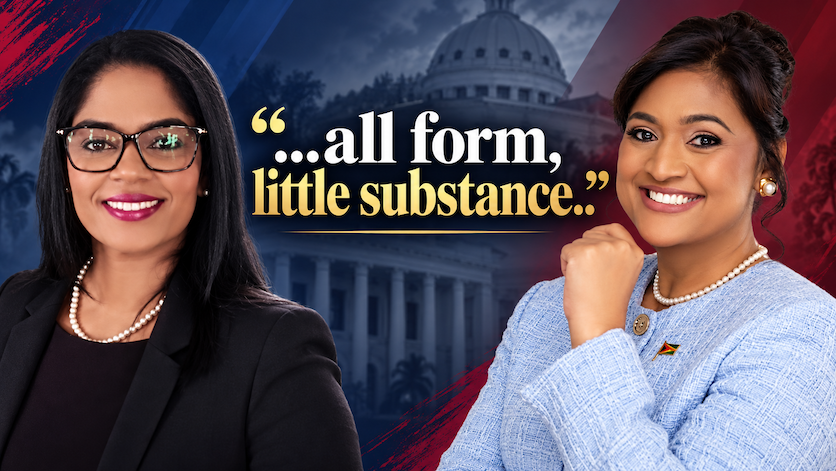
The whispers are getting louder. Priya Manickchand and Sonia Parag are being positioned as the PPP’s presidential candidates for 2030. But behind the carefully curated photo-ops and PR parades lies a far less flattering reality — and the real choice may not be either of them.
Something curious is happening in Guyanese politics. Two ministers; Priya Manickchand and Sonia Parag, are suddenly everywhere. Their social media pages read less like government communications and more like campaign brochures for a beauty pageant. Every school visit, every community walk, every ribbon-cutting is documented, packaged, and pushed out with the precision of a public relations firm working overtime.
The message is unmistakable: these two women are being groomed for something bigger. The presidency in 2030, if the whispers are to be believed. But scratch beneath the polished surface, and a far less flattering picture emerges.
Sonia Parag, the Minister of Education, has made schoolchildren her brand. Not a week passes without her appearing in a classroom, surrounded by smiling students in uniform, handing out books, cutting ribbons on new facilities, or delivering motivational speeches. The optics are flawless. The timing is deliberate.
Many of those children will be first-time voters in 2030. Yet behind the choreography lies a system in crisis. Guyana’s schools are failing. Assessment results, when they are released at all, paint a grim picture of stagnating literacy, poor numeracy, and widening achievement gaps. Reports are delayed, massaged, or quietly buried. The Ministry of Education has become a machine for managing perceptions rather than delivering outcomes.
Parag inherited this mess, but she has done little to fix it. Instead, she has mastered the art of being seen. Being seen with children. Being seen at events. Being seen caring. It is a cynical calculation: if you cannot improve the system, at least make sure the future voters remember your face.
Priya Manickchand and the Portfolio She Lost
Priya Manickchand knows the education file intimately, because she had it taken away from her. As Minister of Education, Manickchand had every opportunity to reform a system crying out for change. She had the time, the resources, and the political cover. What she delivered was mediocrity. Student performance remained flat. Reform promises evaporated. When the portfolio was finally stripped from her, officially described as a “cabinet reshuffle”, insiders knew the truth: it was a verdict on her failure.
In a strange way, losing the education ministry may have been a blessing in disguise. It freed her from a portfolio where her limitations were on full display. Rebranded as Minister of Local Government, she now tours communities, measures drains, and comforts grieving families after tragedies like the MV Barima disaster. These are legitimate duties. But they are also convenient stagecraft, opportunities to look competent without being tested on substance.
The Real Contest Behind the Curtain
The conventional narrative holds that Sonia Parag is President Irfaan Ali’s preferred successor, while Priya Manickchand is Bharrat Jagdeo’s candidate. It is a neat story, the two titans of the PPP each backing their own horse in a genteel race for the future.
But anyone who knows anything about Bharrat Jagdeo knows that he is not a man who plays straight. He is, by reputation, outrageously duplicitous, a political operator who keeps his true intentions buried beneath layers of misdirection. The idea that he has genuinely committed to Manickchand as his successor is, to put it mildly, questionable.
The word among those who watch closely is that Jagdeo’s real choice is someone else entirely: Ashni Singh.
Singh, the Minister of Finance, is not a charismatic figure. He does not tour schools or comfort flood victims for the cameras. But he knows where all the financial bodies are buried. He controls the purse strings of a country suddenly flush with oil money. In a political system where patronage and resource allocation are the true currencies of power, that makes him far more valuable than any amount of positive press.
If Jagdeo is playing a long game; and he always is, then Parag and Manickchand may simply be the visible pieces on the board, drawing attention while the real move is prepared in silence.
The Also-Rans
And what of the others?
Charles Ramson Jr., the Minister of Culture, Youth and Sport, is busy explaining why the Mabaruma sports hall project needs to be re-tendered. It is the kind of unglamorous work that wins no headlines and builds no presidential brand.
Anil Nandlall, the Attorney General, is consumed by judicial appointments, constitutional reform, and the endless battle over social media legislation. He is a legal technician in a political game that rewards performance, not precision.
Frank Anthony, the Minister of Health, labours in the trenches of HIV prevention and international cooperation, vital work, but hardly the stuff of presidential mythology.
None of them is being positioned. None of them is being photographed with schoolchildren. None of them is in the whispered conversations.
The Empty Spectacle
Here is the uncomfortable truth: the 2030 presidential race is being framed as a choice between two women who have not demonstrated the competence to fix the problems they now seek to inherit. One failed at education and was moved aside. The other is still failing at education and is being rewarded with a national profile.
The real decision will not be made on Facebook or in school courtyards. It will be made in the back rooms of the PPP, by men who have spent decades learning how to concentrate and wield power. If Bharrat Jagdeo is involved; and he always is, then the outcome will be determined by calculations that have nothing to do with public popularity and everything to do with who can be trusted to protect the interests of those who matter.
For ordinary Guyanese, the question is not who will be the next presidential candidate. It is why the pool of options is so shallow, and why a failing education system is being used as a backdrop for political theatre rather than treated as the national emergency it is.
A good number of the children in those photos with Sonia Parag will be voters in 2030. The question is whether they will be educated voters, or merely props in a show that was never about them.