The People’s Progressive Party/Civic administration has presided over a transformation in the scale of Guyana’s public spending since returning to office in August 2020.
Fueled by rapidly expanding oil revenues, government budgets have moved into territory previously unseen in Guyana. But alongside the roads, bridges, housing schemes and other projects is another story—one contained in the reports of the Auditor General: overpayments, procurement breaches, delayed projects, undelivered goods and billions of dollars in transactions for which auditors could not establish whether the state received value.
The question is increasingly unavoidable: as Guyana spends more than ever before, is it getting value for the money?
The Trillion-Dollar Spending Machine
The scale of the transformation is evident from the government’s financial records.
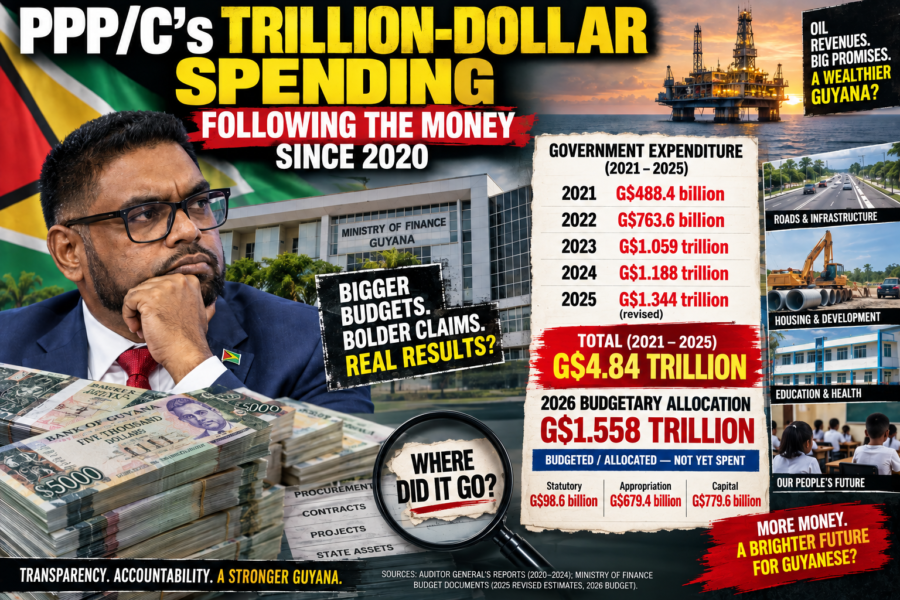
The Auditor General recorded G$615.2 billion in total expenditure in 2022, G$828.6 billion in 2023 and G$1.188 trillion in 2024 from the Consolidated Fund.
In 2024 alone, G$1.272 trillion was made available for expenditure, including G$551.6 billion in current expenditure and G$720.4 billion in capital expenditure. Actual expenditure was G$1.1876 trillion.
And the spending trajectory has continued.
Budget 2026 projects central government expenditure of about G$1.5 trillion, with the full budget totaling G$1.558 trillion. The Public Sector Investment Programme accounts for G$779.6 billion, while non-interest current expenditure is projected at G$705.1 billion.
The government expects G$495 billion to be transferred from the Natural Resource Fund to the 2026 national budget, alongside projected carbon-credit inflows of G$49.7 billion.
These are extraordinary sums for a country of Guyana’s population.
But the Audit Trail Tells Another Story
The government’s spending record cannot be assessed simply by counting roads constructed or contracts signed.
The Auditor General’s reports provide a different measure: whether public money was properly accounted for and whether government received what it paid for.
In its 2024 report, the Audit Office examined 829 contracts valued at G$48.19 billion. It found overpayments totaling G$1.011 billion on 86 contracts administered by ministries and regional administrations.
Of that amount, G$902 million involved contracts executed under central government entities, including Public Works, Education, Health, Human Services, Agriculture, Home Affairs and the Guyana Defence Force. Another G$109.99 million involved regional contracts. The Auditor General reported that the amounts were subsequently recovered through repayments or contractors returning to complete outstanding works.
The findings do not establish that the overpayments were corrupt. They do, however, expose weaknesses in contract administration that become considerably more consequential when government expenditure reaches trillion-dollar levels.
The 2023 audit raised additional concerns.
The Auditor General reported breaches of the Procurement Act involving contracts undertaken by the Guyana Defence Force and the National Drainage and Irrigation Authority, while a Public Works contract experienced significant delays despite notices concerning poor performance.
Billions Without a Clear Paper Trail
Perhaps more troubling are the instances where auditors said they could not establish whether government received value for money.
In the 2023 audit report, 3,134 cheques totaling G$2.463 billion remained on hand when they should have been refunded to the Consolidated Fund.
There were also 149 payment vouchers totaling G$321.252 million that were not presented for audit. The Auditor General said this prevented it from determining whether value was received and whether the funds were used for their intended purposes.
A further 1,153 cheque orders totaling G$3.237 billion remained outstanding. Again, the Auditor General said it could not determine whether value had been received for all sums expended.
These are not allegations of theft. They are audit findings about accountability and documentation.
But they raise a fundamental question: how can citizens be confident that every dollar is producing the promised public benefit if auditors cannot always establish what was received?
Projects, Delays and Failed Deliveries
The audit record also illustrates the risks surrounding large infrastructure programmes.
In 2022, the Auditor General found that three contracts worth a combined G$176.5 million had been terminated because of poor contractor performance.
The audit also identified G$733.554 million in items that had not been delivered to three ministries. At the Ministry of Health alone, drugs and medical supplies worth G$725.499 million had been paid for but had not been received at the time of reporting.
The same report found that G$600.886 million had been paid for 12 drainage pumps, but 10 of the engines supplied were deemed undersized and incapable of operating the pumps over the long term. At the time of the audit, none of the 10 engines had been replaced.
These findings are particularly significant because infrastructure is at the heart of the government’s development strategy.
The Government’s Defence
The administration has repeatedly rejected allegations that its procurement system is inherently corrupt.
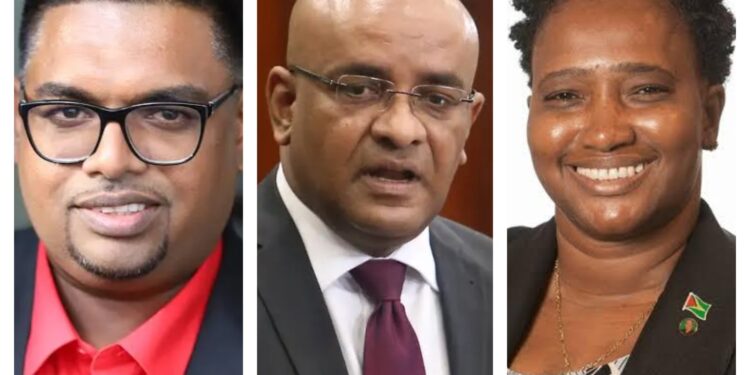
Vice President Bharrat Jagdeo has argued that contracts are being awarded through the procurement system and that records exist for scrutiny. In 2024, he said the government was examining procurement procedures and warned that officials who skirted procurement laws would face consequences.
The government also points to the thousands of contracts awarded to small and medium-sized contractors as evidence that economic opportunities are being spread more widely. In 2024, for example, 325 small contractors in Linden signed road-development contracts worth G$4.2 billion.
There are also major national projects: the government has signed contracts for the Demerara Harbour Bridge, Linden-Mabura Road and the Ogle-Eccles road link, among others.
The issue, therefore, is not whether Guyana is building.
It is whether the scale of spending is matched by the quality of oversight.
The $1.558 Trillion Test
Budget 2026 brings the issue into sharper focus.
The government plans to spend G$1.558 trillion, including G$779.6 billion on the Public Sector Investment Programme.
That means another enormous pool of public money will flow through ministries, agencies, contractors and suppliers.
For taxpayers, the real test will not be the size of the budget announcement.
It will be whether projects are completed on time, contracts are properly administered, procurement rules are followed, payments correspond to work actually delivered and every public dollar can be traced from the Consolidated Fund to its final destination.
Guyana’s oil wealth has given the government unprecedented financial power.
The Auditor General’s reports show why unprecedented spending must be accompanied by unprecedented scrutiny.
The question now is not simply how much money Guyana has spent.
It is where every dollar went—and what Guyana got for it.