

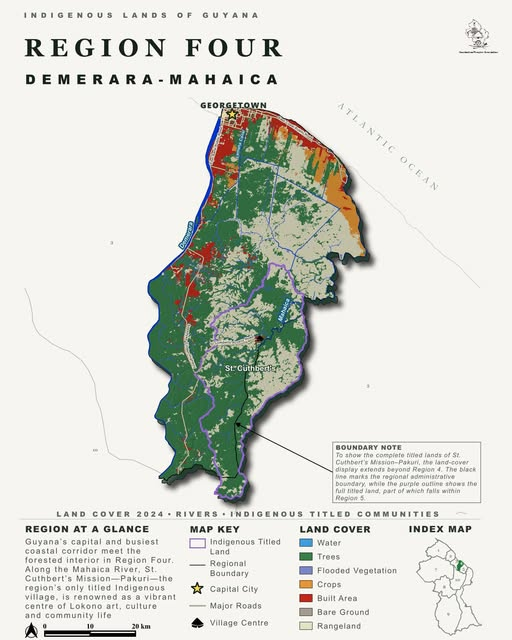
A little-known fact about Pakuri, better known as St Cuthbert’s Mission, is that the country’s only titled Indigenous community in Region Four actually stretches across two administrative regions.
The Amerindian Peoples Association (APA), in an update on its ongoing community outreach, said part of Pakuri’s titled lands lies in Region Five, even though the community itself is recognised as the only Indigenous village in Region Four.
Located along the Mahaica River, Pakuri is primarily home to the Lokono people and is one of Guyana’s best-known Indigenous communities. Its relative proximity to Georgetown has also made it an important centre for Indigenous culture and heritage.
The APA said Pakuri’s circumstances are notably different from those of many hinterland communities.
“Unlike several of the hinterland regions, where numerous Indigenous villages are spread across large territories, Pakuri is recognised as the only Indigenous village in the Demerara-Mahaica Region.”
But the community’s administrative geography is more complicated than its designation as a Region Four village might suggest.
“But many of you may not know that the village straddles two regions! Part of Pakuri’s lands falls within Administrative Region Five (Mahaica-Berbice). So if you didn’t know, now you know!”
The revelation highlights an important distinction between administrative boundaries and Indigenous land ownership in Guyana. While the country is divided into ten administrative regions for purposes of governance and public administration, Indigenous communities may hold titled lands extending across those regional boundaries.
Pakuri’s location and history have given it particular cultural significance. The community, historically known as St Cuthbert’s Mission, is associated with the Lokono nation and is frequently identified as a cultural centre because of its accessibility from the coast and Georgetown.
The APA’s latest update came as its outreach team moved from Region Three into Region Four after spending longer than initially planned in Region Three.
With characteristic humour, the organisation acknowledged the extended stay.
“We know we said we were overnighting in Region Three, but spent more than one night there. So, we will just pretend that it was just one long night.”
The APA then announced its move into Region Four and drew attention to Pakuri as a significant Indigenous community in the region.
“Today, we are moving on to Region Four, and we are sure many of us also know of the only titled Indigenous Community in the Region, Pakuri or commonly known as St Cuthbert’s Mission.”
The community’s lands crossing into Region Five means that, despite Pakuri’s recognition as Region Four’s only Indigenous village, its territorial footprint does not fit neatly within a single administrative boundary.
The detail is more than a geographical curiosity. It is a reminder that the history, land rights and territorial realities of Guyana’s Indigenous communities can extend beyond the administrative lines used to divide the country.


![Haitians deported from the US land in Cap-Haitien, Haiti, on August 27 [Ketlain Difficile/AP Photo]](https://villagevoicenews.com/wp-content/uploads/2026/09/haiti-75x75.webp)




