By Mark DaCosta- Our nation is once again plunged into darkness. Rolling blackouts across the country have left households sweltering and businesses counting losses, while the state power utility insists it can generate sufficient electricity. The uncomfortable truth, however, is that an economy touted as the fastest growing on earth is being let down by infrastructure that has not kept pace with prosperity. The question every Guyanese must ask is a simple one: after decades in office and billions of dollars in public spending, why does the grid still fail us?
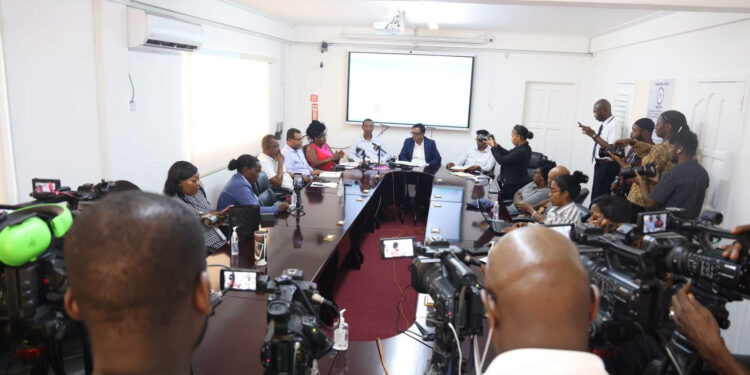
Officials of Guyana Power and Light convened a press conference at the company’s Kingston headquarters last Monday to explain the recent outages that have darkened homes from Saturday night into Monday morning and left Guyanese in unbearable heat. Their explanation was hardly comforting. “The reality is that the distribution system is now facing challenges,” the utility’s executive leader, Kesh Nandlall, conceded, noting that “feeders are now being overloaded, transformers are being taxed and overloaded,” leaving many consumers to endure voltage fluctuations.
The arithmetic is stark. A record 257 megawatts of electricity was demanded on September 4, against an installed capacity of just 265.6 megawatts — a razor-thin margin that leaves almost no room for error. Peak demand stood at 221 megawatts a year ago, and the customer base has ballooned from roughly 201,000 in 2020 to some 250,000 today. The strain is most acute between 7pm and 9pm, when families return home in the fierce El Niño heat and switch on air conditioners, fans and appliances simultaneously. Concrete houses absorb the day’s scorching heat and release it into the evening, Nandlall observed from personal experience, prompting everyone to reach for the switch at once.
The consequences are visible on the streets. “Most of our feeders are tripping right now because of overloading conditions,” said Deputy Chief Executive Officer Bharat Harjohn, explaining that the utility lacks any buffer. “We don’t have the spinning reserve in the system,” he admitted, meaning that when a generating unit trips or a fault occurs, there is precious little reserve power to step in.
His proposed remedy is a form of managed rationing: “We may have to take off an area to ensure it won’t affect all the customers in an area.” He expects the feeder situation to be eased by mid-October. Meanwhile, head of generation Gary Hall was blunt in his diagnosis: “We have capacity. It’s just the distribution network that is failing us at this point.”
The utility’s appeals to consumers have a distinctly familiar ring. Households are being urged to run air conditioners at 25 degrees Celsius rather than a frigid 16, since “for every degree you go up, you save 5 per cent consumption on that unit.” Those installing additional units are being asked to report the increased load. “So we are encouraging all our customers who are increasing their load to notify us,” Nandlall said.
Yet this is the same company that conceded it has not even contemplated compensating customers for the outages — even as its own officials trace Saturday’s blackout to a 35-megavolt-ampere transformer fault at the Kingston substation, and Monday morning’s disruption to a current spike on the Kingston–Vreed-en-Hoop submarine cable. “Now we are presently investigating that to get to the root of that spike in the system that would have caused the system to protect itself,” Nandlall said of the latter incident.
GPL points to a US800 million buildout — new substations, upgraded 30 and 69 kilovolt transmission lines and some 350 kilometres of new medium-voltage distribution — which engineering chief Ryan Ross described as the largest investment since the 1960s. “That will address the immediate problems that Bharat referenced with overloading of feeders,” Ross said, adding “we are doing it at a much higher specification.”
Reassuring as these figures sound, they invite a harder question. The government has budgeted some 69 billion for electricity in 2026 alone, the largest single-year allocation in our country’s history . Billions have flowed to GPL across successive administrations, yet the grid remains chronically fragile and incapable of providing a basic service. And the flagship remedy — the 300-megawatt Wales Gas-to-Energy project — has slipped repeatedly. First promised for December 2024, it is now expected to deliver simple-cycle power only by the end of this year, with full 300-megawatt completion not before mid-2027 .
An oil boom of this scale was never a surprise. Demand growth was entirely foreseeable, and upgrading feeders, transformers and reserve capacity should have been done years ago, not presented now as an urgent response. Telling citizens of the world’s fastest-growing economy to turn down their air conditioners to keep the national grid alive is to place the burden of administrative failure on the very people power is meant to serve. Our nation deserves a grid worthy of its wealth — not excuses, but light. Even people who depend on electricity and internet just to do basic work are helpless in the face of apparent administrative incompetence.