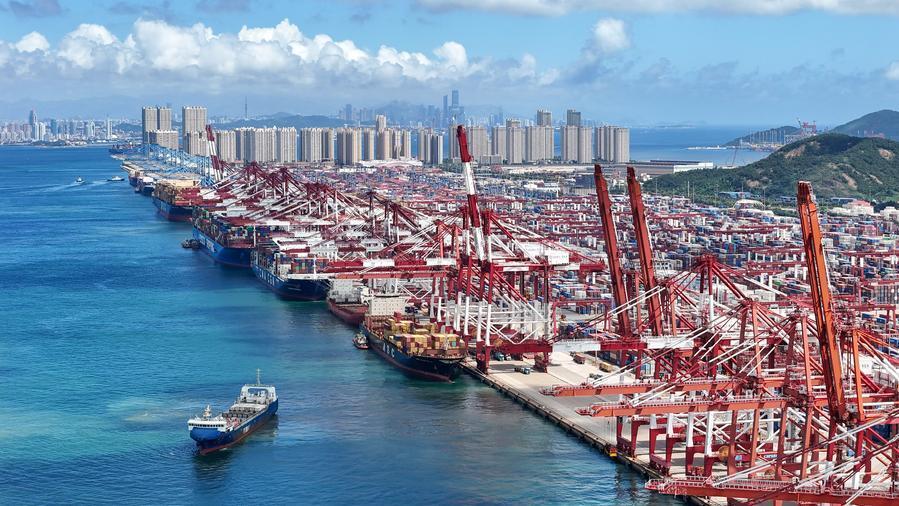
BEIJING, Sept. 8 (Xinhua) — China’s foreign trade maintained swift growth in the first eight months of 2026, with both exports and imports posting solid gains, and import growth continuing to outpace exports, official data showed on Tuesday.
The country’s total goods imports and exports rose 17.6 percent year on year to 34.78 trillion yuan (about 5.13 trillion U.S. dollars) in the January-August period, according to the General Administration of Customs (GAC).
The growth rate was 0.3 percentage points faster than that recorded in the first seven months of the year.
Exports increased 14.6 percent year on year to 20.17 trillion yuan, while imports expanded by 22 percent to 14.61 trillion yuan, the data revealed.
In August alone, China’s goods trade totaled 4.65 trillion yuan, up 19.8 percent from a year earlier and remaining above the 4-trillion-yuan mark for a sixth consecutive month.
Exports grew 18.6 percent year on year in August, while imports rose by 21.7 percent.
Both exports and imports registered double-digit growth for a fourth straight month, and import growth exceeded that of exports for a sixth successive month.
The strength of China’s exports has been underpinned by firm overseas demand, particularly for high-tech and artificial intelligence (AI)-related products.
In the first eight months of 2026, exports of mechanical and electrical products rose 21.9 percent to 12.91 trillion yuan, while exports of integrated circuits surged 95.4 percent year on year to 1.77 trillion yuan, GAC data showed. By contrast, exports of labor-intensive products edged down 0.6 percent in this period.
In U.S. dollar terms, China’s exports rose by 25 percent year on year in August. Experts said this growth was buoyed by strong overseas appetite for high-tech and AI-related products.
Official data also pointed to an improvement in overseas orders, with the manufacturing new export order index rising to 50.1 in August from 49.6 in July, returning to expansion territory.
Lyu Daliang, director of the GAC’s Department of Statistics and Analysis, said China’s goods trade maintained stable growth momentum in August, with both exports and imports posting double-digit growth for a fourth consecutive month. He said this performance demonstrated the strong support provided to foreign trade by China’s complete industrial system, as well as the boost provided by the country’s impressive innovation capacity.
Wen Bin, chief economist at China Minsheng Bank, said the global manufacturing cycle driven by AI-related capital expenditure is expected to continue, boosting both volumes and prices across the semiconductor supply chain and providing support for China’s export growth.
China’s trade ties with a broad range of overseas markets also continued to expand. In the first eight months of this year, trade with ASEAN rose by 20.6 percent year on year to 5.95 trillion yuan, while trade with Belt and Road partner countries increased 15.9 percent to 17.74 trillion yuan, GAC data revealed.
Foreign-invested enterprises also remained active participants in this trade expansion. Nearly 80,000 foreign-invested enterprises recorded imports or exports in the first eight months of the year, while their trade increased by 18.1 percent to 10.15 trillion yuan, faster than the overall growth of foreign trade.
Lyu said more foreign-invested enterprises were becoming deeply integrated into China’s industrial and innovation chains in embracing the “China Opportunity 2.0.” The term highlights that apart from its huge market, China is also offering more innovation dividends to the world through its technological breakthroughs and industrial upgrade.
China remains the world’s largest trader in goods and has been the world’s second-largest import market for 17 consecutive years, with its share of global imports rising to around 10 percent, according to customs authorities.
Tuesday’s data showed robust growth in imports of mechanical and electrical products. Such imports climbed by 31.6 percent to 6.21 trillion yuan in the first eight months of 2026, while agricultural imports rose 6.6 percent to 1.04 trillion yuan.
More granular customs data revealed particularly rapid growth in technology-related imports. In the first eight months of the year, the value of integrated-circuit imports soared 61.7 percent year on year, while imports of diodes and similar semiconductor devices more than doubled.
Wang Qing, chief macro analyst at Golden Credit Rating, said imports would continue to receive support from multiple factors, noting that chip imports were likely to maintain relatively speedy growth in the near term.
Overall, Wang said China’s import value is expected to continue growing at a relatively fast pace in September, although the year-on-year growth rate could ease due to a higher comparison base.