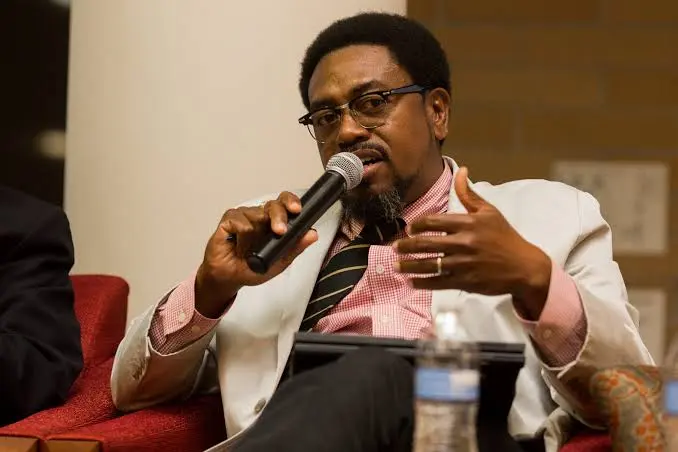
The reconstruction of the west wing of Queen’s College has triggered a wider debate over the purpose and design of public educational buildings, with alumnus Dr. Terrence Richard Blackman questioning whether the new structure will do more than meet the school’s immediate functional needs.
In an essay published September 5 by the Guyana Business Journal, Blackman, a mathematician and professor at Medgar Evers College, CUNY, examines the replacement of the old west wing at the Thomas Lands school and argues that the project represents an opportunity to consider what schools should communicate to the generations of students who use them.
Blackman does not challenge the decision to demolish the old wing, which he says was structurally unsafe.
“They took down the old west wing because they found it structurally unsafe. Nothing in this essay disputes that it had to come down. My subject is what went up in its place.”
His concern is what he describes as the design of the replacement building, based on a construction photograph. He describes it as a three-storey structure with a flat white exterior, red roof and small, regularly spaced windows.
He acknowledges that the building is unfinished and that landscaping, interior spaces and its eventual use could affect the final experience. However, he argues that fundamental decisions about the building’s mass, proportions and openings have already been made.
For Blackman, the issue goes beyond architectural preference.
A former Queen’s College student who entered Form 1A in 1979, he recalls sitting in classrooms along Thomas Road and looking through the large banks of windows towards the light from the Atlantic.
He says those windows provided an important lesson that extended beyond the formal curriculum.
“I was learning that there was an outside. That the room I sat in was not the size of the world. That the horizon was a real place, that other people were standing on it, and that there was, in principle, a way to get there.”
That experience, he says, helped shape his understanding of education and possibility, although he stops short of suggesting that the windows themselves determined his later academic career.
What was in the brief?
A central part of Blackman’s argument concerns what he says was the brief for the new building.
According to his account, the brief contained eight directives from former students, parents and the Ministry of Education.
Former students wanted the character of the old building preserved, the large window banks along Thomas Road retained and external spaces left undisturbed.
Parents called for air conditioning in classrooms, laboratories and the library, as well as modern and maintainable washrooms.
The Ministry, Blackman says, called for a larger library, provision for a future connection between the east and west wings and a durable design requiring minimal future maintenance.
Blackman contends that while the directives established practical requirements, they did not articulate a broader objective for what the building should accomplish educationally or psychologically.
“Eight constraints. No objective. Nobody wrote down what the building was meant to produce in the imagination of a child.”
That distinction is central to his criticism. He argues that functionality and beauty should not be treated as competing objectives, particularly when buildings are expected to serve students for generations.
“Beauty is not the opposite of utility. It is utility measured on the longest horizon.”
Blackman also accepts that former students, including himself, bear some responsibility for the absence of a wider discussion about the project’s ambitions. He notes that three of the eight directives came from former students but says those requests were primarily concerned with preserving features of the past rather than imagining what the school could become.
He suggests that future projects should involve broader consultation with school communities, including members of the Queen’s College diaspora in Guyana, London, Toronto and New York.
He also calls for greater transparency around architectural briefs and drawings so that the public can better understand how major decisions affecting educational infrastructure are made.
A question beyond Queen’s College
Blackman’s argument ultimately extends beyond the rebuilding of one school.
He contends that buildings themselves educate, silently communicating society’s values long after the people who commissioned or designed them are gone.
“The buildings going up this year will still be teaching in the 2090s. They will teach whatever we put in them, including nothing.”
The west wing remains under construction, and its completed form and operation will ultimately determine whether the concerns raised by Blackman are borne out.
But his essay places a larger question on the public agenda: when Guyana builds schools, should the objective be limited to providing functional classrooms and facilities, or should public investment also seek to create spaces capable of inspiring students and shaping their sense of what is possible?
Blackman’s answer is that the objective should be established before the constraints become concrete.
“We had better decide what we are trying to maximize, and decide it before the concrete sets.”
For further reading
The full essay, “The Window on Thomas Road: What a school teaches when nobody is teaching,” by Dr. Terrence Richard Blackman, was published by the Guyana Business Journal on September 5, 2026. Readers can consult the original essay for Blackman’s fuller discussion of the Queen’s College rebuilding project, architectural design, education and the role of beauty in public infrastructure.