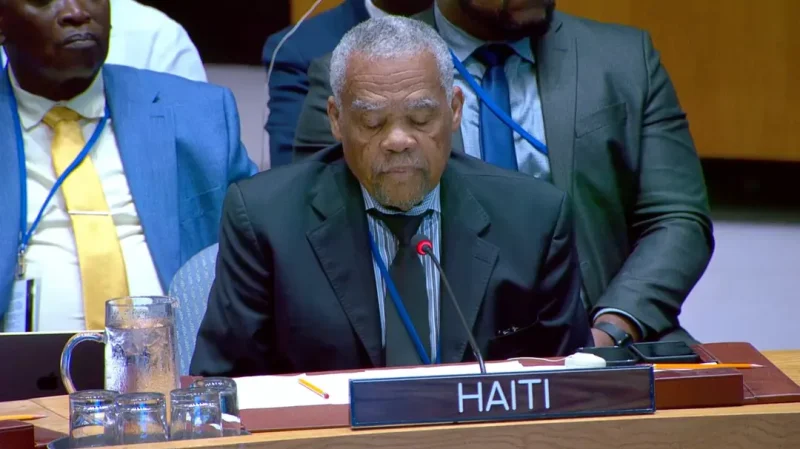
Haiti has called on the international community to accelerate the full deployment of the UN-backed Gang Suppression Force and strengthen enforcement of an arms embargo following a massacre in Kenscoff that left at least 47 people dead.
Addressing an urgent meeting of the United Nations Security Council on Friday, Haiti’s UN Ambassador Eric Pierre said the attack underscored the need for greater international support as armed gangs continue to expand their reach and terrorize communities.
The assault in the mountainous commune southeast of Port-au-Prince claimed the lives of at least 47 people, including three boys and two girls. Dozens of people were abducted, others were injured and homes were set ablaze.
People seeking refuge from the violence were also attacked, including at a church, where gang members executed people and killed others as they attempted to escape.
Pierre condemned “in the strongest possible terms these acts of extreme barbarism” following the deadly Aug. 23-24 attack.
“We express our deep solidarity with the victims, their families and the communities affected by this violence and we remain mobilised to provide urgent responses commensurate with the security challenges,” he said.
Pierre said the massacre demonstrated the continued ability of armed gangs to inflict violence despite efforts by the Haitian National Police and the Armed Forces of Haiti, with support from the Gang Suppression Force.
“The heinous criminal attack in Kenscoff underscores the urgent need for the international community to accelerate the deployment of the GSF to the planned strength of 5,500 personnel as soon as possible and above all to provide it with the full means necessary to carry out its missions alongside the national security forces,” Pierre said.
GSF personnel from contributing countries began operations on June 1, with the force expected to reach 5,500 personnel by October 2026.
Pierre said Haiti’s security forces have been placed on high alert as authorities seek to regain control of gang-held areas.
“The instructions are clear, protect, secure and restore the authority of the state,” he said.
He also called for stronger international enforcement of the UN arms embargo on Haiti to stem the flow of weapons and ammunition to criminal gangs.
“We call on the members of the international community to strengthen their contribution to upholding and implementing of the arms embargo imposed by the Security Council Sanctions Committee Resolution 2653 on Haiti in order to stem the flow of arms and ammunitions which fuel the violence of criminal gangs,” Pierre said.
According to the ambassador, Chad, Mongolia and Côte d’Ivoire have signed agreements with Haiti to join the GSF, while discussions are underway with Jamaica, Sri Lanka, Bangladesh and Guatemala.
The security crisis comes as Haiti prepares to hold its first elections in a decade.
The Provisional Electoral Council has scheduled the first round of presidential and legislative elections, along with a constitutional referendum, for Dec. 13. Haitians have not voted in national elections since 2016, when Jovenel Moïse was elected president. Moïse was assassinated on July 7, 2021.
Pierre said restoring security is essential to ensuring the elections can proceed.
“Today, we need greater synergy at the international level to support the government in restoring security, which is an essential condition in order to organise the upcoming elections in the country,” he said.
Carlos Ruiz Massieu, special representative of the UN secretary-general and head of the United Nations Integrated Office in Haiti, told the Security Council that the Kenscoff massacre was “deeply shocking” but was not an isolated incident.
“It is the latest in a series of attacks affecting the commune of Kenscoff since early 2025. It demonstrates the continued capacity and determination of gangs to terrorise the population, expand their influence beyond the capital and pose a direct challenge to state authority and the rule of law,” Massieu said.
BINUH documented 1,408 people killed and 656 injured in Haiti between April and June 2026 alone, according to Massieu.
He said the attack has triggered renewed public outrage and calls for authorities and international partners to protect civilians, strengthen security institutions and restore public order.
“For far too long, Haitians have lived in fear of being killed, kidnapped or subjected to sexual violence,” Massieu said, warning that without improved security, efforts to strengthen governance and move forward with elections will remain vulnerable to setbacks.
He also called for those responsible for the Kenscoff massacre, as well as those who finance, arm and enable gang violence, to be held accountable.
The Security Council also heard about the mounting humanitarian toll of Haiti’s crisis.
Assistant Secretary-General for Humanitarian Affairs Indrika Ratwatte said an estimated 6.4 million people — more than half of Haiti’s population — need humanitarian assistance.
Nearly 200,000 people were forcibly returned to Haiti during the first eight months of 2026, a 10% increase compared with the same period last year, he said.
Humanitarian organizations also recorded more than 5,500 incidents of gender-based violence during the first six months of the year, or about 30 cases per day. Women and girls accounted for the vast majority of survivors.
Ratwatte urged the international community to focus on stopping the violence, funding humanitarian operations and addressing the underlying causes of the crisis.
“The people of Haiti deserve more than mere survival,” he said. “They deserve safety, opportunity, and hope for a better future.”
caribbeannationalweekly.com