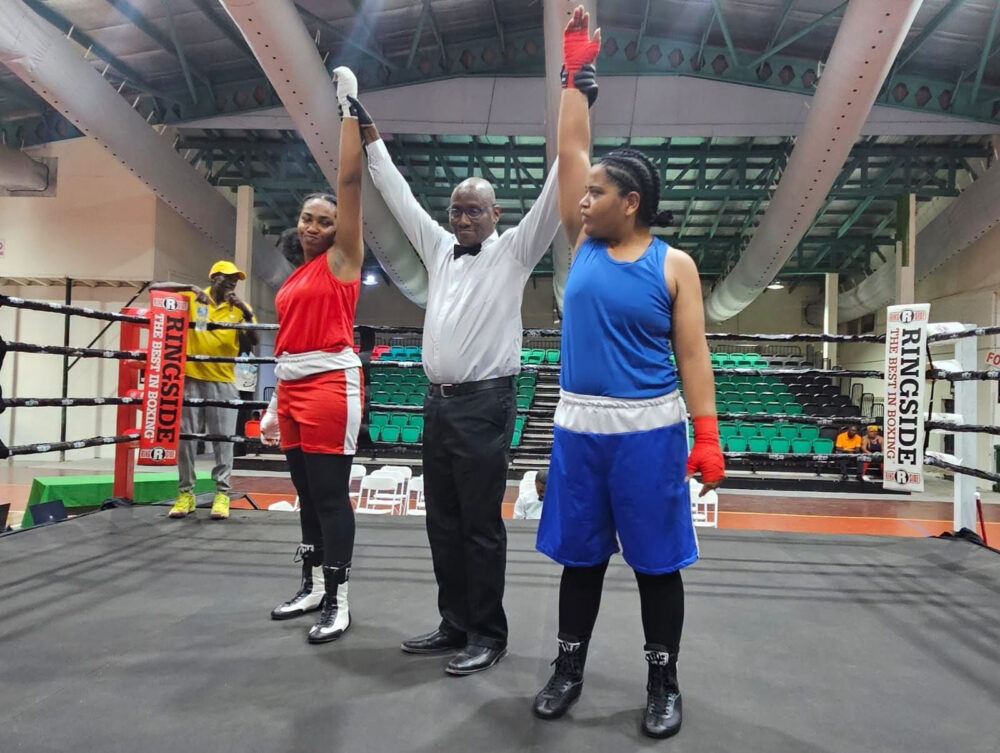
Two female inmates of the Guyana Prison Service (GPS) have made history by stepping into the boxing ring in what organisers describe as the first known bout involving female prisoners in Guyana and potentially the wider Caribbean.
Orina Silas and Shania Benjamin faced each other in an exhibition bout during the ninth annual Winfield Braithwaite Caribbean Schoolboys and Juniors Boxing Championships, marking the first time female inmates have participated in the correctional service’s boxing programme.
Guyana Boxing Association President Steve Ninvalle described the contest as a significant milestone for both Guyana’s correctional system and regional boxing.
“First ever fight involving female inmates of the Guyana prison… quite possibly the first in CARICOM,” Ninvalle said.
The bout formed part of a broader initiative to introduce boxing into Guyana’s correctional facilities as a tool for rehabilitation, discipline and personal development.
The championships, hosted by the Guyana Boxing Association in partnership with the Ministry of Culture, Youth and Sport, have attracted boxers from Guyana, Trinidad and Tobago, Antigua and Barbuda, St Maarten and St Lucia.
The female inmates’ participation represents the latest stage of a structured boxing programme being conducted within the GPS for inmates. While male inmates have previously been exposed to the programme, Silas and Benjamin are the first female participants.
The initiative goes beyond competition, using boxing to develop self-control, concentration, discipline and confidence—qualities viewed as important to rehabilitation and eventual reintegration into society.
Training includes the fundamentals of boxing, such as stance, balance, guard, footwork, distance management, offensive and defensive techniques and head movement. Participants also engage in pad work and heavy-bag drills while learning combinations, timing and rhythm.
Safety remains a central component, with participants supervised by coaches and trained in proper hand wrapping, equipment maintenance and ring safety to reduce the risk of injury.
For female inmates in particular, the programme provides access to a structured and physically demanding activity that requires focus, perseverance and discipline, while broadening the range of rehabilitation opportunities available within the prison system.
The initiative also reflects a growing emphasis on using sport within correctional settings as more than recreation. Structured sporting programmes can provide inmates with constructive outlets, help develop practical and personal skills, and encourage behaviours that support eventual reintegration into society.
The bout between Silas and Benjamin therefore carried significance beyond the ring. It placed female inmates at the centre of a rehabilitation initiative while demonstrating how sport can create opportunities to build confidence, resilience and self-discipline during incarceration.
If Ninvalle’s assessment is confirmed, the exhibition could also hold regional significance as a potential first involving female inmates in CARICOM.
Guyana’s correctional system now faces a new chapter in rehabilitation, with the bout signalling a broader effort to expand opportunities for female inmates and use structured sport to build discipline, confidence and resilience—skills that can support their eventual reintegration into society.