Technical and vocational education and training (TVET) is taking centre stage in regional education discussions as CARICOM Education Ministers consider how to better connect learning with employment, entrepreneurship and the practical skills demanded by Caribbean economies.
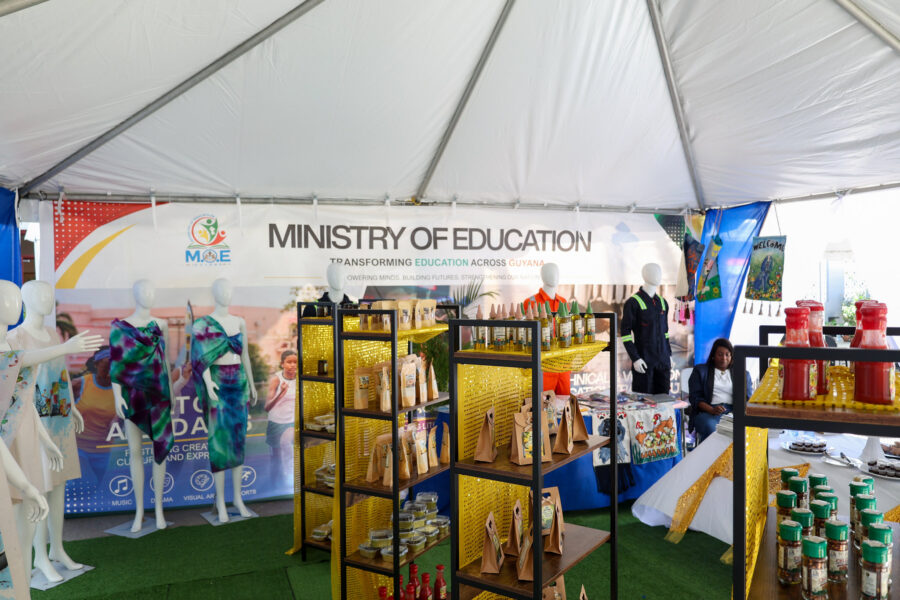
The issue was brought to life on Wednesday, August 12, when a mini exhibition at the Arthur Chung Conference Centre in Georgetown showcased products and projects created by students participating in Guyana’s TVET programmes.
The exhibition coincided with the opening of the 52nd Meeting of the CARICOM Council for Human and Social Development (COHSOD) on Education, where Guyana’s Education Minister, Sonia Parag, and CARICOM Secretary-General Dr Carla Barnett highlighted TVET as an integral part of the education ecosystem.
Rather than presenting vocational education solely as a classroom concept, the exhibition offered regional policymakers a practical look at what students can produce when technical skills are combined with creativity and enterprise.
Displays by the Ministry of Education’s TVET Unit included artwork, clothing, beauty and skincare products and condiments. The exhibits also reflected efforts to involve students more directly in agriculture and agro-processing.
The focus is significant as Caribbean governments confront a persistent challenge: ensuring that young people leave the education system with skills that can translate into meaningful employment and economic participation.
TVET provides an alternative and complementary pathway to traditional academic education, allowing students to develop occupational skills that can support employment, self-employment and further professional training.
The regional meeting is now considering steps that could strengthen that pathway across CARICOM.
Among the key matters before the Education Ministers is the proposed approval of CARICOM Vocational Qualification (CVQ) Standards, alongside consideration of a regional framework for apprenticeship.
The development and recognition of common vocational standards could help strengthen confidence in qualifications earned across member states, while a regional apprenticeship framework could provide young people with greater opportunities to combine formal instruction with practical workplace experience.
Those initiatives could become increasingly important as Caribbean economies undergo rapid technological and economic changes and employers demand workers with specialised technical competencies.
The Georgetown exhibition also underscored another potential benefit of TVET: youth entrepreneurship.
A student who learns to make clothing, beauty products, food items or other marketable goods is acquiring more than a technical skill. With access to financing, markets and business training, those skills can potentially become the foundation for a small enterprise and a source of employment for others.
The inclusion of agriculture and agro-processing is particularly relevant to Caribbean economies seeking to strengthen food security, increase domestic production and create new opportunities for young people.
The discussions therefore extend well beyond the classroom. They involve the region’s capacity to develop a workforce capable of supporting economic growth while giving young people practical alternatives to traditional academic pathways.
For Guyana, the issue carries additional weight as the country’s economy expands and demand grows for skilled workers across construction, energy, manufacturing, agriculture, hospitality, technology and other sectors.
A stronger TVET system could help ensure that economic expansion creates opportunities for Guyanese with different talents and educational interests—not only those pursuing university degrees.
The regional challenge, however, is to ensure that vocational education is not treated as a lesser alternative to academic education.
The products displayed at the Arthur Chung Conference Centre offered a compelling counterpoint: students were not simply learning theories; they were making products, developing skills and demonstrating the potential to turn knowledge into economic value.
As CARICOM considers common vocational standards and an apprenticeship framework, the wider question is whether the region can build an education system in which academic achievement, technical competence and entrepreneurship are all recognised as essential to national development.
The TVET exhibition in Georgetown provided a glimpse of what that future could look like—young Caribbean people equipped not merely to seek jobs, but to create value, build businesses and become skilled contributors to their communities and economies.