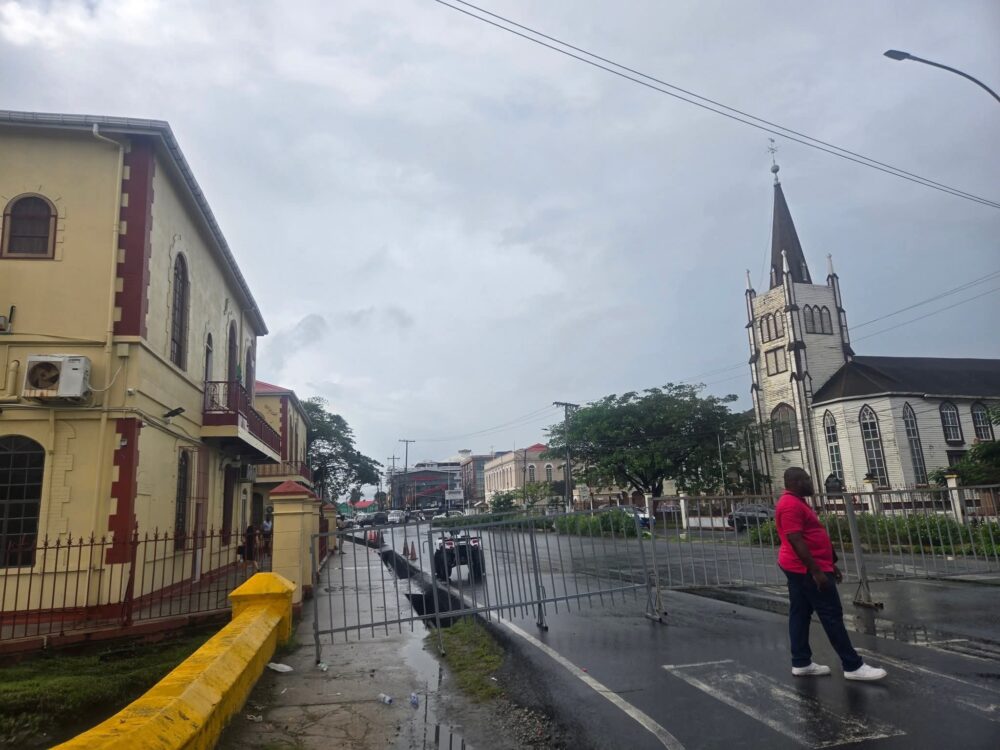
Hours before Principal Magistrate Judy Latchman is scheduled to rule on the high-profile extradition case involving businessman Nazir “Shell” Mohamed and his son, Azruddin Mohamed — the presumptive Leader of the Opposition, whose We Invest In Nationhood party (WIN) secured 16 of the 29 opposition seats declared by GECOM — police erected barricades along the roadway leading to the Georgetown Magistrates’ Court. A Partnership For National Unity (APNU) holds 12 seats, and the Forward Guyana Movement (FGM) holds one.
The security move, executed early this morning, has sparked immediate political backlash and heightened public scrutiny.
The We Invest In Nationhood party condemned the barricades, framing them as part of a broader pattern of political hostility. In a statement posted to its social media platforms, the party accused the government of weaponising law enforcement to inconvenience ordinary citizens for political gain.
“Due to the Mohameds ruling this morning at 9am, the PPP has ordered the police to barricade the roads,” the party stated, arguing that the sudden road closures were not merely precautionary but a deliberate act intended to intimidate and disrupt.
WIN emphasised that the closure of this major artery severely affects parents, schoolchildren, and workers navigating the morning rush.
“This is how the PPP is hell-bent on the Mohameds and especially Opposition Leader-in-waiting Azruddin Mohamed to inconvenience the lives of tens of thousands of Guyanese that must traverse this Avenue to get their children to school so that they can get to work on time. This is how uncaring this PPP government reveals themselves to be.”
The barricades highlight the politically charged atmosphere surrounding today’s ruling, which has already drawn accusations of state overreach, judicial pressure, and an orchestrated attempt to weaken emerging opposition forces. The government’s heavy-handed security posture has intensified concerns that the extradition matter has shifted from a legal process into an overt political confrontation, raising broader questions about public trust and the health of Guyana’s democratic institutions.