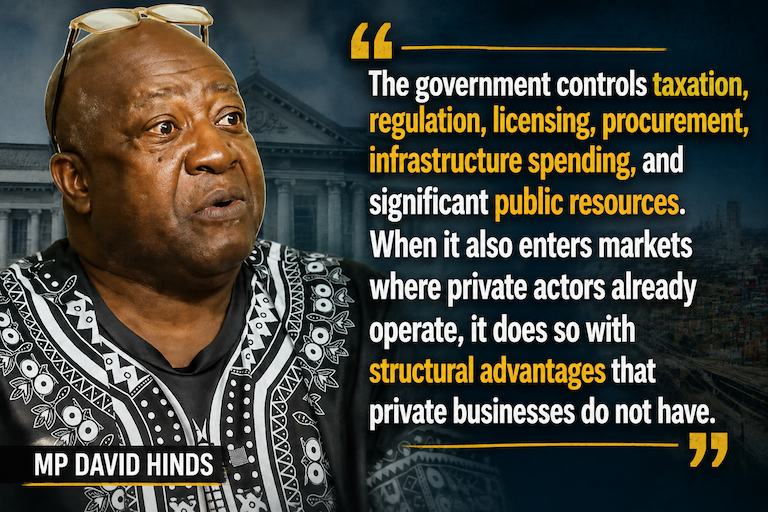
Georgetown, Guyana – Opposition Member of Parliament Dr. David Hinds has questioned the PPP/C government’s expanding role in commercial activity, arguing that it is increasingly blurring the line between the state as regulator and provider, and the state as a market competitor.
Hinds’ comments come amid debate over Guyana Water Incorporated’s entry into bottled water production. He maintained that water is a public good and that the government’s primary responsibility should remain the delivery of safe, reliable water through the public system.
“Water is a common good, and so the distribution of water should be first and foremost socialized,” Hinds said. “We are moving from socialized water distribution as a common good to water now as a profit-making venture, and that goes against a cardinal function of government.”
He also questioned the rationale for state involvement in a market already served by private businesses, noting that consumers who want bottled water already have that option.
“If one wants to buy bottled water rather than water coming through the tap, that’s a personal choice, and the private sector already provides that,” he said.
Hinds further pointed to what he sees as a contradiction in the PPP’s economic posture, arguing that if the party has moved away from socialism, its growing engagement in state-run commercial ventures warrants scrutiny.
“When government engages in state-sponsored economic activities, one has to ask what the motives are,” he said, suggesting such ventures could become “a medium for funneling resources to friends, families and favourites.”
He also argued that the government is drifting from its core functions of service delivery and regulation.
“What we are seeing here is a not-so-subtle movement of this government away from its role as a distributor of social goods and as a regulator,” he said.
Hinds went on to allege that this shift could enable politically connected individuals to benefit from state resources, describing it as part of what he termed the “criminalization of the state.”
“It is friends and favourites of the government making money through the facilitation of the state,” he charged.
The allegations reflect Hinds’ political views and are not established as fact in the information provided.
Beyond the specific issue of bottled water, his remarks raise broader questions about the state’s expanding economic footprint.
The government controls taxation, regulation, licensing, procurement, infrastructure spending, and significant public resources. When it also enters markets where private actors already operate, it does so with structural advantages that private businesses do not have.
The issue therefore goes to the heart of the PPP/C’s economic philosophy and the role it envisions for the state in an oil-rich Guyana.
If private-sector development remains a stated priority, the government may face increasing scrutiny over why it is entering commercial markets, how such ventures are financed, whether they compete on equal terms with private firms, and, ultimately, who benefits when the state acts simultaneously as policymaker, regulator, financier, and market participant.