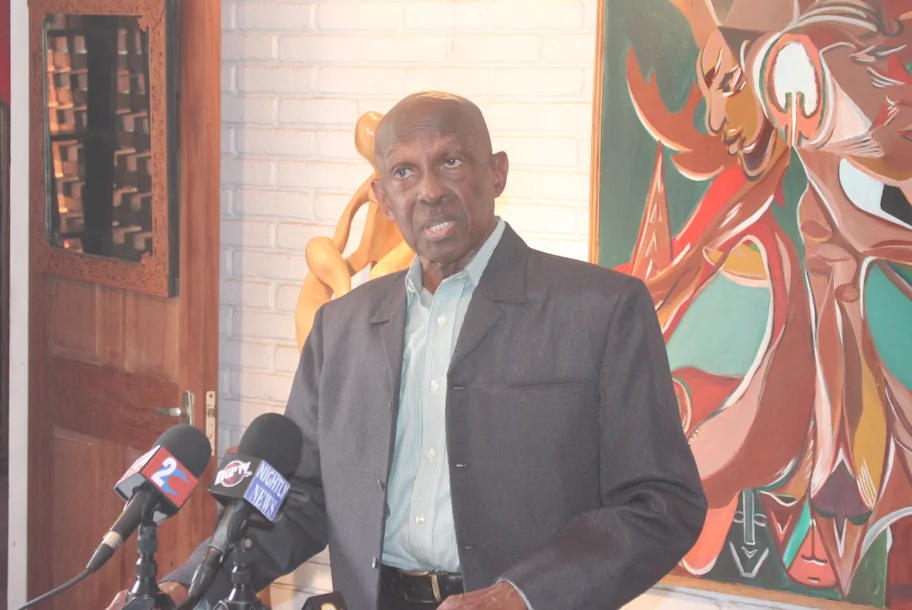
Former Prime Minister and former Mayor of Georgetown Hamilton Green has delivered a searing Emancipation Day message, warning that nearly 188 years after slavery was abolished in Guyana, Afro-Guyanese are confronting what he describes as a “subtle form of re-enslavement” through economic exclusion, political marginalisation and the erosion of historical consciousness.
In a letter published by Village Voice News on July 29, Green urged descendants of enslaved Africans to view Emancipation Day—not merely as a cultural celebration, but as a renewed call to resist injustice, reclaim their dignity and fight for equal participation in a country transformed by oil wealth but, he argues, still marked by deep inequalities.
“As we observe the official end of the brutality of slavery in Guyana, there are ominous signs that the descendants of manumitted Africans face the real prospect of a subtle form of re-enslavement,” Green wrote.
His warning builds on remarks he delivered at an Independence forum in May, where he declared, “The struggle has now begun. We are being subtly re-enslaved,” cautioning that Guyana’s unprecedented economic boom means little if ordinary citizens remain economically marginalized and politically powerless.
Slavery was legally abolished in British Guiana on August 1, 1838, after centuries of resistance by enslaved Africans, including major uprisings led by national heroes such as Cuffy in 1763, Damon in 1834 and Quamina in the 1823 Demerara Rebellion. Green argues that the freedom won through blood, sacrifice and rebellion is now threatened by new forms of domination.
His comments come against the backdrop of persistent complaints by African-Guyanese organisations and citizens that Afro-Guyanese continue to face unequal access to economic opportunities, state contracts, land, public employment and positions of influence, despite Guyana becoming one of the world’s fastest-growing economies following the discovery of offshore oil.
Green argued that the greatest danger is not only economic exclusion but a loss of historical awareness.
“This occasion requires understanding the threat, and preparing young and old African descendants to be studious, diligent, and demand justice,” he wrote.
“The task for all of us is urgent and requires strength, determination, unity of action and sacrifice where necessary.”
Drawing parallels between the trans-Atlantic slave trade and present-day Guyana, Green said slavery endured not only because of European exploitation but because some African leaders were seduced by personal gain.
“Slavery lasted for centuries partly because of European treachery and African chiefs who were consumed and confused by materialism and the crumbs from the imperial coloniser,” he wrote.
“In Guyana today this relationship is developing at a fast rate.”
At his May address, Green similarly warned that “history is repeating itself,” arguing that local collaborators were once again enabling outside interests to dominate Guyana’s future.
The veteran statesman also lamented what he sees as the enduring psychological scars of slavery. He pointed to the loss of African names and identity, noting that while other ethnic groups largely retained surnames reflecting their ancestral origins, Afro-Guyanese continue to bear the names of former slave owners and British slave-trading cities.
He also said he was “horrified” that some Afro-Guyanese continue to purchase skin-lightening products, describing it as evidence that “emancipation is incomplete.”
Green’s most pointed criticism was reserved for what he likened to the colonial “house slave” mentality.
“Massa, with care and craftiness, cultivated a class referred to as the house slave, whose loyalty was no longer with the majority known as the field slave,” he wrote.
“Events in Guyana, particularly over the last few decades suggest that this condition is well in place.”
He argued that Guyana’s oil wealth has widened the gap between the political elite and ordinary citizens. Speaking in May, he questioned whether the country’s rapid economic growth had translated into dignity for working-class Guyanese, pointing to teachers leaving the country and families struggling to survive.
“They people have no bread! Let them eat cake,” Green declared, accusing the political class of becoming detached from the hardships facing ordinary people.
Green also renewed the call for reparatory justice, saying President Irfaan Ali should use Guyana’s billions in oil revenues to establish a national reparations fund dedicated to youth development and education.
“I expect… President Dr Irfaan Mohamed Ali will announce that the Guyana government will make a substantial contribution to the establishment of a reparation fund,” he wrote, adding that the fund should be managed transparently by credible organisations.
He reminded Guyanese that Emancipation was never granted voluntarily by the colonial plantocracy.
“It was the constant uprisings and rebellions by the slaves that brought the European plantocracy to their senses, making slavery no longer a profitable venture,” he wrote.
Calling for a new generation of civic activism, Green declared: “This Emancipation Day must help us break the remaining mental chains that still bind some us.“
“No one give a people real freedom,” he added. “They have to demand it, and the watchword is struggle, consistent struggle.“
Concluding his appeal, Green urged Guyanese—particularly teachers, religious leaders, professionals and parents—to invest in educating and mentoring young people, arguing that true emancipation will only be realised when descendants of enslaved Africans are equipped to participate fully and equally in shaping Guyana’s future.
“The period ahead must not be seen as a burden,” he wrote, “but as a booster for the betterment of the descendants of those whose sacrifice help shape the Guyana we know today.”