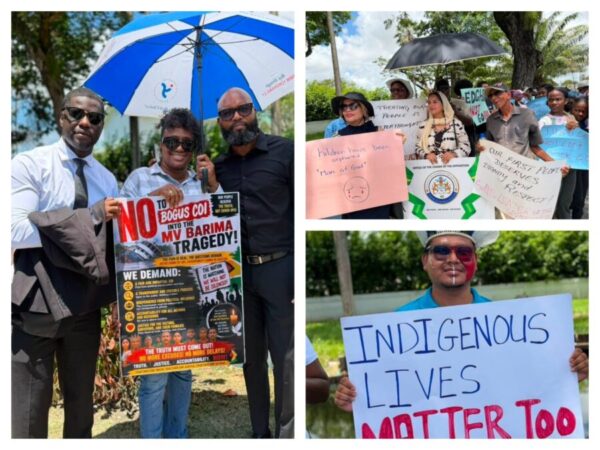
Public anger over the MV Barima tragedy intensified on Wednesday, July 29, as protests erupted across Guyana, with hundreds of citizens taking to the streets demanding justice for the 73 victims, the release of the three Transport and Harbours Department employees charged with murder, and the resignation of Public Works Minister Juan Edghill and Minister within the Ministry of Public Works Deodat Indar.
The coordinated demonstrations, which spanned Georgetown, Den Amstel on the West Coast of Demerara and Melanie Damishana on the East Coast Demerara, came a day after the joint opposition-parliamentarians and non-parliamentarians- staged a protest outside the Arthur Chung Conference Centre during the sitting of the National Assembly on July 28, where similar calls were made for political accountability over the country’s deadliest maritime disaster in decades.
Carrying photographs of those who perished and others who remain unaccounted for, protesters chanted, “Jail the criminals, free the innocent,” and “Who must go? Edghill and Indar must go,” among other call-and-response slogans, while expressing the view that frontline workers were being scapegoated as senior officials responsible for the ferry service escaped accountability.
The demonstrations unfolded against the backdrop of growing public outrage over the July 18 sinking of the state-owned MV Barima, which capsized off Guyana’s northwestern coast while en route from Georgetown to Port Kaituma.
Although the Government initially reported that the ferry was carrying 116 passengers and 17 crew members—a total of 133 persons—official figures have steadily increased since the tragedy. Authorities have since acknowledged that as many as 179 people may have been aboard the vessel. To date, however, no definitive passenger manifest has been produced, leaving the true number of passengers unknown.

Authorities have confirmed 73 deaths and 76 verified survivors, while questions continue to swirl about the whereabouts of other passengers and the apparent breakdown in passenger accounting systems.
The tragedy has also sparked widespread debate over the seaworthiness of the nearly century-old vessel, its maintenance history, regulatory oversight and whether the responsibility for the disaster extends far beyond the three employees now facing murder charges.
APA Leads Protest at Office of the President
In Georgetown, the Amerindian Peoples Association (APA) organised a picketing exercise outside the Office of the President. The protest attracted support from opposition political parties, civil society organisations and relatives of victims.
Among those participating was Joel Simpson of the Society Against Sexual Orientation Discrimination (SASOD), who said public confidence in any investigation depended on those with ministerial responsibility stepping aside.
“People are calling on the minister to do the decent thing and resign or call on President Irfaan Ali to fire them, not only because of the negligence in MV Barima but also to allow for a free and impartial investigation,” Simpson said.
Demonstrators argued that an investigation cannot inspire public confidence while the ministers with direct responsibility for the Transport and Harbours Department remain in office.

Villages Rally Behind Accused Workers
Support for the three accused workers also spilled into their home communities.
In Den Amstel, West Coast Demerara, residents marched in solidarity with Delon Granderson, 33, the Transport and Harbours Department’s Cargo Superintendent at the Kingston Goods Wharf. Granderson has been charged with murder for the deaths arising from the sinking.
As Cargo Superintendent, Granderson was responsible for overseeing cargo operations, passenger boarding and ticketing before the vessel departed Georgetown.
Residents insisted he was being unfairly blamed for failures that they contend occurred at much higher levels of government.
Holding placards and chanting “Free the innocent, jail the criminals,” demonstrators demanded his immediate release while calling for the dismissal of Ministers Juan Edghill and Deodat Indar.
At Melanie Damishana, East Coast Demerara, residents mounted a similar protest in support of Rondell Dwayne Roberts, 42, the vessel’s Chief Mate. Roberts served as the senior deck officer responsible for assisting the captain with navigation, vessel safety and supervision of deck operations.
The third accused is Captain Kevin Price, 40, the Master of the MV Barima, who was responsible for the vessel’s overall command and navigation.
The three men were jointly charged with murder following legal advice from the Director of Public Prosecutions and are scheduled to return to court on August 3.

Growing Calls for Political Accountability
The decision to charge the three workers has divided public opinion.
Many Guyanese have questioned whether frontline employees are being held solely responsible while decisions relating to the vessel’s maintenance, inspections, certification, continued operation and overall management of the ferry service remain under scrutiny.
The Government has established a five-member Commission of Inquiry to investigate the disaster. However, protesters argued that the credibility of that inquiry depends on ensuring it is conducted independently and free from political influence.
Wednesday’s demonstrations marked the broadest public mobilisation since the tragedy, reflecting growing frustration not only over the loss of life but also over what many see as a failure of political leadership and accountability.
For the families of the victims, the protests were about more than the criminal charges against three workers. They were a demand for answers about how a state-operated ferry carrying an unknown number of passengers was allowed to sail, why the official passenger count continues to change, and whether those ultimately responsible for ensuring the safety of Guyana’s ferry system will ever be held to account.
From Georgetown to villages along the East and West Coast, the chants carried the same message: Guyanese are no longer mourning in silence. What began as grief over the loss of 73 lives has evolved into a nationwide demand for accountability, with growing calls for those at the highest levels of government to answer for the decisions that preceded one of the country’s worst maritime disasters.