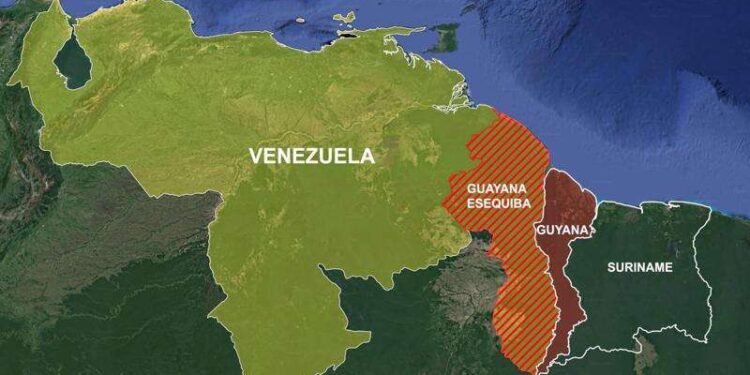
GEORGETOWN, Guyana — The New York Caribbean Guyana Institute for Democracy (CGID) has sharply condemned a U.S. State Department statement on the Guyana–Venezuela border controversy, accusing Washington of entertaining the possibility of a new bilateral border settlement and warning that it undermines Guyana’s sovereignty over Essequibo.
The controversy erupted after press reports alleged that a U.S. State Department official had requested that Guyana concede part of its territory in Essequibo to Venezuela as part of a settlement. The reports triggered widespread condemnation on social media, prompting the U.S. Embassy in Guyana to issue a statement insisting that Washington’s policy on the land boundary “has not changed.”
The State Department statement reaffirmed U.S. support for the 1899 Arbitral Award, which determined the land boundary between Venezuela and Guyana, and said the boundary “should be respected unless or until a new boundary is set by a competent legal body or with the consent of both parties.”
But CGID seized on that caveat, rejecting what it described as the statement’s “intimation” that a new boundary could be established between Guyana and Venezuela “by a competent legal body or with the consent of both parties.”
“CGID completely rejects the intimation in the US statement of the potential establishment of a new boundary between Guyana and Venezuela,” the organization said in a statement released Thursday. It urged Guyana’s governing PPP government to do the same immediately.
The group insisted that the Guyanese people will accept no change to the country’s borders and will accept only the 1899 Arbitral Award, which establishes the current boundaries.
“Guyana has lost enough territory to Venezuela over the course of history, including Ankoko Island,” CGID said. “Guyanese are not prepared to give an inch more. Not even a blade of grass!”
The statement places fresh pressure on the PPP administration to publicly reject any suggestion of negotiated territorial concessions, even as the U.S. insists its position remains unchanged. CGID’s intervention also signals that the diplomatic fallout from the reported official request is far from contained, with the organization framing the U.S. clarification as insufficient reassurance rather than a full retraction.
The U.S. Embassy has not responded to CGID’s condemnation.