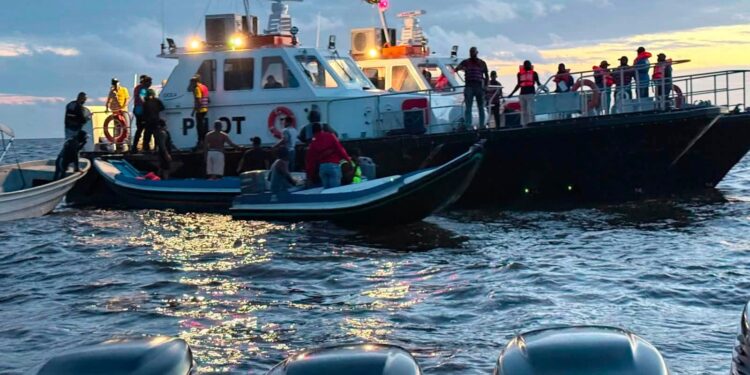
The death toll from the MV Barima disaster has risen to 53, with 76 survivors now verified, as Prime Minister Brigadier (Ret’d) Mark Phillips on Tuesday acknowledged that government cargo was among the freight aboard the ill-fated ferry and admitted there appeared to have been a “breakdown” in the vessel’s pre-departure inspection process.
Providing the latest update on the search and recovery operation, Phillips said 26 victims have been positively identified, while one additional body has been located inside the wreck but has not yet been recovered. He confirmed that no survivors have been found at the wreck site, where French Guianese and Guyanese divers continue underwater recovery operations.
The 87-year-old MV Barima capsized late on Saturday, July 18, during its voyage from Georgetown to Port Kaituma in Region One, becoming one of Guyana’s worst maritime disasters in decades. What initially appeared to be a routine passenger voyage has evolved into a national tragedy that has sparked widespread questions about maritime safety, government oversight and the continued operation of ageing vessels.
Authorities initially reported that 116 passengers and 17 crew members were aboard. However, after dozens of survivors were found not to be listed on the official manifest, investigators reviewed surveillance footage from the Kingston Goods Wharf and now estimate that 179 passengers and crew were on the ferry when it sank approximately 10 nautical miles off the Essequibo Coast.
Phillips said aircraft continue transporting relatives to Suddie Hospital in Region Two to assist with the identification of loved ones, while 11 victims have already been released to their families and returned to their respective communities for burial.
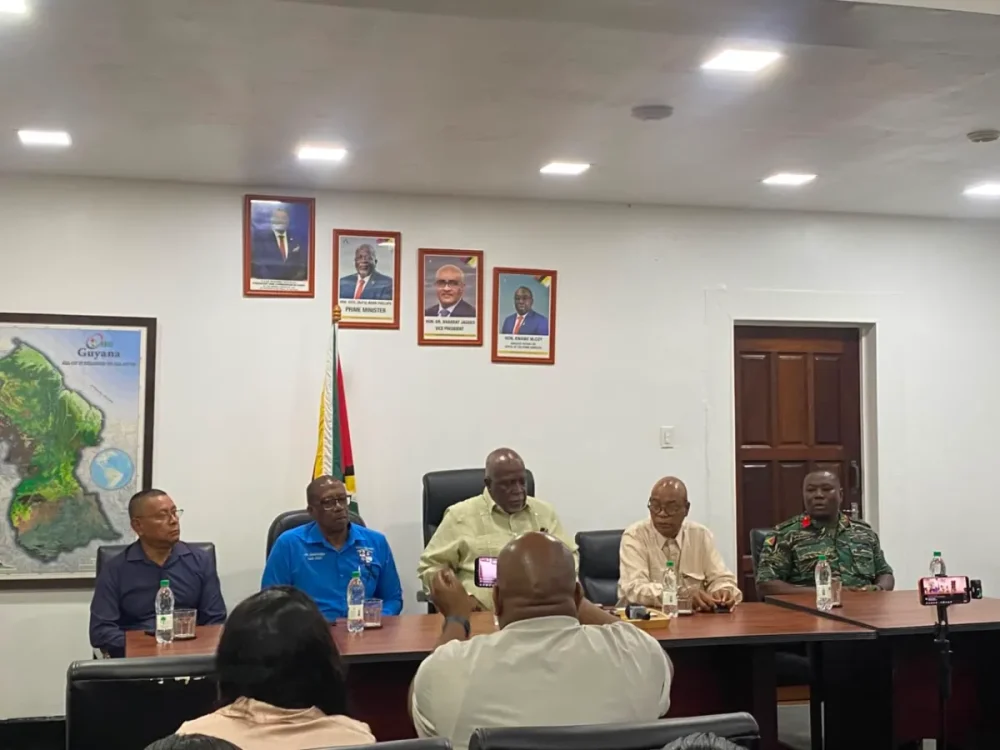
During a news conference, the Prime Minister also disclosed that the government lost several pieces of equipment in the sinking.
Responding to questions about government cargo aboard the vessel, Phillips confirmed that the Ministry of Public Works lost equipment, fuel, machinery and All-Terrain Vehicles (ATVs).
“All those things will be itemised as part of the whole investigative process,” he said.
Asked whether any government official or minister instructed that the equipment be loaded despite weight restrictions, Phillips said he had received no such information.
“I don’t have such a report. I cannot say yes or no. I don’t have such a report. If there is such a report out there, I would say when the investigation commence, those people can come forward and submit statements to that effect.”
Public Works Minister Juan Edghill said the equipment was being transported to support construction works in Region One. He added that the ferry was designed to carry four vehicles and that the cargo manifest recorded only a pickup and one motor car aboard the vessel.
However, questions over the loading process intensified when journalists asked how authorities failed to detect that significantly more passengers had boarded the vessel than were recorded on the official manifest.
While Edghill maintained that vessels are subject to inspection before departure, Phillips interrupted to acknowledge that the system had failed.
“What you were raising there, obviously, there was some breakdown in the system,” the Prime Minister said, adding that the failure would form part of the official investigation.
The admission comes amid mounting public scrutiny of the government’s handling of the tragedy. Opposition parties, civil society organisations and the Institute for Action Against Discrimination (IFAAD) have called for Minister Edghill’s resignation, arguing that public confidence in the management of Guyana’s maritime sector has been severely undermined.
Those demands have been fuelled by the revelation that, in 2023, Edghill announced that a replacement vessel was on its way to Guyana to replace the ageing MV Barima. Three years later, the promised replacement had not materialised, and the 1939-built ferry remained in service until it sank.
When asked Tuesday about the growing calls for his resignation, Edghill declined to respond directly.
The government has pledged a full investigation into the disaster, including the vessel’s loading procedures, inspection regime, passenger manifest and the circumstances surrounding the sinking. However, that promise has been met with growing skepticism.
For many Guyanese, confidence in an investigation led by the same administration now under scrutiny is in short supply. With questions surrounding the vessel’s maintenance, the accuracy of the passenger manifest, the apparent breakdown in inspection procedures, and the government’s failure to deliver on its 2023 promise to replace the ageing MV Barima, there are increasing calls for an independent, transparent inquiry with international participation. Many believe that only an investigation free from political influence will determine whether this tragedy resulted from systemic failures and whether it could have been prevented.