Monday, July 13, 2026
Village Voice News
ADVERTISEMENT
  • Home
  • News
  • Sports
  • Editorial
  • Letters
  • Global
  • Columns
    • Eye On Guyana
    • Hindsight
    • Lincoln Lewis Speaks
    • Future Notes
    • Blackout
    • From The Desk of Roysdale Forde SC
    • Diplomatic Speak
    • Mark’s Take
    • In the village
    • Mind Your Business
    • Bad & Bold
    • The Voice of Labour
    • The Herbal Section
    • Politics 101 with Dr. David Hinds
    • Talking Dollars & Making Sense
    • Book Review 
  • Education & Technology
  • E-Paper
  • Contact Us
No Result
View All Result
  • Home
  • News
  • Sports
  • Editorial
  • Letters
  • Global
  • Columns
    • Eye On Guyana
    • Hindsight
    • Lincoln Lewis Speaks
    • Future Notes
    • Blackout
    • From The Desk of Roysdale Forde SC
    • Diplomatic Speak
    • Mark’s Take
    • In the village
    • Mind Your Business
    • Bad & Bold
    • The Voice of Labour
    • The Herbal Section
    • Politics 101 with Dr. David Hinds
    • Talking Dollars & Making Sense
    • Book Review 
  • Education & Technology
  • E-Paper
  • Contact Us
No Result
View All Result
Village Voice News
No Result
View All Result
Home News

Guyana’s Workforce Mostly in Labour, Agriculture and Traditional Work, Unprepared for Specialized Service Occupations Required by Rapidly Modernizing Economy

Staff Writer by Staff Writer
July 13, 2026
in News
0
SHARES
0
VIEWS
Share on FacebookShare on Twitter

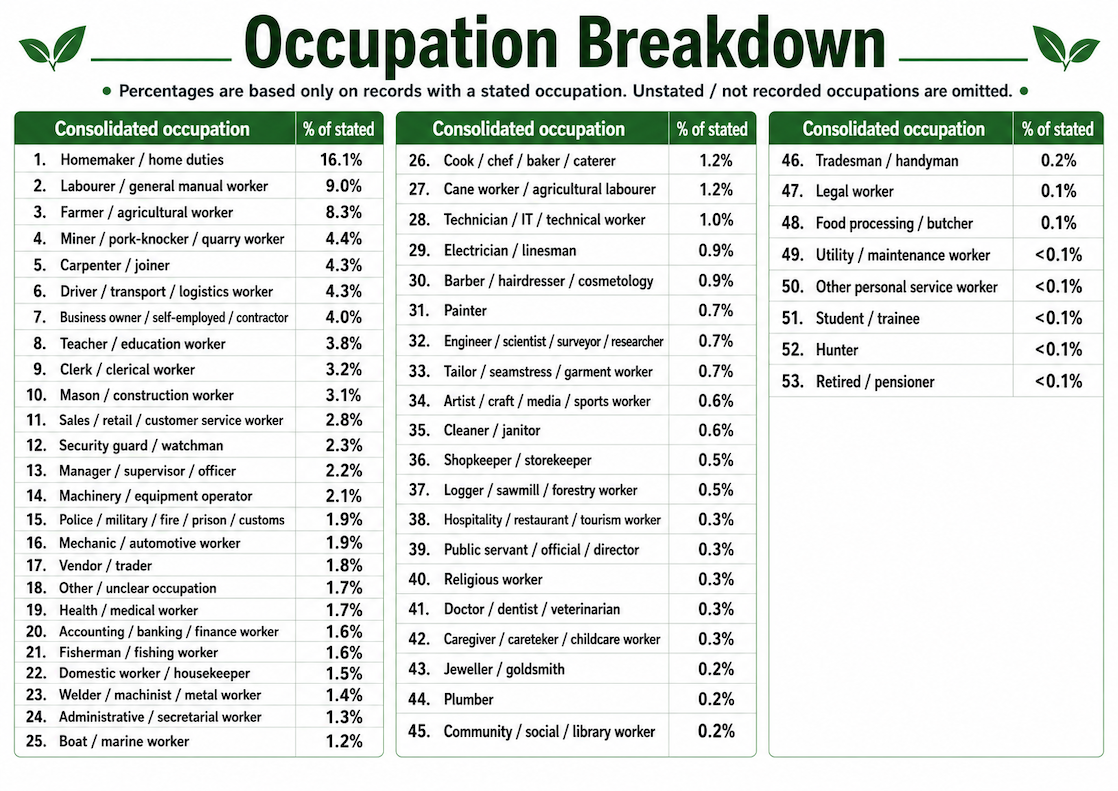
A review of the stated occupations in Guyana’s 2025 electors list suggests that the country’s adult workforce remains heavily concentrated in traditional, manual and lower-specialization forms of work, even as the national economy is being rapidly transformed by oil wealth, infrastructure expansion and growing demand for specialized services.

Among records where an occupation was stated, the largest category was homemaker or home duties at 16.1 percent, followed by labourer or general manual worker at 9 percent, farmer or agricultural worker at 8.3 percent, miner or pork-knocker at 4.4 percent, carpenter at 4.3 percent, driver or transport worker at 4.3 percent, business owner or self-employed worker at 4 percent, teacher at 3.8 percent, clerk at 3.2 percent and mason or construction worker at 3.1 percent. The list points to a labour market still rooted in household work, farming, mining, construction, transport, small trade and general manual work.

READ ALSO

Guyana, CARICOM Relief Reaches Venezuela as Recovery Effort Intensifies

Weekend Road Carnage Claims Three Lives as Guyana’s Deadly Traffic Crisis Deepens

This does not mean that these occupations are unimportant. They are the backbone of daily survival and local production. However, the pattern raises a serious development question for a small country now managing one of the fastest-growing oil economies in the world. A modern oil economy requires far more than oil workers. It requires engineers, technicians, accountants, project managers, logistics specialists, welders, electricians, mechanics, data workers, health professionals, educators, administrators, compliance officers and business service providers. The occupation breakdown suggests that Guyana may not yet have enough trained people in the specialized service areas needed to support such rapid expansion.

The data also showed a major weakness in labour-market information itself. More than half of the records reviewed had no meaningful occupation recorded. That makes planning even more difficult. A government managing oil revenues, local content policy, education reform and workforce development needs reliable information about who is working, who is unemployed, who is outside the formal workforce, and which skills are missing.

The implications are significant. As oil-linked firms expand, competition for workers will increase across construction, transport, logistics, administration, maintenance, security, education and health. That can drive up wages in some sectors while leaving traditional workers behind. It can also increase project costs, deepen inequality and force companies to import labour if local training does not keep pace.

Guyana’s central challenge is therefore not only to build roads, bridges, hotels and government offices. It is to build people. Oil revenues must be directed aggressively toward technical and vocational education, STEM training, apprenticeships, women’s workforce participation, management training, digital skills, entrepreneurship support and diaspora skills attraction. Without a deliberate workforce strategy, Guyana risks becoming an oil-rich country with too few locally trained workers to fully participate in its own modernization.
ShareTweetSendShareSend

Related Posts

Ambassador to Venezuela, H.E. Dr Richard Van West-Charles, and Venezuela’s Minister of Foreign Affairs, H.E. Yvan Gil, officially received the supplies (DPI photo)
Global

Guyana, CARICOM Relief Reaches Venezuela as Recovery Effort Intensifies

by Admin
July 13, 2026

By Mark DaCosta- Guyana’s post-earthquake humanitarian consignment has successfully reached the Bolivarian Republic of Venezuela, a development confirmed by the...

Read moreDetails
File photo
News

Weekend Road Carnage Claims Three Lives as Guyana’s Deadly Traffic Crisis Deepens

by Admin
July 13, 2026

By Mark DaCosta- The roads of our nation have once again run red as a devastating weekend of carnage claimed...

Read moreDetails
herd of young white cows  (Google photo)
News

Brazilian Heifer Dies as Opposition Demands Probe into Govt’s Herd Expansion Programme

by Admin
July 13, 2026

The death of a pregnant Brazilian heifer imported under the Government of Guyana's national herd expansion programme has intensified scrutiny...

Read moreDetails
Next Post

Jamaica to receive prestigious Esri President's Award for Leadership in GIS innovation


EDITOR'S PICK

Former President David Granger

Former Pres Granger reviews the rise and fall of small political parties

October 27, 2024

PM Phillips attacks Saul for internationalising marginalisation in Guyana

November 25, 2022

Guilty verdict for George Floyd’s killer brings relief, calls for wider justice 

April 21, 2021
United Nations Secretary-General António Guterres

UN chief extends Chinese New Year wishes

January 26, 2025

© 2024 Village Voice

No Result
View All Result
  • Home
  • News
  • Sports
  • Editorial
  • Letters
  • Global
  • Columns
    • Eye On Guyana
    • Hindsight
    • Lincoln Lewis Speaks
    • Future Notes
    • Blackout
    • From The Desk of Roysdale Forde SC
    • Diplomatic Speak
    • Mark’s Take
    • In the village
    • Mind Your Business
    • Bad & Bold
    • The Voice of Labour
    • The Herbal Section
    • Politics 101 with Dr. David Hinds
    • Talking Dollars & Making Sense
    • Book Review 
  • Education & Technology
  • E-Paper
  • Contact Us

© 2024 Village Voice