Monday, July 13, 2026
Village Voice News
ADVERTISEMENT
  • Home
  • News
  • Sports
  • Editorial
  • Letters
  • Global
  • Columns
    • Eye On Guyana
    • Hindsight
    • Lincoln Lewis Speaks
    • Future Notes
    • Blackout
    • From The Desk of Roysdale Forde SC
    • Diplomatic Speak
    • Mark’s Take
    • In the village
    • Mind Your Business
    • Bad & Bold
    • The Voice of Labour
    • The Herbal Section
    • Politics 101 with Dr. David Hinds
    • Talking Dollars & Making Sense
    • Book Review 
  • Education & Technology
  • E-Paper
  • Contact Us
No Result
View All Result
  • Home
  • News
  • Sports
  • Editorial
  • Letters
  • Global
  • Columns
    • Eye On Guyana
    • Hindsight
    • Lincoln Lewis Speaks
    • Future Notes
    • Blackout
    • From The Desk of Roysdale Forde SC
    • Diplomatic Speak
    • Mark’s Take
    • In the village
    • Mind Your Business
    • Bad & Bold
    • The Voice of Labour
    • The Herbal Section
    • Politics 101 with Dr. David Hinds
    • Talking Dollars & Making Sense
    • Book Review 
  • Education & Technology
  • E-Paper
  • Contact Us
No Result
View All Result
Village Voice News
No Result
View All Result
Home News

Guyana’s Workforce Mostly in Labour, Agriculture and Traditional Work, Unprepared for Specialized Service Occupations Required by Rapidly Modernizing Economy

Staff Writer by Staff Writer
July 13, 2026
in News
0
SHARES
0
VIEWS
Share on FacebookShare on Twitter

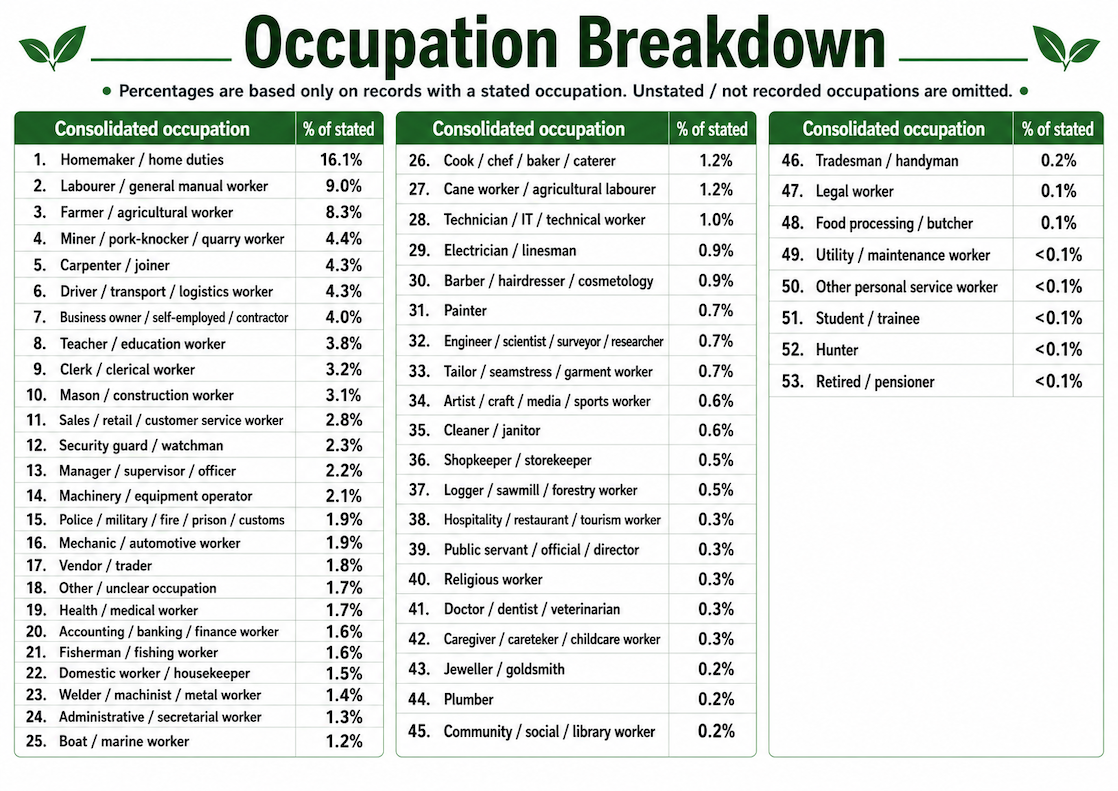
A review of the stated occupations in Guyana’s 2025 electors list suggests that the country’s adult workforce remains heavily concentrated in traditional, manual and lower-specialization forms of work, even as the national economy is being rapidly transformed by oil wealth, infrastructure expansion and growing demand for specialized services.

Among records where an occupation was stated, the largest category was homemaker or home duties at 16.1 percent, followed by labourer or general manual worker at 9 percent, farmer or agricultural worker at 8.3 percent, miner or pork-knocker at 4.4 percent, carpenter at 4.3 percent, driver or transport worker at 4.3 percent, business owner or self-employed worker at 4 percent, teacher at 3.8 percent, clerk at 3.2 percent and mason or construction worker at 3.1 percent. The list points to a labour market still rooted in household work, farming, mining, construction, transport, small trade and general manual work.

READ ALSO

BILLIONS FOR RACECARS, NOTHING FOR THE PEOPLE: Guyana’s Grand Prix Spectacle Exposes Government’s Contempt for the Poor

Lall Questions Fagundes Murder Breakthrough- Urges Guyanese to ‘Study the Sequence’

This does not mean that these occupations are unimportant. They are the backbone of daily survival and local production. However, the pattern raises a serious development question for a small country now managing one of the fastest-growing oil economies in the world. A modern oil economy requires far more than oil workers. It requires engineers, technicians, accountants, project managers, logistics specialists, welders, electricians, mechanics, data workers, health professionals, educators, administrators, compliance officers and business service providers. The occupation breakdown suggests that Guyana may not yet have enough trained people in the specialized service areas needed to support such rapid expansion.

The data also showed a major weakness in labour-market information itself. More than half of the records reviewed had no meaningful occupation recorded. That makes planning even more difficult. A government managing oil revenues, local content policy, education reform and workforce development needs reliable information about who is working, who is unemployed, who is outside the formal workforce, and which skills are missing.

The implications are significant. As oil-linked firms expand, competition for workers will increase across construction, transport, logistics, administration, maintenance, security, education and health. That can drive up wages in some sectors while leaving traditional workers behind. It can also increase project costs, deepen inequality and force companies to import labour if local training does not keep pace.

Guyana’s central challenge is therefore not only to build roads, bridges, hotels and government offices. It is to build people. Oil revenues must be directed aggressively toward technical and vocational education, STEM training, apprenticeships, women’s workforce participation, management training, digital skills, entrepreneurship support and diaspora skills attraction. Without a deliberate workforce strategy, Guyana risks becoming an oil-rich country with too few locally trained workers to fully participate in its own modernization.

ShareTweetSendShareSend

Related Posts

News

BILLIONS FOR RACECARS, NOTHING FOR THE PEOPLE: Guyana’s Grand Prix Spectacle Exposes Government’s Contempt for the Poor

by Staff Writer
July 13, 2026

By Our Investigative Correspondent As His Excellency President Dr. Irfaan Ali posed for photos with international drivers at the glitzy...

Read moreDetails
Ricardo Fagundes  (Kaieteur News photo)
News

Lall Questions Fagundes Murder Breakthrough- Urges Guyanese to ‘Study the Sequence’

by Admin
July 13, 2026

Social commentator GHK Lall is questioning the timing of the dramatic breakthrough in the investigation into the execution-style murder of...

Read moreDetails
President Irfaan Ali and his farm at Long Creek
News

APNU Calls for President Ali to Resign Over Long Creek Farm

by Admin
July 13, 2026

The parliamentary opposition A Partnership for National Unity (APNU) has called on President Mohamed Irfaan Ali to resign to facilitate...

Read moreDetails
Next Post

Jamaica to receive prestigious Esri President's Award for Leadership in GIS innovation


EDITOR'S PICK

Prime Minister of India, Shri Narendra Modi

India’s Prime Minister Modi to visit Guyana from November 19-21

November 13, 2024
L-R Azruddin Mohamed, Aubrey Norton, Cathy Hughes

WIN’s Rise Forces Political Rethink-Norton, Hughes Acknowledge Voter Shift After Sept 1 Elections

September 13, 2025
Annette Ferguson MP (Shadow Minister for Housing and Water)

Minister Dr. Vindyha Persaud silence in midst of human tragedies disturbing

July 26, 2024
Senator-elect Jim Banks j

‘The goal should be to deport every illegal’: U.S Republican Senator-elect on immigration

November 9, 2024

© 2024 Village Voice

No Result
View All Result
  • Home
  • News
  • Sports
  • Editorial
  • Letters
  • Global
  • Columns
    • Eye On Guyana
    • Hindsight
    • Lincoln Lewis Speaks
    • Future Notes
    • Blackout
    • From The Desk of Roysdale Forde SC
    • Diplomatic Speak
    • Mark’s Take
    • In the village
    • Mind Your Business
    • Bad & Bold
    • The Voice of Labour
    • The Herbal Section
    • Politics 101 with Dr. David Hinds
    • Talking Dollars & Making Sense
    • Book Review 
  • Education & Technology
  • E-Paper
  • Contact Us

© 2024 Village Voice