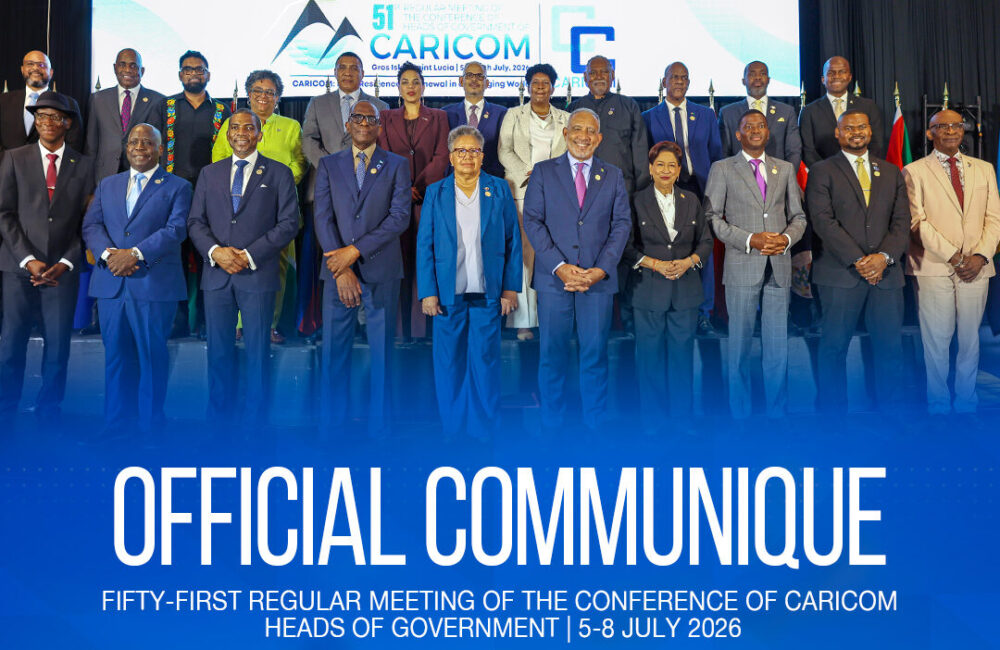
Guyana emerged as one of the dominant beneficiaries of the 51st CARICOM Heads of Government Meeting, securing regional backing on a series of high-profile initiatives ranging from its border controversy with Venezuela and its bid to host the 2030 United Nations Climate Change Conference (COP35) to its nominee for United Nations Secretary-General. The breadth of support has drawn attention to Georgetown’s growing influence within the 15-member bloc, an influence that has expanded alongside the country’s emergence as the Caribbean’s fastest-growing oil producer.
While the four-day summit in Gros Islet, Saint Lucia, addressed familiar regional concerns such as the rising cost of living, climate change, food security, Haiti and regional security, many of the headline decisions centred on Guyana. Observers are likely to note that several longstanding challenges confronting ordinary Caribbean citizens—including persistently high food prices, youth unemployment, violent crime and the slow pace of implementing the CARICOM Single Market and Economy (CSME)—received broad policy commitments but few concrete, time-bound actions.
President Irfaan Ali attended the July 5-8 meeting alongside Ambassador Carolyn Rodrigues-Birkett, Guyana’s Permanent Representative to the United Nations, whose campaign for the UN’s top diplomatic post received a significant regional boost.
In one of the summit’s most consequential decisions, Heads of Government unanimously endorsed Rodrigues-Birkett as the Caribbean Community’s candidate for United Nations Secretary-General.
The leaders said they “strongly welcomed Guyana’s nomination of Ambassador Carolyn Rodrigues-Birkett and expressed their full endorsement for her candidacy,” positioning the veteran diplomat to seek wider international support ahead of the UN selection process.
CARICOM also reaffirmed its “unequivocal and unwavering support” for Guyana’s sovereignty and territorial integrity in its ongoing border controversy with Venezuela.
Heads of Government noted that oral hearings before the International Court of Justice (ICJ) on the validity of the 1899 Arbitral Award concluded in May and that the Court’s eventual judgment would be “final and binding.”
The Conference also expressed concern that Venezuelan territory was allegedly being used to launch attacks against Guyanese security personnel operating within Guyana’s sovereign territory.
The leaders said they expected “the Government of the Bolivarian Republic of Venezuela will apprehend the perpetrators and place them before the judicial authorities in Venezuela.”
Guyana also secured continued regional backing for its bid to host COP35 in 2030 under the United Nations Framework Convention on Climate Change. CARICOM endorsed the Community’s Climate Diplomacy and COP35 Framework for 2026-2030 and urged high-level participation in the Second Global Biodiversity Alliance Summit, which Guyana will host from October 26-28 this year.
The country also won approval to host two major regional events after Heads of Government accepted Guyana’s offers to stage CARIFESTA 2027 and the CARIFTA Games 2027.
Beyond Guyana’s agenda, CARICOM leaders acknowledged that the rising cost of living remains the Region’s foremost concern, attributing inflation to geopolitical conflicts, supply chain disruptions and global economic uncertainty. They discussed expanding labour mobility, activating an intraregional ferry service, strengthening cross-border payment systems and deepening regional capital markets to advance the CSME.
However, despite repeated acknowledgements that Caribbean families continue to grapple with soaring food prices and declining purchasing power, the communiqué stopped short of announcing any coordinated regional programme or immediate relief measures. Earlier this week, Barbados Prime Minister Mia Mottley had called on the Caribbean private sector to play a greater role in reducing food prices and easing the burden on consumers, underscoring the urgency of an issue that continues to dominate household budgets across the Region.
Heads of Government also agreed to establish a Blue-Ribbon Commission of regional and international experts to develop a CARICOM policy framework on artificial intelligence, including governance standards and capacity-building priorities.
On Haiti, the Conference reaffirmed its support for the Haitian Government and agreed to provide humanitarian assistance as security conditions gradually improve. Guyana committed an initial shipment of 500 tonnes of rice, while CARICOM also agreed to support renewal of the Gang Suppression Force’s mandate and consider The Bahamas’ proposal for a permanent CARICOM presence in Port-au-Prince.
The leaders approved the “CARICOM Ten Point Plan for Reparations: A Manifesto for the Coming Enlightenment,” while also welcoming French Guiana as CARICOM’s eighth Associate Member, joining Martinique, which became an Associate Member in June.
On governance, Heads of Government agreed to seek an advisory opinion from the Caribbean Court of Justice (CCJ) after Trinidad and Tobago maintained its objection to the process used to reappoint CARICOM Secretary-General Dr. Carla Barnett. The Community said the current arrangements would remain in place pending the Court’s opinion.
For Guyana, the summit was unquestionably a diplomatic success. It left Saint Lucia with regional endorsement for its border case, its climate ambitions, its candidate for the world’s highest diplomatic office, and two major regional events.
For the wider Caribbean, however, the more difficult question remains whether ordinary citizens—struggling with high food prices, unaffordable housing, crime, stagnant wages and sluggish economic integration—will see tangible benefits from another summit heavy on declarations and endorsements. As CARICOM celebrates another round of consensus, many across the Region will be watching to see whether those commitments translate into measurable action or become yet another communiqué long on ambition but short on delivery.