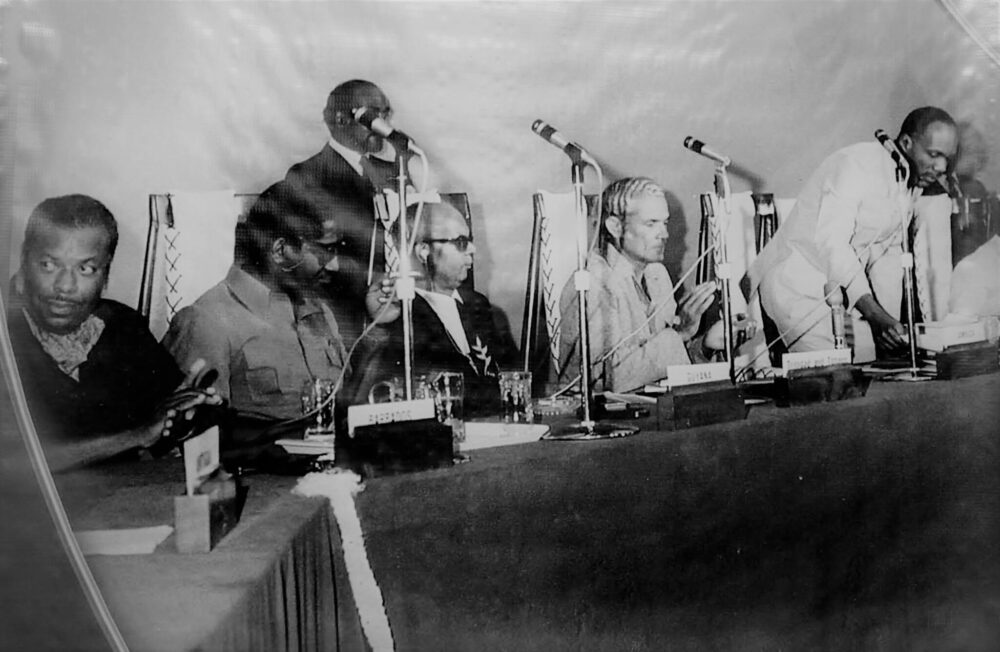
Fifty-three years after the signing of the Treaty of Chaguaramas, the Caribbean Community (CARICOM) remains one of the world’s longest-standing regional integration movements—a powerful symbol of Caribbean resilience, self-determination and the conviction that the region’s future would be stronger through unity than division.
That vision was championed by four statesmen whose names have become inseparable from the Caribbean integration movement: Prime Ministers Errol Barrow of Barbados, Forbes Burnham of Guyana, Dr. Eric Williams of Trinidad and Tobago and Michael Manley of Jamaica. Their signatures on the Treaty of Chaguaramas on July 4, 1973, transformed decades of political aspiration into the Caribbean Community, creating an institution that has endured for more than half a century. The achievement was not without challenges.
CARICOM’s roots lie in the collapse of the British West Indies Federation in 1962. Although the Federation’s failure ended the Caribbean’s first formal experiment in political union, history records that its demise became “the real beginning of what is now the Caribbean Community.”
Rather than allowing that setback to define the region’s future, Caribbean leaders turned disappointment into determination. They resolved to preserve and strengthen cooperation among the islands and mainland territories, convinced that shared history, culture and economic interests demanded a common destiny.
The momentum was reinforced when Jamaica and Trinidad and Tobago attained independence in August 1962, gaining full control over their domestic and foreign affairs and ushering in a new era of Caribbean self-governance.
It was during this period that the Government of Trinidad and Tobago advanced an ambitious proposal for a Caribbean Community embracing not only the former Federation’s members but also the three Guianas and every island in the Caribbean Sea, whether independent or still under colonial administration.
That vision began taking practical shape in July 1963 when Trinidad and Tobago convened the first Conference of Heads of Government, attended by the leaders of Barbados, British Guiana, Jamaica and Trinidad and Tobago. According to the historical record, the four leaders “all spoke clearly of the need for close cooperation with Europe, Africa and Latin America,” signalling the Caribbean’s intention to engage the wider world as a united region.
Momentum accelerated in 1965 when discussions among the Premiers of Barbados and British Guiana and the Chief Minister of Antigua produced concrete plans for a Caribbean Free Trade Area. By December that year, Antigua, Barbados and British Guiana signed the Dickenson Bay Agreement establishing the Caribbean Free Trade Association (CARIFTA).
CARIFTA came into force on May 1, 1968, with Antigua, Barbados, Guyana and Trinidad and Tobago as its founding participants. Later that year, Dominica, Grenada, St. Kitts/Nevis/Anguilla, Saint Lucia, St. Vincent, Jamaica and Montserrat joined the Association, followed by British Honduras, now Belize, in May 1971.
Recognising that economic cooperation alone could not fulfil the aspirations of Caribbean people, regional leaders agreed at the Seventh Heads of Government Conference in October 1972 to transform CARIFTA into a Common Market and establish the Caribbean Community.
That historic decision culminated in Georgetown, Guyana, in April 1973, where Heads of Government finalised the legal instruments for the Treaty of Chaguaramas. On July 4, 1973, Barrow, Burnham, Williams and Manley formally signed the Treaty, forever securing their place as the Founding Fathers of CARICOM.
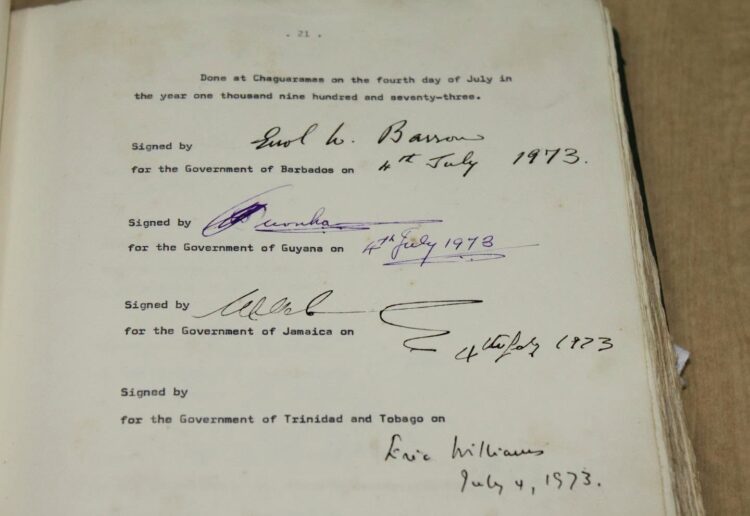
The Treaty entered into force on August 1, 1973, establishing the Caribbean Community and Common Market (CARICOM). The Georgetown Accord also paved the way for Antigua, British Honduras (Belize), Dominica, Grenada, Saint Lucia, Montserrat, St. Kitts/Nevis/Anguilla and St. Vincent to become full members by May 1, 1974.
Today, CARICOM comprises 15 full Member States: Antigua and Barbuda, The Bahamas, Barbados, Belize, Dominica, Grenada, Guyana, Haiti, Jamaica, Montserrat, Saint Kitts and Nevis, Saint Lucia, Saint Vincent and the Grenadines, Suriname and Trinidad and Tobago.
The Community is also supported by six Associate Members: Anguilla, Bermuda, British Virgin Islands, Cayman Islands, Turks and Caicos Islands and Martinique.
More than five decades after its birth, CARICOM remains far more than a regional institution. It is the enduring legacy of four visionary leaders and generations of Caribbean people who believed that despite differences of size, language and geography, the region’s greatest strength would always lie in its unity.