


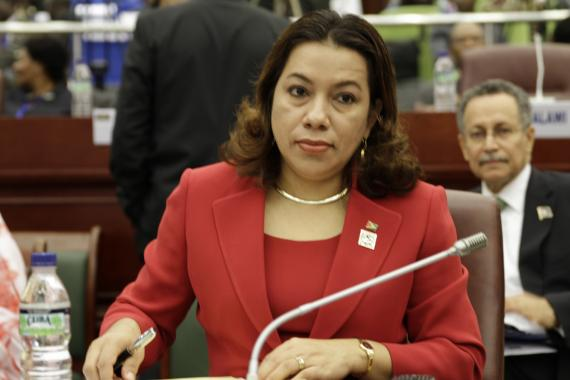
Guyana’s decision to nominate its Permanent Representative to the United Nations, Ambassador Carolyn Rodrigues-Birkett, for the post of United Nations Secretary-General has elevated the country’s international profile, but political analyst Earl Manget believes the former foreign minister faces formidable hurdles in a race dominated by globally renowned statesmen and seasoned diplomats.
In a Facebook post, Manget described President Irfaan Ali’s nomination as an opportunity to showcase Guyana on the world stage, while cautioning that Rodrigues-Birkett’s quest for the UN’s highest office remains “a steep hill to climb.”
If elected, Rodrigues-Birkett would make history as the first woman to serve as Secretary-General of the United Nations, succeeding António Guterres of Portugal when his second five-year term ends in December 2026.
Manget noted that previous holders of the office—including Kofi Annan, Ban Ki-moon, Boutros Boutros-Ghali, Javier Pérez de Cuéllar, Dag Hammarskjöld and Trygve Lie—had already earned international distinction before assuming the world’s most prominent diplomatic role.
“The achievements of these men were stupendous. How they handled global controversies, conflicts, and crises was a measure of their sage diplomacy and statesmanship, political acumen, and towering leadership. Most had already distinguished themselves on the world stage before they were elevated to the top post,” he wrote.
While describing the nomination as one that could “increase Guyana’s visibility globally” and demonstrate “the capabilities of its people,” Manget argued that the candidacy will inevitably place both Rodrigues-Birkett and Guyana under heightened international scrutiny.
“The candidate’s experience, qualifications, leadership, and the policies and initiatives she espouses will be examined. However, she doesn’t exist in a vacuum. Guyana will, likewise, face increasing international scrutiny,” he said.
According to Manget, anyone aspiring to become the UN’s chief administrative officer and global mediator must demonstrate a clear vision on issues ranging from international peace and security to climate change, multilateralism, humanitarian law, institutional reform and the growing disregard for international law.
He stressed that, unlike a national political office, the Secretary-General must function independently of the government that nominated him or her.
“Ambassador Birkett wouldn’t be carrying out the dictates of any specific political party or government. If selected and appointed, she would be designated to act as an independent diplomat who advocates for the interests of all global citizens, all 8 billion of them. She must act in pursuit of the common good.”
Manget said experience could prove decisive in a field of internationally distinguished candidates. Among those seeking the post are former Chilean President Michelle Bachelet, who also served as Executive Director of UN Women and United Nations High Commissioner for Human Rights; Director General of the International Atomic Energy Agency (IAEA) Rafael Grossi, one of the world’s leading nuclear diplomats; United Nations Conference on Trade and Development (UNCTAD) Secretary-General and former Costa Rican Vice-President Rebeca Grynspan, an internationally respected development economist; former President of the United Nations General Assembly María Fernanda Espinosa of Ecuador, who also served as her country’s foreign and defence minister; and former Senegalese President and African Union Chairperson Macky Sall, an influential advocate for African development and reform of global governance institutions.
Against that backdrop, Manget questioned whether Rodrigues-Birkett has developed the international profile typically associated with candidates for the UN’s highest office.
While acknowledging Guyana’s positions on major international issues, he said there remains “a relative paucity of scholarly works (articles in reputable foreign affairs journals, presentations at international policy forums, conference papers, etc.) to glean any innovative strategies she might deploy to deal with crisis prevention, conflict resolution, UN institutional reform, enforcement of humanitarian law, and other global realities.”
Although he said her performance during this week’s televised interactive dialogues suggested “she could be up to the task,” he maintained that experience remains a defining factor in the contest.
“The breadth of experience they have amassed is a far cry from leading a foreign mission or a government department,” Manget observed, noting that the United Nations’ financial challenges also demand proven administrative and management capabilities.
He contrasted Rodrigues-Birkett’s international standing with that of Barbadian Prime Minister Mia Mottley, whose advocacy on climate finance reform and the interests of developing countries has earned widespread recognition within the international community.
“She definitely has the bona fides,” he remarked.
Manget also underscored the intensely political nature of the Secretary-General selection process.
Although no formal qualifications exist for the office, candidates must first secure the backing of the 15-member UN Security Council. Any recommendation requires at least nine votes and, crucially, no veto from any of the Council’s five permanent members—China, France, Russia, the United Kingdom and the United States. The successful nominee is then presented to the 193-member General Assembly for formal appointment, traditionally by acclamation.
“The behind-the-scenes jockeying for votes is reflected in the ‘straw polls’ as candidates fall by the wayside and dark horses emerge. In the final analysis, it’s the five permanent members of the UNSC… who will ultimately determine the next secretary-general,” Manget wrote.
Still, he cautioned against dismissing Guyana’s chances outright.
Recalling the late Dr. Mohamed Shahabuddeen’s election to the International Court of Justice in 1987, Manget noted that the distinguished Guyanese jurist overcame long odds to defeat a heavily favoured Brazilian candidate after multiple rounds of voting.
He attributed that victory in part to Guyana’s international reputation at the time, particularly its leadership in the anti-apartheid struggle, support for Namibian independence and advocacy for the Palestinian cause through the United Nations and the Non-Aligned Movement.
“Maybe the government and current delegation have the same goodwill working for them and, with a cadre of seasoned diplomats guiding the candidate, she could make a case as to why she’s the best person for the post. Wish her well.”
See full post below:
CAROLYN RODRIGUES BIRKETT’S BID FOR UN SECRETARY GENERAL: A Steep Hill to Climb
Guyana’s President H.E. Dr. Irfaan Ali has nominated the current Permanent Representative to the United Nations (UN), H.E. Carolyn Rodrigues Birkette for the post of UN Secretary General. If selected, she would be the first female to head that august institution, following in the hallowed footsteps of the incumbent António Manuel de Oliveira Guterres (Portugal), as well as former secretaries-general Ban Ki-moon (Republic of Korea), Kofi Annan (Ghana), Boutros Boutros-Ghali (Egypt), Javier Pèrez de Cuèllar (Peru), Kurt Waldheim (Austria), U Thant (Burma, now Myanmar), Dag Hammarskjöld (Sweden), and Trygve Lie (Norway).
The achievements of these men were stupendous. How they handled global controversies, conflicts, and crises was a measure of their sage diplomacy and statemanship, political acumen, and towering leadership. Most had already distinguished themselves on the world stage before they were elevated to the top post.
At this juncture in Guyana’s history, this nomination could serve to increase Guyana’s visibility globally, to show the world the capabilities of its people. The candidate’s experience, qualifications, leadership, and the policies and initiatives she espouses will be examined. However, she doesn’t exist in a vacuum. Guyana will, likewise, face increasing international scrutiny. Profound existential questions await the nominee concerning matters of peace, security, multilaterialism, human rights, climate change, increasing disregard for international law, and gridlock at the UN. How does her worldview align with the three pillars of the UN? Can the political ethos of the party, government, and country she represents be translated to prioritize and deal with major issues on the global agenda? Remember, as the chief administrative officer and a global mediator for the UN, Ambassador Birkett wouldn’t be carrying out the dictates of any specific political party or government. If selected and appointed, she would be designated to act as an independent diplomat who advocates for the interests of all global citizens, all 8 billion of them. She must act in pursuit of the common good.
We know enough of Guyana’s views on specific global issues, sometimes subjected to the winds of change and pressure politics. However, there is a relative paucity of scholarly works (articles in reputable foreign affairs journals, presentations at international policy forums, conference papers, etc.) to glean any innovative strategies she might deploy to deal with crisis prevention, conflict resolution, UN institutional reform, enforcement of humanitarian law, and other global realities. How would she contend with the inevitable crisis situation, one after another, while navigating a heavily bureaucratic institution, comprising member nations driven by competing and conflicting agendas?
Her presentation at the televized “interactive dialogues” this week suggests that she could up to the task but there’s a steep learning curve ahead. This harkens to the important question of experience vis-à-vis the competition. The list includes: Michelle Bachelet Jeria: Former President of Chile and former UN High Commissioner for Human Rights (backed by Brazil, Chile, and Mexico); Rafael Mariano Grossi: Director-General of the International Atomic Energy Agency, IAEA (backed by Argentina); Rebeca Grynspan Mayufis: Secretary-General of UNCTAD and former Vice President of Costa Rica (backed by Costa Rica); Macky Sall: Former President of Senegal (backed by Burundi); and María Fernanda Espinosa Garcés: Former President of the UN General Assembly and Ecuadorian diplomat and linguist (backed by Antigua and Barbuda, no less!).
The breath of experience they have amassed is a far cry from leading a foreign mission or a government department. Here, among other things, financial management and accountability is paramount, given the UN’s ongoing systemic budget deficits. In this regard, Guyana’s candidate has hardly made a ripple on the world stage. At least, not in the same way as Barbadian Prime Minister
Mia Mottley, whose strident advocacy for climate finance reform, the cause of developing nations and multilateralism has garnered her recognition as a highly influential voice at the UN. She definitely has the bona fides.
Next, there’s the question of where the support would come from. The selection process is two-fold. The UN Security Council (UNSC), through a series of “straw polls,” decides on one candidate who must meet the 9-vote threshold (out of 15). If a permanent member of the council vetoes a candidate that puts an end to the candidature. Once the Security Council recommends a candidate, the UN General Assembly then votes to formalize the appointment, traditionally by acclamation.
The behind the scenes jockeying for votes is reflected in the “straw polls” as candidates fall by the wayside and dark horses emerge. In the final analysis, it’s the five permanent members of the UNSC – China, France, Russia, the United Kingdom and the United States – who will ultimately determine the next secretary general.
Interestingly, no formal qualifications have been set out for the position, despite efforts of France and China to establish some qualifications through precedents. The United States and the United Kingdom have supported candidates who don’t meet the Sino-French requirements. China and France have also insisted candidates speak both English and French. Mais oui, Mde. Birkett.
With prominent Latin Americans in the fray, and a lone African candidate mixing it up, let the diplomatic haggling begin!
Longshots can and do pull off upsets. I recall the late Dr. Mohamed Shahabuddeen, former Attorney General and Minister of Justice of Guyana, was given little chance when he unseated Brazilian diplomat and jurist José Sette-Câmara Filho and was elected to the International Court of Justice ,(ICJ) in 1987. It was even suggested that Dr. Shahabuddeen should wait his turn and try instead for the International Criminal Court (ICC). After several rounds of balloting, the Guyana delegation at the UN was able to muster a groundswell of support, especially from African countries grateful for the outsized role Guyana had hitherto played in the fight against apartheid, Namibian independence, and the Palestinian cause at the UN and in the Non-Aligned Movement.
Maybe the government and current delegation have the same goodwill working for them and, with a cadre of seasoned diplomats guiding the candidate, she could make a case as to why she’s the best person for the post. Wish her well.
(Posted by Earl Manget on Facebook)





![Photo taken on July 14, 2020 shows the Golden Bauhinia Square in Hong Kong. [Photo/Xinhua]](https://sp-ao.shortpixel.ai/client/to_webp,q_glossy,ret_img,w_120,h_86/https://villagevoicenews.com/wp-content/uploads/2022/12/golden-120x86.jpeg)


