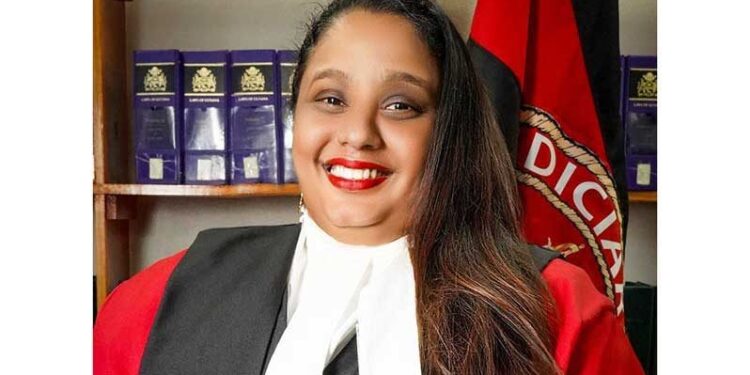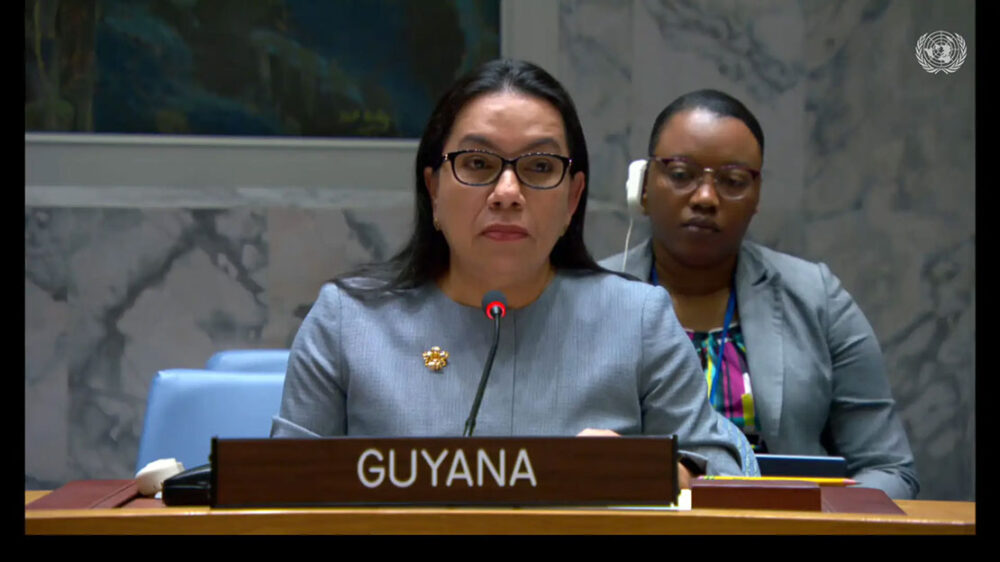
Guyana’s decision to nominate Ambassador Carolyn Rodrigues-Birkett for the position of United Nations Secretary-General has been met with rare bipartisan support at home, but the announcement has also drawn attention to the formidable international challenge that lies ahead.
On Friday, President Irfaan Ali announced that Guyana will formally nominate Rodrigues-Birkett to succeed António Guterres when his second term expires on December 31, 2026.
The nomination represents perhaps the most ambitious diplomatic undertaking in Guyana’s history and signals the country’s belief that its growing international profile qualifies it to put forward a candidate for the world’s most important multilateral office.
“Over the past several years, Guyana has emerged as an influential voice on the global stage,” President Ali said, citing Guyana’s recent tenure on the United Nations Security Council and its advocacy on climate change, food security, biodiversity and the interests of small developing states.
The President argued that Rodrigues-Birkett possesses the qualifications required to lead the organisation.
“Ambassador Rodrigues Birkett has acquired the experience, expertise, judgement, and diplomatic skills necessary to perform ably and effectively carry out the duties of Secretary-General of the United Nations,” he said.
The Alliance For Change (AFC) quickly endorsed the nomination, describing Rodrigues-Birkett as possessing the “experience, diplomatic acumen, integrity, and global perspective” needed to lead the United Nations at a time of growing international instability.
The party called on the Government to immediately engage CARICOM, the Commonwealth, the Organisation of American States and other international bodies to secure support for the candidacy.
The endorsement is notable because it creates a rare moment of political consensus in Guyana, where the Government and Opposition are often sharply divided on major national issues.
Yet while there appears to be little disagreement about Rodrigues-Birkett’s credentials, a more difficult question remains: can a diplomat from a small developing state realistically secure the world’s most powerful diplomatic position?
Rodrigues-Birkett enters the contest with a lengthy record of service in diplomacy and government, though her experience will inevitably be measured against that of candidates who have led nations, major international agencies, or both.
She has served as Guyana’s Permanent Representative to the United Nations since 2020, led Guyana’s participation during its Security Council tenure, served as Foreign Minister from 2008 to 2015, headed the Food and Agriculture Organization’s liaison office in Geneva from 2017 to 2020, and previously served as Minister of Amerindian Affairs from 2001 to 2008.
Perhaps most significantly, she served as President of the 65th Session of the United Nations General Assembly, one of the highest offices ever held by a Guyanese diplomat.
However, the race for Secretary-General is rarely determined by qualifications alone.
Under the UN selection process, candidates must first secure the recommendation of the Security Council before being appointed by the 193-member General Assembly. Any one of the five permanent members of the Security Council—the United States, China, Russia, the United Kingdom or France—can effectively block a candidate through the use of its veto.
The process is therefore as much a geopolitical contest as it is an assessment of professional qualifications.
While no formal requirements are stipulated in the UN Charter, successful candidates have traditionally emerged from the ranks of senior diplomats, foreign ministers, prime ministers, presidents or leaders of major international institutions. Fluency in English and French, the principal working languages of the United Nations, is generally expected, while proficiency in additional UN languages is considered an asset.
Rodrigues-Birkett is expected to face competition from several internationally recognised figures.
Among the names frequently mentioned are former Chilean President Michelle Bachelet, who also served as United Nations High Commissioner for Human Rights; Rebeca Grynspan, the former Vice President of Costa Rica and current Secretary-General of the United Nations Conference on Trade and Development (UNCTAD); and Argentine diplomat Rafael Grossi, Director General of the International Atomic Energy Agency (IAEA).
Each brings credentials that could prove attractive to member states. Bachelet has served as both a head of state and a senior UN official. Grynspan currently leads a major UN institution and is widely respected in development and economic policy circles. Grossi has spent years negotiating directly with major powers on issues involving nuclear security, Iran, Ukraine and global non-proliferation efforts.
Rodrigues-Birkett’s path may be further complicated by competition emerging from within the wider Latin American and Caribbean region itself.
Earlier this year, Antigua and Barbuda—a fellow CARICOM member state and one of Guyana’s regional partners within the Caribbean Community—formally nominated Ecuadorian diplomat María Fernanda Espinosa Garcés to succeed Guterres.
Espinosa brings significant credentials of her own. She has served as Ecuador’s Foreign Minister, Minister of Defence, Permanent Representative to the United Nations, and President of the 73rd Session of the United Nations General Assembly.
The nomination introduces an additional dimension to the race. While many diplomats believe the principle of regional rotation favours a candidate from Latin America and the Caribbean, multiple candidacies from the same region could potentially divide support that might otherwise coalesce around a single nominee.
It also raises questions about whether CARICOM member states will eventually unite behind one candidate or whether individual states will pursue their own diplomatic preferences.
Another factor shaping the race is the growing international campaign for the United Nations to appoint its first female Secretary-General. In the organisation’s 80-year history, the position has never been held by a woman.
That sentiment could work in Rodrigues-Birkett’s favour. However, if member states rally behind the idea of electing a woman, she would still find herself competing against candidates such as Bachelet, Grynspan and Espinosa, all of whom possess extensive international experience and broader global visibility.
For Guyana, the nomination itself is significant. It reflects not only the confidence of a country that has become increasingly visible in international affairs through its recent Security Council tenure, but also the legacy of a foreign service that earned international respect in the post-independence era.
Under the administrations of the People’s National Congress (PNC) led by Forbes Burnham and later Desmond Hoyte, which guided Guyana through Independence and the formative decades that followed, the country built a diplomatic corps that frequently punched above its weight internationally. Guyana became a prominent advocate for decolonisation, non-alignment, the struggle against apartheid, national sovereignty, South-South cooperation and the interests of developing nations. Despite its small size, it established a reputation as an active and influential participant in global affairs, particularly within the United Nations, the Commonwealth and the Non-Aligned Movement.
Rodrigues-Birkett’s candidacy may benefit from that tradition. Her own diplomatic career has been shaped by a foreign service that produced generations of respected diplomats and helped position Guyana as a credible voice in multilateral diplomacy.
Yet history alone will not secure the office. The realities of contemporary geopolitics, competition from internationally recognised candidates, the strategic calculations of major powers and even competing nominations from within the wider Latin American and Caribbean region will all weigh heavily on the outcome.
Whether Rodrigues-Birkett ultimately succeeds may depend less on her qualifications than on whether Guyana can convert decades of diplomatic goodwill and its growing international profile into the broad coalition of support required to navigate the Security Council and secure the backing of the wider UN membership.
For now, the nomination stands as both a statement of national ambition and a test of whether a small state with a proud diplomatic tradition can elevate one of its own to the highest office in multilateral diplomacy.