ICJ 6 Powerful MEMBER Countries DEFY ICJ Rulings, USA, ISREAL, CHINA, UK, RUSSIA & THAILAND.
The International Court of Justice (ICJ) does not track a specific “number” of IGNORED rulings.
While NATIONS GENERALLY COMPLY, a number of landmark, legally binding judgments and provisional measures have been DEFILED.
The ICJ lacks DIRECT ENFORCEMENT POWER and relies on the UN Security Council, where veto-wielding members OFTEN BLOCK enforcement actions.
The following 6 countries have notably IGNORED ICJ rulings:
The United States: Defied the court’s 1986 binding judgment to pay reparations to Nicaragua for mining its harbors and funding the Contra rebels.
The U.S. also defied a 2018 provisional measure regarding certain Iranian sanctions, leading the U.S. to withdraw from the underlying treaty entirely.
Israel: Defied the court’s legally binding 2024 provisional measures ordering the state to prevent acts of genocide, halt military operations in Rafah, and allow unhindered humanitarian aid into the Gaza Strip.
China: Dismissed the ICJ-backed 2016 ruling in favor of the Philippines regarding maritime rights in the South China Sea.
The United Kingdom: Ignored a 2019 advisory opinion demanding the decolonization of the Chagos Islands.
Russia: Refused to comply with a 2022 binding provisional measure demanding the immediate suspension of its military invasion of Ukraine, as well as a subsequent 2024 judgment dismissing its jurisdictional objections in the genocide case brought by Ukraine.
Thailand: Refused to comply with a 1962 judgment (reaffirmed in 2013) requiring the withdrawal of its military forces from the Preah Vihear temple area on the Cambodian border.
MY PERSONAL RELATIONSHIPS BACK-CHANNEL prediction:
MERITS favour Guyana.
Venezuela’s “unknown” is whether it can flip 2-3 judges via Brazil/Mexico/Africa relationships.
JUDGES are independent, and 3 already RECUSED in jurisdiction phase for conflicts.
From the 15, a NARROW 8-7 or 9-6 WIN still BINDS Venezuela LEGALLY. Non-compliance = Diplomatic/Economic isolation, NOT Territory.
Guyana WINS
“The ICJ has spoken. Essequibo is Guyana’s. LAW WON. Our Borders are settled. Our Future is Ours. Now WE BUILD.
Both WIN / Peace
“Guyana’s title is secure. But peace is the real win. We choose partnership over protest, trade over tension. Two neighbours, ONE FUTURE.
Scenario 1: “Guyana WINS” — ICJ upholds the 1899 Arbitral Award
What the Court says: The 1899 Award is “valid and legally binding”. The boundary is the one drawn in 1899. Venezuela’s claim to Essequibo has no legal basis.
On the grounds:
Essequibo / Land:
Legal status : Essequibo remains Guyanese territory under international law. Venezuela’s “Zona en Reclamación” and its 2024 “State of Guyana Essequiba” law would have no legal standing.
Administration: Guyana continues to administer all of Essequibo — roads, police, schools, elections, mining licenses. No Venezuelan governor, no new Venezuelan state.
Ankoko Island: The island in the Cuyuni River is split. The 1899 map puts most of it on the Guyanese side. A Guyana win would lock that in — Venezuela keeps only what 1899 gave it.
Offshore / Oil Blocks:
Liza, Stabroek, Kaieteur, Corentyne, etc.: All current oil/gas blocks stay under Guyana’s control. ExxonMobil, Hess, CNOOC licenses are internationally recognized.
Investment confidence: A legal win removes “sovereign risk” from Venezuela’s claim. More investors, lower insurance, easier financing for new projects. Guyana’s NRF inflows get even stronger.
Enforcement/Diplomacy:
ICJ ruling is binding, but Venezuela has already said it WILL NOT respect it. Enforcement goes to UN Security Council. Realistically: Guyana gets stronger diplomatic backing, CARICOM/US/UK support, and can take Venezuela to UN/regional forums if it tries to seize land.
Day-to-day: No immediate Venezuelan withdrawal from disputed areas, but any Venezuelan military/police activity west of Essequibo River would be a clear breach of international law.
Risk: Venezuela could double down — more referendums, more maps, more rhetoric. But legally, Guyana’s title is settled.
Scenario 2: “Both WIN / PEACE” — ICJ affirms Guyana’s TITLE + calls for COOPERATION.
What the Court says: Same LEGAL finding — 1899 Award stands, Guyana owns Essequibo. BUT the judgment ADDS LANGUAGE urging “peaceful Co-existence, JOINT resource management, and non-use of force.” This is RARE , but courts sometimes DO IT in resource/territory CASES to prevent CONFLICT.
On the grounds:
Essequibo / Land:
Sovereignty: Still Guyana’s. Venezuela legally drops claim to annex territory. No “State of Guyana Essequiba.”
Cooperation zones: Court could suggest demilitarized border zones, joint customs, or cross-border development projects. Think “Guyana controls, Venezuela trades.” Ankoko Island stays split, but both sides agree with civilian access, trade, and tourism.
Offshore / Oil Blocks:
Guyana retains control of Stabroek, Liza, etc. No revenue-sharing required by the Court.
Voluntary JOINT projects: IF both agree, they could create a joint fisheries, gas pipelines, or environmental protection zones in disputed maritime areas. This would be political, not ordered by ICJ. Venezuela gets economic access without ceding sovereignty; Guyana gets stability + regional goodwill.
De-escalation: Oil companies face less risk of Venezuelan harassment/interference. Insurance rates drop.
Enforcement/Diplomacy:
Face-saving for Venezuela: Caracas can tell its public “we didn’t lose — we secured cooperation and respect.” That makes compliance more likely.
Long-term PEACE: Two oil-rich neighbors choose law + trade over conflict. CARICOM, Brazil, UN all back the framework. Sets precedent: even with oil, borders can be settled by law.
RISK: If cooperation never materializes, you default back to Scenario 1 — Guyana has the LAW, Venezuela has GRIEVANCE.
OVERALL
Guyana WINS = Legal clarity. Guyana gets 100% of Essequibo + all oil and holds the law as a shield.
BOTH WIN = Legal clarity + political bridge. Guyana still gets 100% LEGALLY, but BOTH SIDES get a ROADMAP to TRADE, INVEST, and AVOID WAR.
What WILL NOT change EITHER WAY : The ICJ DOES NOT “redraw” borders OR split oil. It rules on the 1899 Award. Any oil sharing or joint zones would have to be negotiated after, NOT ordered by judges.
“Guyana WINS” — Law Affirmed AT ICJ RULING
“Today, International Law spoke. The ICJ confirmed what Guyanese have always known — Essequibo is ours. The 1899 Award stands, and with it, our borders, our oil, and our future. This isn’t about revenge. It’s about justice. Guyana is small, but we stood on principle — and principle won. Now we build: more investment, more security, more opportunities for every Guyanese. The map is settled. Let the work begin.”
“Both WIN / Peace” — Law + Cooperation AT ICJ RULING
“The Court has spoken: Guyana’s title is secure. But the judges also reminded us — borders don’t have to mean battlefields. Guyana won in law, and now we offer Venezuela a choice: partnership over protest, trade over tension. We can share a border and share prosperity. Essequibo remains Guyanese, our oil remains ours, but peace remains open. Two oil-rich nations can show the world that law and development go hand in hand.”
GLOBALLY, WISE LEADERS and CITIZENS KNOW:
JUDGES are PEOPLE FIRST — they carry backgrounds, FRIENDSHIPS, national histories, and POLITICAL environments with them into the courtroom. In THREORY, the ICJ Statute DEMANDS total independence: JUDGES must not function as GOVERNMENT representatives, must have NO EXTERNAL influence, and must decide only on law and evidence.
BUT IN PRACTICE, influence CREEPS IN. Nationality SHAPES legal training and worldview. Governments NOMINATE and LOBBY for candidates. Friends, former colleagues, and diplomatic networks overlap. And when cases involve OIL, BORDERS, or major POWERS, the PRESSURE OUTSIDE The Hague IS REAL. So, while every JUDGMENT is written in the LANGUAGE of LAW, we CANNOT PRETEND JUDGES operate in a VACUUM— the HUMAN and POLITICAL context often SITS beside the LEGAL reasoning, even if it never makes it into the text.
Here’s the current ICJ bench as of 2026 — the 15 judges who will decide Guyana v. Venezuela. No two judges are from the same country:
ICJ 15 Judges 2026, Nationalities, Role/Term
Yuji Iwasawa * Japan *President * since 3 March 2025
Julia Sebutinde *Uganda *Vice-President * 2024–2027
Peter Tomka * Slovakia *Judge since 2003
Ronny Abraham * France * Judge since 2005
Abdulqawi Ahmed Yusuf * Somalia *Judge since 2009
Xue Hanqin * China * Judge since 2010
Dalveer Bhandari * India * Judge since 2012
Leonardo Nemer Caldeira Brant * Brazil * Judge since 2022
Georg Nolte * Germany * Judge since 2021
Hilary Charlesworth * Australia * Judge since 2021
Sarah Hull Cleveland * United States * Judge since 2024
Juan Manuel Gómez Robledo Verduzco * Mexico * Judge since 2024
Bogdan-Lucian Aurescu * Romania * Judge since 2024
Dire Tladi * South Africa * Judge since 2024
Phoebe Okowa * Kenya * Judge since 12 Nov 2025
AD HOC 2 JUDGES for this case TO TOTAL 17 JUDGES
Because Guyana and Venezuela do not both have Nationals on the Bench, EACH PICKED ONE AD HOC JUDGE for THIS CASE ONLY:
GUYANA : Rüdiger Wolfrum
VENEZUELA: Philippe Couvreur
They BOTH sit with the 15 JUDGES and have EQUAL VOTING RIGHTS.
KEY THINGS PEOPLE WATCH
Regional BALANCE — The Statute tries to ensure representation from Africa, Asia, Latin America, Western Europe + others.
Independence RULE — Statute says judges “may not exercise any political or administrative function, and do not function as a representative of their home state.”
LEGALLY, votes are supposed to be on LAW + EVIDENCE…………….. But …………….. ELECTIONS are by GOVERNMENTS, and GEOPOLITICS around OIL/BORDERS ALWAYS shape the context OUTSIDE the COURTROOM.
https://www.icj-cij.org/cases-by-country
SWOT: Guyana vs Venezuela — ICJ Essequibo Case
The ICJ case is over the 1899 Arbitral Award. Guyana wants the Court to confirm Venezuela has no claim to the ∼61% of Guyana west of the Essequibo River.
Venezuela rejects ICJ jurisdiction and claims the 1899 award is “null & void”.
GUYANA Strengths
Strong LEGAL position: Guyana’s case rests on the 1899 Arbitral Award + 1966 Geneva Agreement Article IV(2) which refers disputes to “a means of settlement” — UN SG chose ICJ in 2018.
ICJ jurisdiction accepted: In Dec 2020 the ICJ ruled 12-4 it has jurisdiction to hear Guyana’s case on validity of 1899 Award. Venezuela boycotted but didn’t stop proceedings.
International backing: UK, US, Brazil, CARICOM, OAS, Commonwealth, EU, India all officially support Guyana’s sovereignty/territorial integrity.
No military escalation risk: Guyana has no standing army comparable to Venezuela. ICJ route avoids conflict.
Documentary evidence: British archives, maps, and 1899 Tribunal records back Guyana’s claim.
GUYANA Weaknesses
Small state vs Big Neighbor: Venezuela has 28M people + larger military/diplomatic reach. Guyana must rely on law, not power.
New OIL wealth = PRESSURE : ExxonMobil discoveries 2015+ made Essequibo valuable. Venezuela uses this to rally domestic support.
Limited ENFORCEMENT Power: ICJ has no police. If Venezuela ignores a ruling, Guyana needs UNSC/CARICOM/US support to enforce.
GUYANA Opportunities
FINAL, Binding Ruling: ICJ judgment would give Guyana permanent legal certainty, unlock full investment in offshore + Essequibo.
NRF Investment Signal: President Dr. Ali is now signaling NRF money can go abroad. Legal win boosts investor confidence. One MILLION BARREL of OIL per DAY by the late 2026.
Diaspora + Global Narrative: Frame as “small democracy vs revisionism” — good for climate/biodiversity leadership too.
GUYANA Threats
Venezuela’s Referendum/Non-Recognition: Dec 2023 referendum voted ∼95% to reject ICJ + claim Essequibo. Creates political pressure.
Referendum maps/“NEW STATE”: Venezuela created “Guayana Esequiba” state + ID cards. Could escalate if ICJ rules against them.
Regional ALLIES: Russia, China, Iran, Cuba back Venezuela DIPLOMATICALLY. Could VETO UNSC enforcement?
VENEZUELA Strengths
Political narrative: “1899 Award was fraud/arbitral tribunal bribed”. Plays well domestically. Unites people vs external threat.
Size & Leverage: Larger population, military, oil reserves. Can pressure Guyana via land border, migration, trade.
Non-participation strategy: By not appearing at ICJ, avoids legitimizing process while still contesting outcome politically.
Allies on UNSC: Russia, China can block enforcement if ICJ rules for Guyana.
VENEZUELA Weaknesses
Jurisdiction Lost: ICJ already ruled it has jurisdiction 2020. Boycotting now weakens legal credibility.
NO new evidence: Has NOT produced documents overturning 1899 Award. Case relies on process, not territory.
Economic Crisis: Sanctions + oil decline limit ability to sustain long legal/diplomatic fight.
Isolation on Issue: Even most Latin America states don’t back Venezuela’s claim. Brazil has troops on border, pro-Guyana.
VENEZUELA Opportunities
Delay Tactics: Refuse to participate, question ICJ, push bilateral talks instead of legal process.
Referendum Leverage: Use domestic VOTE to claim mandate, negotiate from “people’s will” position.
OIL Diplomacy: Offer Guyana energy cooperation if claim dropped — but Guyana unlikely to accept.
VENEZUELA Threats
Binding ICJ LOSS: IF ICJ confirms 1899 Award, Venezuela loses all legal ground. Further non-recognition = diplomatic isolation.
Sanctions Risk: Any MILITARY move into Essequibo would TRIGGER US/UK/CARICOM sanctions + Brazil response.
Domestic Backlash: IF GOVERNMENT CANNOT deliver Essequibo after years of rhetoric, opposition gains.
OVERALL ICJ OUTLLOK
LEGAL: Guyana is ahead. ICJ already has jurisdiction + Guyana’s documents are stronger.
POLITICAL: Venezuela is fighting in public opinion + UN, NOT the courtroom. With continuing DAILY HIGH Personal Relationships with TOP Leaders in Gulf Cooperation Council, OPEC, BRICS+, African Union, and their Ambassadors in 107 Nations.
ENFORCEMENT: Winner will need US/UK/Brazil/CARICOM to uphold RULING IF LOSER IGNORES IT.
TIMELINE & JUDGEMENT: Merits phase ongoing. Judgment likely 2026-2027.
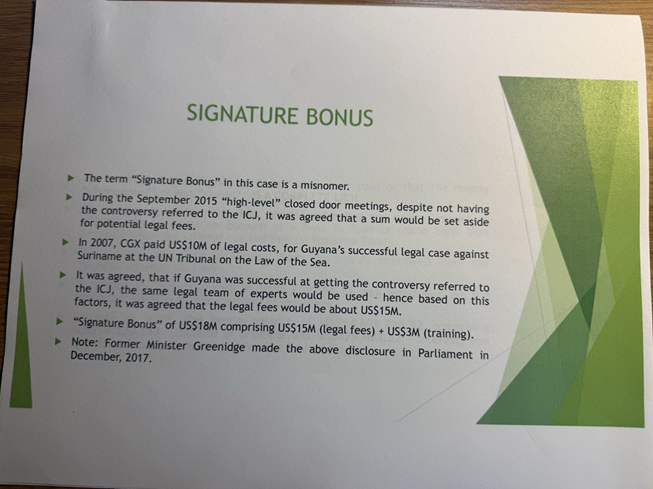
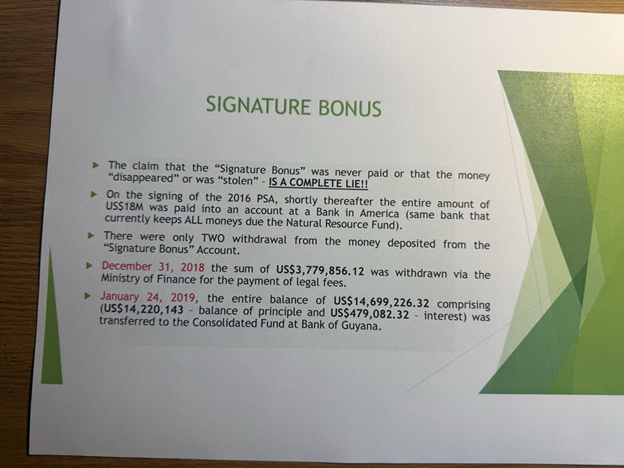
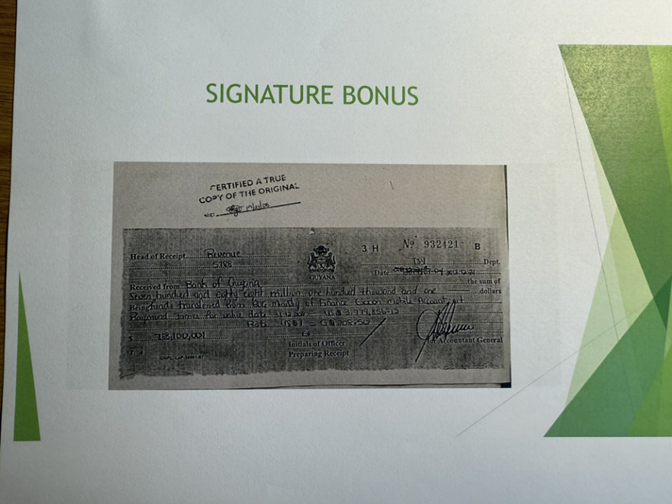
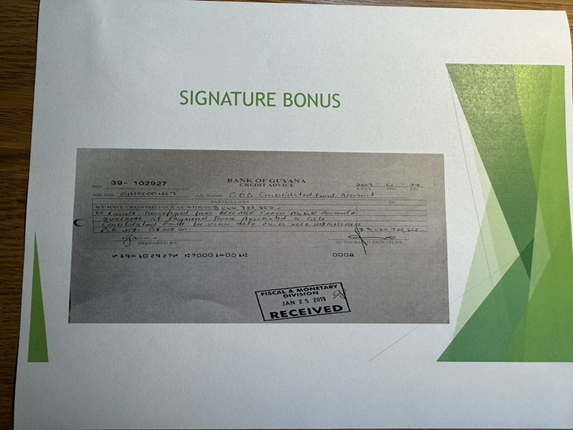
FACTS, TRUTH, with EVIDENCE on the USD $18M PSA BONUS from EXXON for ICJ Legal Expenses
Exxon USD $18 million. LOGISTICS. The USA BANK ACCOUNT was opened by the FINANCE SECRETARY, who SENT OUT a letter, which was copied to the Ministers of FINANCE and NATURAL RESOURCES. Also, the Finance Secretary and Governor of Bank of Guyana WOULD NOT have acted without instructions from the Senior Minister of Finance, and he, in turn, would have had to consult with His Excellency, the President, BEFORE, doing anything.
SILENCE OVER many YEARS by the Late Sir Shridath Ramphal, Guyana OIL Advisor & Attorney FOR EXXON & ICJ, and GOVERNOR of the BANK OF GUYANA, as blames are attributed to the 2015-2020 Minister of Natural Resources, when IN REALITY, the Minister of Natural Resources ALONE, COULD NOT, Conceptualize, Document and Execute the USD $18 Million from EXXON by himself. CHAIN of AUTHORITY applied.
Exxon USD $18 Million: LOGISTICS. The Finance Secretary had to be AUTHORIZED by the Minister of Finance in conjunction with the President. Therefore, The Minister of Natural Resources COULD NEVER OPEN the USA Bank Account in the NAME of GUYANA. This USA Account used; is the SAME ACCOUNT, EXXON is using for Natural Resource Fund NRF ROYALTIES to Guyana
QUOTE. “A picture is worth a thousand words” Fred R. Barnard
NEXT 5 Power Point PICTURES including Ministry of Finance AND Bank of Guyana RECEIPTS, with the Compliments of Hon. David Patterson, CHAIRMAN, AFC, and Shadow Minister of Natural Resources INCLUDING OIL.
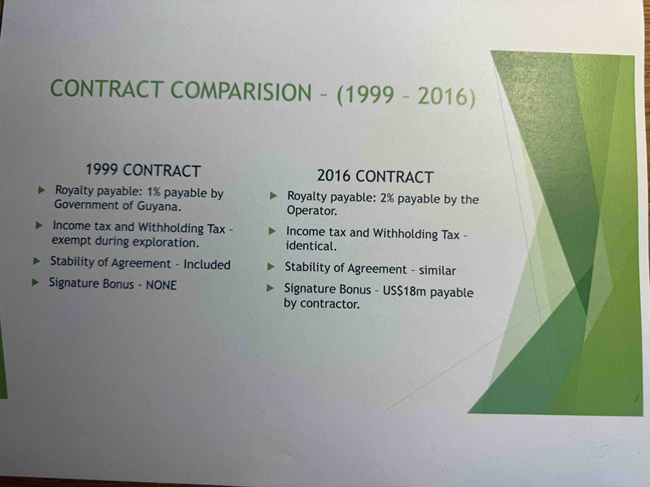
BOOK: “ From Destiny to Prosperity” by Raphael G.C. Trotman: Page 39: EXXON DEAL was the WORST EVER “ The 2016 agreement, was, for all intents and purposes, an IMPROVEMENT of the 1999 AGREEMENT. With ALL the DECLARATIONS about Guyana’s Economy being THE FASTEST GROWING and BEST IN THE HEMISPHERE. I DO NOT KNOW, how ANYONE can CONSCIOUSLY SAY that the AGREEMENT is the WORST EVER.”
“ Additionally, RYSTAD Energy, Wood McKenzie, and the IMF among others, HAVE CONFIRMED that Guyana’s Agreement is WITHIN the AVERAGE for NEW FRONTIER OIL Producers.” “ We are NOT arguing that it is the Best, BUT, given the circumstances ( Venezuela at the Border, and Exxon pressures for Agreement signing et al), IT CAN be IMPROVED, IF there is A WILL TO DO SO.”