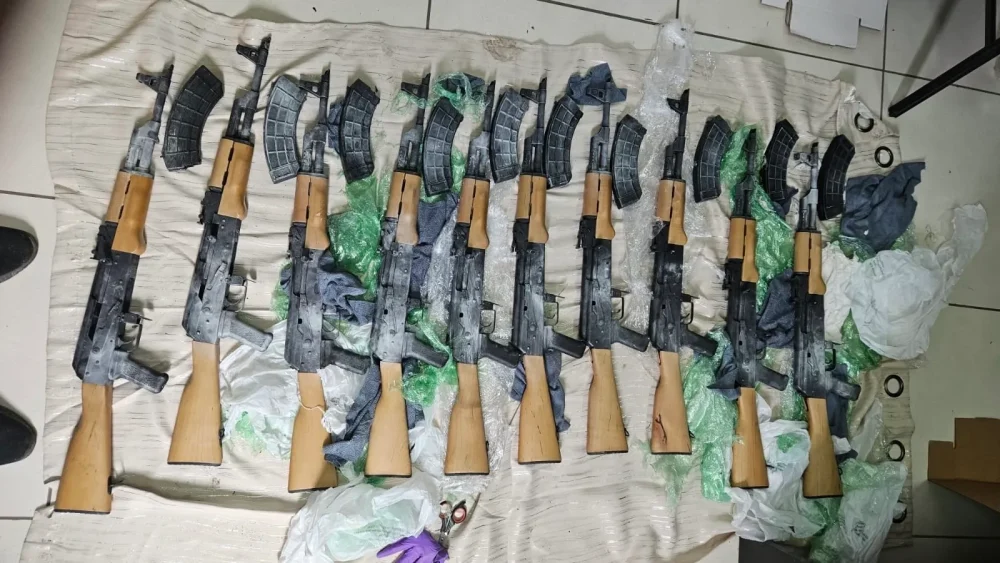
By Mark DaCosta- In a significant breakthrough for law enforcement, police have successfully intercepted ten AK-47 rifles believed to have been intended for criminal use. This operation, which unfolded on the early morning of May 22, 2026, along the No. 11 Village Public Road in Corentyne, Berbice, has illuminated the ongoing challenge posed by the proliferation of illegal firearms and raised urgent questions about security and governance.
During a strategic stop-and-search operation conducted between 1:00 AM and 4:30 AM, ranks from the police force were engaged in monitoring activities along the Berbice River Bridge Access Road when they attempted to halt a suspicious vehicle — a black Toyota Fielder Wagon, registered as HC 9018. The individual driving the car, however, evaded capture, fleeing the scene toward the east, which propelled law enforcement into action. Following intelligence received, police conducted a thorough search of No. 11 Village Public Road that culminated in the discovery of the rifles, which were found wrapped in plastic and cloth.
Upon inspection, the firearms exhibited the distinctive hallmarks of 7.62x39mm rifles and bore signs of tampering, indicating possible efforts to conceal their serial numbers. This is not merely a singular instance; it reflects a broader, unsettling trend where illegal firearms are being deliberately modified to thwart identification by authorities. After their recovery, these weapons were transported to the Central Police Station, where they will be stored pending further judicial proceedings.
As the investigation progressed, police identified the driver of HC 9018 as a 33-year-old taxi driver hailing from Goed Fortuin, West Bank Demerara. In a coordinated interception operation, authorities apprehended the suspect at Nabaclis, located on the East Coast, further heightening suspicions regarding the connection of this individual to larger networks engaged in the trafficking of illegal arms. Additionally, around 6:00 AM, another vehicle — a white Toyota Runx, registration number PSS 4272 — was found abandoned at Savannah Park in New Amsterdam. This vehicle is now a point of interest, as police suspect it may have played a role in the transportation of the confiscated firearms.
According to police sources, this disturbing incident is emblematic of a much more extensive issue facing our nation — a burgeoning illegal arms market that not only undercuts public safety but also threatens the very foundation of our society. The illicit proliferation of firearms in Guyana has become a pressing concern, one that intertwines itself with the evolving landscape of crime as the country continues to face economic opportunities coupled with security vulnerabilities. The absence of a domestic arms manufacturing industry means that every illegal weapon infiltrating our territories comes from abroad, flowing in from international hotspots of arms trade.
According to official statistics and other information from the Guyana Police Force (GPF), troubling patterns emerge which should cause alarm. Weapons are primarily sourced from North American and South American countries, with the United States and Brazil being the most prominent suppliers. Firearms from the U.S. often arrive in shipping containers or via personal luggage at major ports, while those from Brazil breach our porous borders, particularly in remote areas like the Rupununi region. This clandestine network is complemented by supply chains extending from Venezuela and even manufacturers as far afield as Italy and Turkey, creating a complex and deeply entrenched black market.
Recent data released by the GPF underscores both the gravity of the firearms crisis and the reactive measures taken by law enforcement. In 2024 alone, police seized a record-breaking 178 illegal firearms, with an additional 100 taken off the streets by mid-November 2025. Alarmingly, the statistics reveal a pronounced trend towards high-capacity semi-automatic pistols and handguns, indicating a shift in criminal preference likely driven by their ease of concealment and firepower. With over 30 percent of these weapons showing signs of serial number obliteration, it highlights a concerning trend where gangs actively evade the tracking of their operations.
Such firearms do not merely contribute to statistical tallies; they are integrated into the fabric of criminal enterprises, particularly those involved in armed robbery and drug trafficking. Guyana’s geographical position, serving as a link in the international cocaine supply chain, has escalated the stakes. Criminal elements exploit firearms to secure transit routes and defend their operations, heightening the troubling state of affairs within urban areas — Region 4A, including Georgetown, remains a principal site for firearm-related crimes, particularly during peak evening hours when urban commerce is active.
The ramifications of this arms influx extend far beyond mere numbers. The presence of illegal firearms cultivates a climate of fear among citizens, obstructing community development and breeding a sense of insecurity. The social and psychological toll is sufficiently severe, disrupting local economies and imposing additional demands on our strained public health system, which is burdened with the costs of treating victims of gun-related violence. Furthermore, this ongoing violence threatens to normalise the use of weapons among our youth, framing guns as symbols of status and survival rather than instruments of death.
According to police sources, to counter this growing threat, our law enforcement agencies must intensify collaboration and engage in intelligence-led operations, but they cannot navigate this crisis alone. Initiatives such as the CARICOM Gun Intelligence Unit and partnerships with international entities hold critical importance. Yet for lasting solutions, we must also tackle the socio-economic factors driving individuals toward criminal networks — merely fortifying borders without addressing the underlying demand will fall short of achieving true security.
With every illicit firearm intercepted, we stand at a critical juncture — not just for our law enforcement agencies, but for our society at large.