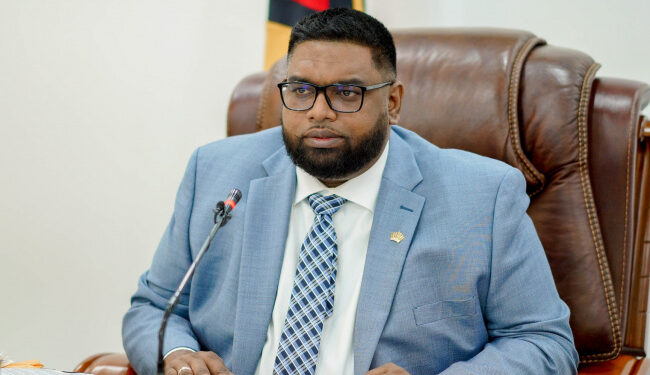
A desperate letter smuggled out of a remote Region Seven quarry has triggered a multi-agency investigation, a diplomatic crisis between Georgetown and New Delhi, and uncomfortable questions about who is truly protecting foreign workers on Guyanese soil — and whether the Ali administration is moving fast enough to answer that question.
The letter arrived at the office of the Toshao of Batavia Village as a desperate act of last resort. Penned by Indian nationals trapped inside a quarry compound deep in Guyana’s Region Seven — the rugged Cuyuni-Mazaruni interior accessible only by boat.
It described a world where workers could not leave without paying a $5,000 USD “exit fee” per person, where passports had been seized, where one of their colleagues had died, and where another had been repatriated after losing four fingers in a workplace accident.
These were not the conditions the men had been promised when they signed contracts to work for EKAA HRIM Earth Resources Management, a quarry operation owned by Coimbatore-based Indian businessman Saju Bhaskar. They were something far darker.
What has unfolded since that letter surfaced has shaken Guyana’s political and diplomatic establishment, triggered a multi-agency government probe, and drawn the sharp attention of anti-corruption watchdog Transparency International — whose Guyana chapter is now calling for a thorough and comprehensive investigation into what it describes as a failure of Guyana’s regulatory and labour systems at their most fundamental level.
The Letter That Broke the Silence
The 38 Indian nationals — primarily men aged 25 and older — had been employed at the EKAA HRIM quarry in Batavia Village on Amerindian Toshao land in Region Seven. Their allegations, when they finally reached Georgetown, were harrowing in scope: exploitative contracts that bore little resemblance to what they had agreed to in India, withheld wages and arbitrary salary cuts, starvation-level food provisions that failed to account for the fact that several workers were vegetarian, and a near-complete absence of proper medical facilities at a site that relied entirely on unreliable boat transport for any movement in or out.
Compounding all of this was the death of worker Sekhar Chhetri, whom colleagues allege died as a direct result of being forced to work under extreme duress without adequate rest or medical care. The company has publicly stated Chhetri died of a heart attack, a claim the Guyana Trade Union Congress says does not absolve the employer of legal and moral scrutiny.
A second worker was repatriated to India after losing four fingers in a workplace accident — his fate a grim testament to the safety standards that prevailed at the site. Workers also told reporters that for two years, no labour commissioner, health minister, or safety department officer had set foot at the quarry.
“No labour commissioner or minister has come there. The health minister also not come there. Safety Department, don’t ask. Never visited.” — Indian workers at the EKAA quarry, as reported by Kaieteur News
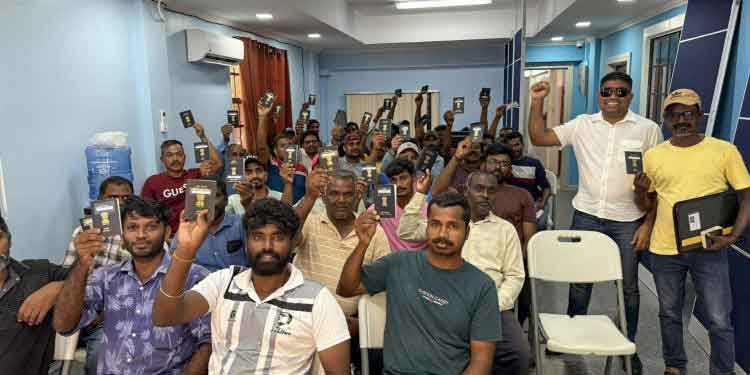
It was Opposition Leader Azruddin Mohamed who played the catalytic role in bringing the workers’ plight to national attention — transporting them from the interior to Georgetown and accompanying them to the Indian High Commission and the Ministry of Labour. On May 15, 2026, he formally urged the government to intervene. His description of what the workers endured was unequivocal: this, he said, amounted to human trafficking.
Passports as Chains
Among the most explosive allegations is the confiscation and withholding of the workers’ Indian passports by quarry management — a practice that civil society organisations and opposition figures have characterised as a criminal offence under Guyana’s Combating of Trafficking in Persons Act.
The Alliance for Labour and People (ALP) was blunt in its assessment: “Under Guyana’s Combating of Trafficking in Persons Act, passport confiscation alone is a criminal offence. No worker on Guyanese soil should be stripped of their freedom or dignity for someone else’s profit.”
Minister of Labour Keoma Griffith moved swiftly once the crisis became public. Following an emergency meeting with Acting Indian High Commissioner to Guyana, Manoj Kumar, he issued a 24-hour ultimatum to EKAA HRIM demanding the return of the passports.
By his account, the documents were returned within a short turnaround. However, the Minister stopped well short of characterising the confiscation as trafficking, declining to make that determination pending a fuller investigation. “I’m not going to make an allegation of human trafficking without a demand,” he said.
That measured posture has itself become a source of controversy. Critics — including Kaieteur News and multiple civil society organisations — pointed out that the government chose to grant the company a 24-hour grace period to respond rather than initiating immediate prosecutions, despite what they describe as overwhelming and visible evidence of illegality.
For those workers who had effectively been held in the interior, the grace period felt less like due process and more like institutional deference to a well-connected investor.
A Company With Presidential Connections
EKAA HRIM Earth Resources Management is not an obscure operation. The company, owned by Saju Bhaskar — the Coimbatore-based head of Texila University — holds a 15-year renewable lease on the Batavia quarry, with an option to extend at the end of that period.
By the company’s own figures, US$10 million has already been invested in the operation, with total projected costs reaching US$20 million upon completion.
More significantly, the quarry’s commissioning ceremony in September 2023 was attended by President Dr. Irfaan Ali himself, with the Ministry of Natural Resources sharing photographs of the event on social media.
That high-profile governmental endorsement is now the source of pointed questions. If the President was present to celebrate this investment, critics ask, why were two years allowed to pass without a single regulatory visit to inspect the conditions of the workers who made it operate?
EKAA HRIM has denied the workers’ allegations. Minister Griffith confirmed that company representatives provided explanations for the outstanding wage payments, though he was awaiting further documentation.
The denial, however, sits uneasily alongside the fact that the passports were returned almost immediately upon government demand — an act that critics argue implicitly acknowledges the wrongfulness of their original retention.
Transparency International Calls for Accountability
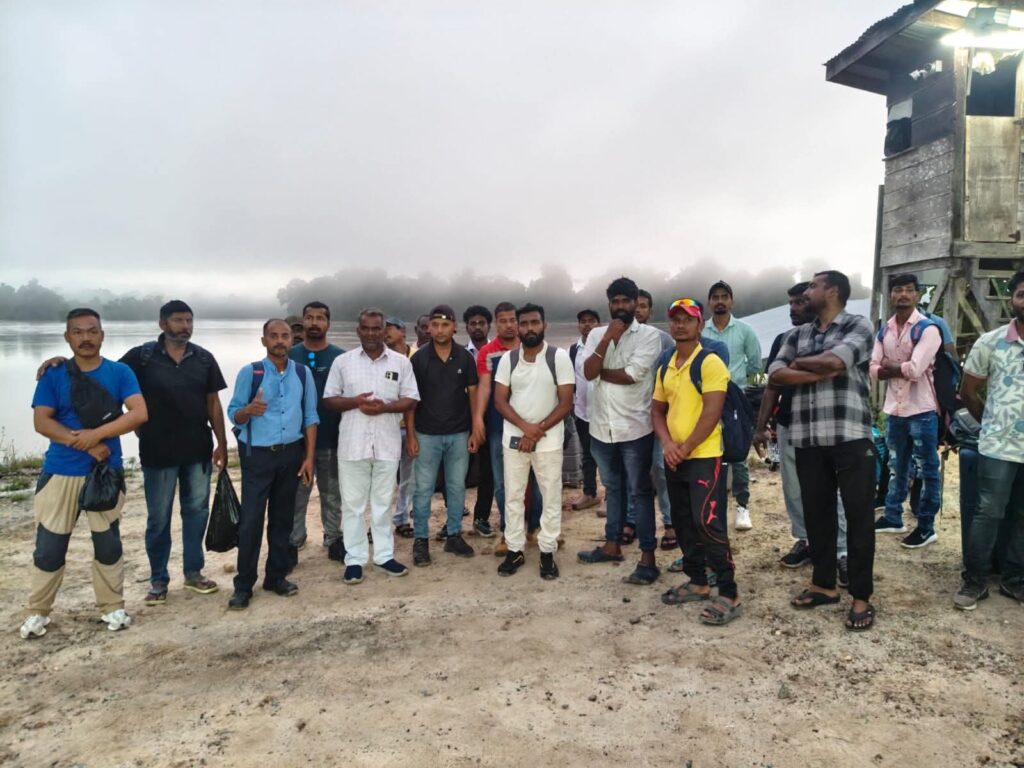
Into this contested space has stepped Transparency International’s Guyana Chapter, whose formal statement has added an institutional dimension to the growing chorus of concern. The Chapter is calling on the Government of Guyana — and the Ministry of Labour in particular — to investigate the matter thoroughly and comprehensively, stating plainly that “this matter suggests that proper regulatory and labour systems were not followed and may have been corrupted.”
Beyond the immediate case, TI Guyana has implored the Ministry to improve and expand its inspectorate division to ensure that all workers on Guyanese soil — citizens and migrants alike — are properly protected.
It is a demand that strikes at a structural weakness long identified by labour advocates: Guyana’s inspectorate capacity has not kept pace with the rapid expansion of its extractive industries, creating enforcement gaps that unscrupulous employers have been able to exploit.
“This matter suggests that proper regulatory and labour systems were not followed and may have been corrupted.” — Transparency International Guyana Chapter
The six demands formally submitted by the opposition delegation encapsulate what justice would require: the immediate return of all passports, full payment of outstanding wages, compensation for inhumane treatment and contract breaches, compensation for the family of deceased worker Sekhar Chhetri, redress for the worker who lost four fingers, and EKAA HRIM bearing all costs of repatriation — including the return of Chhetri’s remains to India.
The Government’s Balancing Act
To its credit, the Ali administration did mobilise a multi-agency response once the crisis became impossible to ignore. A joint task force comprising officers from the Ministry of Labour and Manpower Planning, the Guyana Police Force, and the Trafficking in Persons Unit under the Ministry of Home Affairs was dispatched to conduct inquiries and assess the situation on the ground.
On the diplomatic front, Minister Griffith met directly with the Acting Indian High Commissioner, and the Indian Union Labour Minister, Mansukh Mandaviya, confirmed his ministry was also looking into the matter.
Yet the pace and framing of the government’s response has drawn sustained criticism. The decision to give EKAA HRIM 24 hours to respond — rather than suspending operations pending investigation — struck many as protecting an investor at the expense of the workers.
Kaieteur News and the ALP have both called for a suspension of quarry operations until the probe is complete. The government has not yet indicated whether it will comply with that demand.
A Caribbean Cautionary Tale
The EKAA HRIM scandal carries implications that extend well beyond the borders of Region Seven. As Caribbean nations — led by Guyana — aggressively court foreign direct investment to capitalise on extractive booms, the regulatory framework governing those investments has struggled to keep pace.
Guyana’s oil windfall has brought international capital and international scrutiny in equal measure, but the case of 38 Indian workers in Batavia reveals a more uncomfortable truth: that the regulatory infrastructure needed to govern that capital humanely is still dangerously underdeveloped.
The pattern is familiar across the region. From bauxite operations in Jamaica to agricultural estates in Trinidad, extractive and agro-industrial enterprises have routinely outpaced the capacity of labour inspectorates to enforce basic standards, particularly in geographically remote locations.
The Caribbean Community’s aspirations toward regional labour standards remain aspirational rather than operational. What happened in Batavia did not require sophisticated criminality — it required only that no one with enforcement authority ever show up.
For the men themselves — the 38 who made it to Georgetown, the one who returned to India without four fingers, and the one whose remains have yet to go home — the geopolitics and policy debates are secondary.
They came to Guyana seeking opportunity. What they found was exploitation, isolation, and fear. Whether the Guyanese state can deliver justice commensurate with what they endured will say much about the kind of society oil-rich Guyana is choosing to become. WiredJA