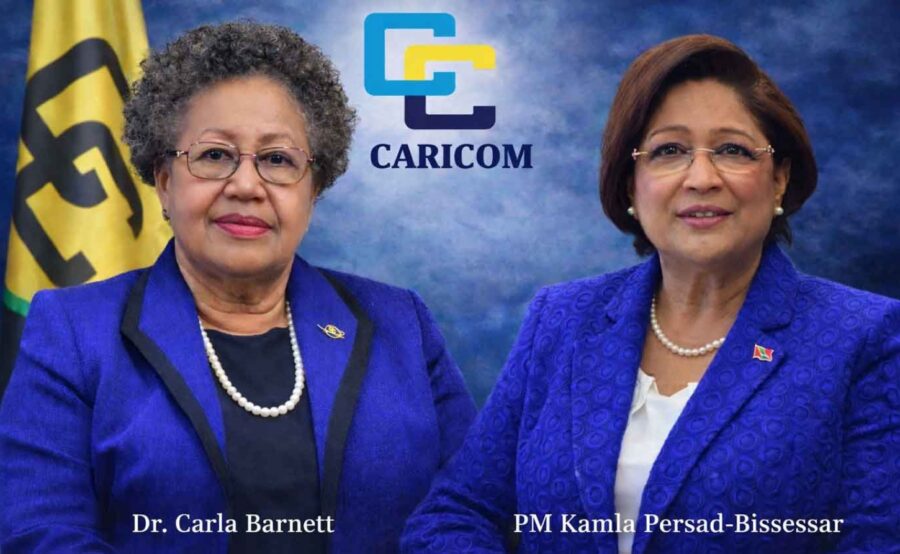
Trinidad and Tobago (T&T) has openly challenged the authority of the Caribbean Community (CARICOM), with Prime Minister Kamla Persad-Bissessar declaring that her government will not recognise CARICOM Secretary-General Dr Carla Barnett beyond the expiration of her current term in August 2026.
Persad-Bissessar delivered the position in uncompromising terms this week, stating: “That’s not going to change. We do not recognise her after August 2026. This is our final position.”
The dispute has escalated into one of the most serious internal confrontations in CARICOM in recent years, raising questions about governance, transparency, procedural fairness, and the future cohesion of the 15-member regional bloc.
CARICOM was founded on July 4, 1973, with the signing of the Treaty of Chaguaramas by Barbados, Guyana, Jamaica, and Trinidad and Tobago. The founding leaders — Prime Minister Forbes Burnham of Guyana, Prime Minister Errol Barrow of Barbados, Prime Minister Michael Manley of Jamaica, and Prime Minister Dr. Eric Williams of Trinidad and Tobago — envisioned a regional body aimed at advancing economic integration, coordinating foreign policy, strengthening functional cooperation, and improving the social and economic well-being of Caribbean peoples.
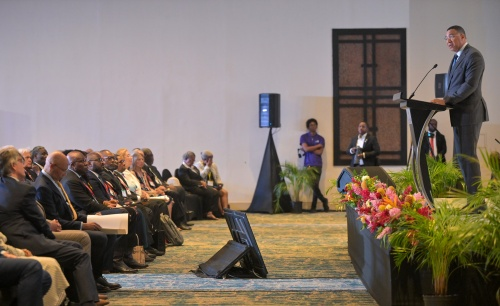
The current impasse stems from the 50th Regular Meeting of the Conference of Heads of Government held in St Kitts and Nevis in February, where Barnett’s reappointment was reportedly advanced while Trinidad and Tobago was absent from the discussions.
Port of Spain contends that the matter was never formally placed on the plenary agenda and that the process violated provisions of the Revised Treaty of Chaguaramas.
Foreign Affairs Minister Sean Sobers said he received a WhatsApp message on the morning of the Nevis retreat informing him that he had been disinvited from the meeting.
Persad-Bissessar subsequently accused Barnett of drafting a CARICOM press statement issued under the name of CARICOM Chairman Dr. Terrance Drew defending the reappointment process while omitting any reference to the disinvitation message.
According to the Prime Minister, the WhatsApp communication remains visible within the Council for Foreign and Community Relations (COFCOR) group chat.
“No, they are still hiding from providing responses,” Persad-Bissessar said when questioned about requests for clarification. “It’s really shameful that the entire group knows that Barnett did disinvite Minister Sobers via WhatsApp, but they still persist in continuing with dishonesty.”
The Prime Minister also criticised CARICOM foreign ministers for what she described as a “deliberate and disgraceful silence,” arguing that officials who were aware of the evidence failed to publicly address the controversy.
Sobers has reportedly written to Chairman Drew requesting the official retreat notes and formally referencing the WhatsApp exchange, but Trinidad and Tobago says no response has yet been received.
The issue resurfaced during a virtual CARICOM meeting convened last Friday at the request of Montserrat. Representatives from ten of the fifteen member states participated.
Trinidad and Tobago objected to the proceedings, noting that both Persad-Bissessar and Sobers were unavailable because of an official visit by India’s External Affairs Minister Subrahmanyam Jaishankar and parliamentary responsibilities at home. Despite the objections, the majority of participating states agreed that Barnett’s reappointment should stand.
Persad-Bissessar also rejected proposals to refer the matter to the Caribbean Court of Justice, reiterating that her government has no intention of making the CCJ Trinidad and Tobago’s final appellate court.
The Prime Minister signalled that her administration is prepared to strengthen trade and diplomatic ties beyond the Caribbean region.
“We are actively working to expand our trade network with the Middle East, South America, India, and Africa,” she said, adding that Trinidad and Tobago would continue seeking new markets independently of CARICOM.
Responding to reports that Jamaican Prime Minister Andrew Holness has been attempting to mediate the dispute, Persad-Bissessar acknowledged their friendship but declined to disclose details of their discussions.
She maintained, however, that Trinidad and Tobago would continue to attend CARICOM meetings except in circumstances where representatives are “disinvited.”
On speculation that Trinidad and Tobago could face expulsion from the regional body, Persad-Bissessar remained defiant.
“They are free to expel us from Caricom if they wish to do so,” she said. “Life goes on in Trinidad and Tobago, with or without Caricom. The world stops for no one.”
The Prime Minister further characterised CARICOM as “dysfunctional” and “chaotic,” claiming the organisation failed to provide requested meeting minutes, performance evaluations, and other records linked to the dispute.
She also stressed that CARICOM remains fundamentally a common market arrangement rather than a political union, arguing that member states ultimately retain sovereign authority over the extent of their participation in the regional integration movement.
The controversy was first reported by the Trinidad Express.