In the heart of Georgetown lies the Parade Ground, a space too often treated as ordinary. It is not. Beneath its grass and goalposts rests a history marked by terror, resistance, and colonial violence. Any contemporary discussion about its use must begin with an honest acknowledgment of what transpired there during and after the 1823 Demerara Slave Rebellion.
The 1823 uprising was one of the most significant acts of resistance by enslaved Africans in the British Caribbean. It was not a chaotic revolt, but a deliberate and disciplined response to bondage, brutality, and broken promises of reform. Enslaved men and women rose with courage and clarity of purpose, asserting a simple and enduring truth: freedom is not a privilege to be granted; it is a right to be claimed.
The colonial response was swift and merciless. After the rebellion was suppressed, the Parade Ground became a theatre of repression. Enslaved Africans were court-martialed, sentenced, and executed there. Bodies were publicly displayed. Heads were mounted on stakes. These acts were not about justice or order; they were instruments of terror. The message was unmistakable: resistance would be met with annihilation.
This history matters profoundly today. Land remembers. The Parade Ground is not merely a location where executions occurred; it is a site where colonial authority sought to extinguish Black dignity, resistance, and self-determination. To occupy or alter that space without acknowledgment is to participate in historical erasure. It is to silence the suffering and courage of those who dared to challenge an inhuman system.
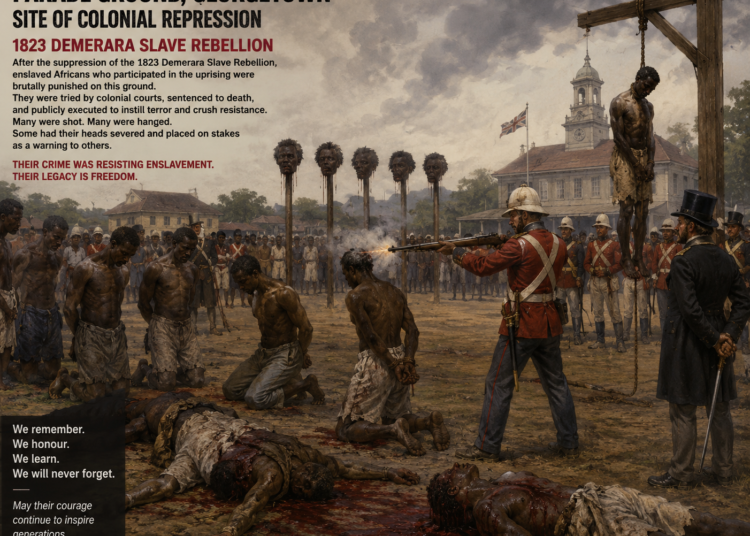
In this context, the PPP Government must seriously reconsider the historical weight of the Parade Ground, particularly as it relates to our African brothers and sisters whose blood was spilled there. In my humble view, no infrastructure—no buildings, monuments of convenience, or commercial development—should be erected on that sacred ground. To do so would be to build progress on the unmarked graves of resistance, without consent from history or conscience.
Modern Guyana rightly celebrates independence, resilience, and multicultural nationhood. Yet independence without memory is incomplete. When a site of execution and terror is treated as just another recreational or development space, the nation risks normalising colonial violence through omission. Silence becomes complicity. Forgetting becomes a second injustice.
This is not an argument against public access, nor a call to imprison the site in perpetual mourning. Rather, it is a demand for respect, context, and genuine consultation. Any decision affecting the Parade Ground must be guided by historical truth and moral responsibility. Memorialization, education, and visible interpretation are not optional gestures; they are obligations owed to those who suffered and resisted there.
The enslaved Africans executed at the Parade Ground did not die as criminals. They died as resisters to oppression. Their defiance helped expose the moral bankruptcy of slavery and hastened its eventual demise across the British Empire. To deny the gravity of their sacrifice is to misunderstand the very foundations of freedom in Guyana.
The Parade Ground should stand as a national conscience—a space that compels reflection and honesty. Development that ignores its history is not progress. It is erasure. And erasure remains one of the final weapons of colonialism.
A just society does not build over its graves without remembrance. It pauses. It listens. And it tells the truth.